Facebook video ads: 15 examples that actually work
Your next Facebook ad doesn’t need a blank-page brainstorm. Steal the structure behind 15 scroll-stopping video ads, then turn each hook, script starter, placement, and test idea into creative your team can ship today.
The best video ads examples are useful because they show the creative decision. This swipe file breaks down examples of Facebook video ads by hook, proof, placement, funnel stage, and next test. Use it to turn strong Facebook ads video examples into mobile-first creatives for Feed, Reels, and Stories.
You open a new ad project, add the product shot, write three hooks, then still don’t know which version deserves spend.
That’s where real Facebook video examples help. I’ll show you what each ad does in the first seconds, why the structure works, and how to turn the pattern into a Facebook ad video your team can ship without overthinking the edit.
15 best Facebook video ad examples
Each example below follows the same recipe: what it is, why it works, how to build it, and which metrics to watch. Scan for the pattern that fits your offer, then ship a clean first version: one hook, one payoff, one clear CTA. Keep the tips in mind — short, sound-off, mobile-first, and track the ladder: 3-second view → 10-second hold → CTR → conversion. Pick one, publish today.
1. AppSumo: Bold-number kinetic text + question hook
A short, text-led video where a big result number owns the first frame, followed by one sharp question and a single benefit line. Simple motion keeps the message readable.
Result:
Number-first framing plus a curiosity question lifts thumb-stop rate and outbound CTR by aligning value with intent. Key KPIs: 3-second view rate, 10-second hold, link CTR, lead starts/CPA.
How to use it:
- Open on the largest credible number
- Follow with a 5–7-word audience question
- Add one proof line and a plain CTA
- Use high-contrast kinetic text; no busy backgrounds
- Export 9:16, 4:5, and 1:1; burn in captions
Metrics to watch: Thumb-stop 3s → Message hold 10s → Link CTR → Lead starts → CPA.
2. Asana Rebel: In-app micro-demo + free mini-workout
A straight-to-the-point screen demo that shows the app flow while a 6–8s workout snippet plays. A native headline bar frames the promise so viewers grasp the value at a glance.
Result:
Real usage plus immediate value lifts 3-second stops, mid-view completion, saves, and click-outs to install or trial. Strong fit filtering reduces low-intent clicks.
How to use it:
- Capture a clean screen recording: browse workouts → start a routine → see progress
- Intercut phone-in-hand shots for realism; keep captions burned in
- Use a short headline bar
- Give one mini-class moment, then end-card CTA
- Export 9:16 and 4:5; keep text inside safe zones
Metrics to watch: 3s view rate → VTR50 → Saves/Shares → Outbound CTR → Install/Signup rate.
3. Blinkist: Stat-led explainer + on-brand design
A clean, design-consistent video that opens with one credible stat, then a simple problem→solution line and quick UI beats.
Result:
A big number plus clear visuals boosts thumb-stop and comprehension, improving CTR and trial starts without confusion.
How to use it:
- Lead with one verified stat in large type; add a tiny “Source” footnote
- Follow with two lines: the problem, then the solution in plain words
- Show 2–3 UI moments only
- Lock colors, type, and iconography to brand; keep motion calm
- End with a specific CTA and a benefit tag
Metrics to watch: 3s view rate → VTR50/75 → Link CTR → Trial starts → CAC/Payback.
4. Ultimate Ears: Rapid-cut colorways + personalization proof
A 15s square video that cycles through multiple Boom3 skins and color combos in quick, beat-matched cuts. On-screen copy points to customization without slowing the sequence.
Result:
Fast variety helps viewers “see their version,” lifting 3s stops, mid-view completion, and clicks to the configurator.
How to use it:
- Front-load 8–12 color/material swaps in the first 6–8 seconds
- Keep backgrounds plain; use one clear line: “Customize yours”
- End-card: “Build yours” with a clean deep link to the configurator
- Export 1:1, plus 9:16 and 4:5; keep text inside safe zones
Metrics to watch: 3s view rate → VTR50/95 → Configurator clicks → Add-to-cart → CPA.
5. Oreo Thins: Dark-mode mood + late-night micro-spot
A short, stylized spot in dark mode. Clean object motion and minimal type cue a “night treat” vibe; a quick white→black shift hooks attention, then settles into sleek product shots.
Result:
Mood-first framing boosts thumb-stop and mid-view completion, while a simple flavor CTA lifts product page clicks in evening hours.
How to use it:
- Open with a fast light→dark transition; keep backgrounds simple
- Use 1–2 lines of large type
- Feature slow, satisfying product motion
- Time delivery to evening; test “Add to cart” vs. “Shop flavors”
- Export 9:16 and 4:5; maintain strong contrast and readable captions
Metrics to watch: 3s view rate → VTR50 → Evening CTR → PDP views → ATC/CPA.
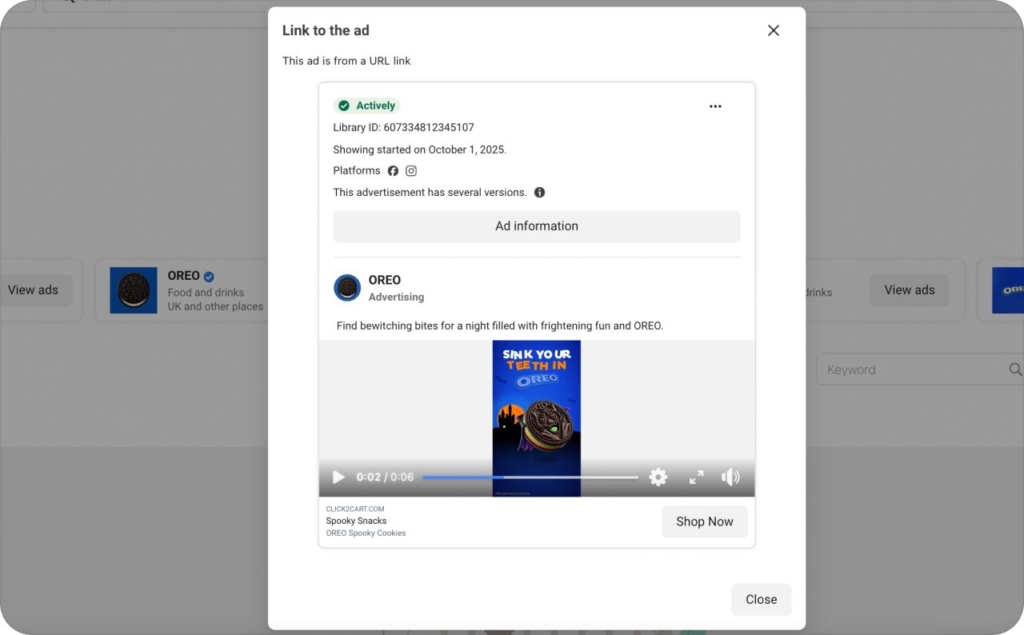
Photo source: Oreo Ad in Meta Library
6. VSCO: Bright kinetic text + TikTok/Reels pacing
A sub-15s spot with a bright backdrop, bold animated type, and quick UI beats. Color pops and large on-screen phrases and the promise in the first two seconds.
Result:
Bold motion + readable copy lift thumb-stop and VTR50 while keeping comprehension high. Clear value lines improve click-outs to install or trial.
How to use it:
- Open with a 2-second headline in large type; keep it on-brand
- Alternate UI moments with color pops
- Layer short overlays that match the action on screen
- Keep a steady beat; avoid overstuffed transitions
- Export 9:16 and 4:5; burn in captions for mute viewing
Metrics to watch: 3s view rate → VTR50/75 → Outbound CTR → Install/Signup rate.
7. Comrade Berlin: Gamified loop — “Pause to pick yours”
A fast-cut looping GIF/video that swaps ball designs and backgrounds every few frames. One fixed CTA — “Pause to pick yours”, turns the scroll into a quick game.
Result:
Interactive intent increases dwell time, replays, saves, and click-through to product pages — strong signals that lift remarketing performance.
How to use it:
- Build 40–60 frames: center the ball, swap patterns/environments rapidly
- Keep one stable overlay: “Pause to pick yours.” High contrast, large type
- Tune speed: GIF 8–12 fps, video 24–30 fps; make it seamless
- Add a clean end-card: “Shop your match” → deep link to variants
- Export 9:16 and 4:5; keep copy in safe zones
Metrics to watch: 3s view rate → Average watch time/replays → Saves/Comments → CTR to PDP → Variant views → Add-to-cart.
8. NerdWallet: Pattern-break mascot + one-line money tip
A quirky, unexpected character delivers a single, plain-language finance tip in large on-screen text. Short, lo-fi, and unmistakably different from the feed.
Result:
The visual oddity stops the scroll; the simple tip keeps viewers. Expect higher 3-second stops, mid-view completion, and clicks to a calculator or explainer.
How to use it:
- Open on the unexpected character in frame 1
- Show one tip in 6–10 words; keep it on screen long enough to read
- Add a quick proof beat
- End with a clean CTA
- If budget is tight, use an AI avatar or simple lipsync — focus on clarity
Metrics to watch: 3s view rate → VTR50 → Outbound CTR → Tool/article engagement → Lead starts/CPA.
9. Tropicfeel: Seamless transitions + versatility-in-motion
A Reels-style edit that jumps between locations, outfits, and weather with seamless transitions. No VO. Minimal text. The visuals prove “one jacket, many scenarios.”
Result:
Fast, silent-first storytelling lifts 3s stops, VTR50/75, saves, and click-outs, while clearly signaling versatility to the right buyers.
How to use it:
- Outline 4–6 environments
- Keep one anchor item in every scene for continuity
- Use action-based cuts to hide transitions; match horizon lines
- Add 2–3 short overlays tied to scenes
- Export 9:16 first; color-correct for consistency; burn in captions only where needed
Metrics to watch: 3s view rate → VTR50/75 → Saves/Replays → CTR → PDP views → Add-to-cart.
10. Meta AI: Everyday micro-scenario + AI assist nudge
A simple, real-life moment where an on-screen AI suggestion solves the issue in seconds. Minimal text, clean visuals, no fluff.
Result:
Relatable utility lifts 3s stops, VTR50, positive sentiment, and click-through to “Learn more” or demo, positioning AI as a calm, helpful co-pilot.
How to use it:
- Pick one believable moment with a clear friction point
- Show the problem in 2–3 seconds
- Insert an AI/app nudge
- Show the quick resolution; close with a plain CTA
- Keep captions concise; export 9:16 and 4:5
Metrics to watch: 3s view rate → VTR50 → Brand lift or CTR → Tool engagement → Signup/Lead rate.
11. Calm: In-app micro-session + social-proof badge
A quiet, in-app demo that starts a 30–60s breathing or sleep session on screen. Minimal text. A small “App of the Year” badge builds trust without breaking the mood.
Result:
Real experience + proof lifts 3s stops, VTR50/100, saves, and install CTR — great for retargeting warm audiences who’ve visited but didn’t download.
How to use it:
- Screen record a single flow: open app → select “1-minute breathing” → session begins
- Keep captions sparse. Low-volume ambient audio only
- Add one subtle trust element in a corner
- End-card: “Start free trial” or “Try a 1-minute reset.”
- Export 9:16 and 4:5; keep text inside ~10% safe zones
Metrics to watch: 3s view rate → VTR50/100 → Saves → Install CTR → Trial starts/CPI.
12. Canva: Simple feature micro-demo + action line
A clean, step-by-step demo that shows one popular feature in use. Short on words, heavy on visible action.
Result:
Immediate understanding lifts 3s stops, VTR50, and click-outs to “Try template,” while filtering for users who want quick creation.
How to use it:
- Pick one high-usage feature and demo it in 8–12 seconds
- Use plain, action-led overlays: “Crop • Auto-layout • Export.”
- Keep backgrounds uncluttered; cursor and hand motions clear
- End with a direct CTA that deep-links to a template
- Export 9:16 and 4:5; burn captions for mute viewing
Metrics to watch: 3s view rate → VTR50 → Template CTR → Project starts → Signup/Activation rate.
13. Design Pickle: Outcome-first testimonial carousel
A video-carousel of short customer clips. Each card opens with the result, then a 4–6s quote over the speaker’s face with clear captions.
Result:
Social proof plus outcomes increases swipes, dwell per card, and click-through to demo/plan pages — great for B2B lead gen.
How to use it:
- Collect 3–5 clips; lead each with the outcome in big type
- Show the person talking
- Burn in captions; keep clips under 6 seconds each
- Final card: “See plans” or “Book a 10-min demo.”
- Test card order by strongest outcome; refresh monthly
Metrics to watch: 3s view rate → Swipes per user → Card dwell → Link CTR → Demo requests/Leads → CPL.
14. DoorDash: Native “how to start earning” montage
A fast, social-native video that shows the sign-up flow, first delivery, and payout screen in quick cuts. Light captions answer the big questions upfront.
Result:
Clear steps + relatable tone reduce objections and lift 3s stops, VTR50, application starts, and completion rate — ideal for side-hustle seekers.
How to use it:
- Map three beats: Apply → First delivery → Get paid
- Overlay concise answers: “18+ • Background check • Choose your hours.”
- Add a realistic earnings glimpse
- Keep the edit native: handheld shots, quick scene changes, casual VO or captions
- End-card: “Start dashing” → deep link to sign-up; prefill city if possible
Metrics to watch: 3s view rate → VTR50 → CTA CTR → App starts → App completions → Cost per approved Dasher.
15. Oakley Meta: Athlete POV + AI glasses in action
A 2026 Super Bowl video ad where athletes and creators use Oakley Meta smart glasses during fast, high-pressure moments. The spot shows Marshawn Lynch, IShowSpeed, Sky Brown, Spike Lee, Kate Courtney, and others capturing action hands-free instead of explaining the product in a traditional tech demo.
Result:
POV action makes the product benefit visible in seconds. The viewer sees what the glasses do while people move, film, listen, and react in real scenarios. This works well for AI products because it turns a feature list into a use case, which makes the ad easier to understand and easier to remember.
How to use it:
- Open with movement in the first second: running, biking, cooking, packing, filming, or fixing something
- Show the product being used inside the moment, not after the setup
- Add one short on-screen AI cue, like “Record this” or “What’s the next step?”
- Cut to the result fast, so the viewer sees the payoff
- Keep captions short and readable for sound-off viewing
- Build 9:16 first, then adapt to 4:5 for Feed
Metrics to watch: 3s view rate → 6s hold → Reels completion rate → Link CTR → PDP views → Add-to-cart.
FAQ
You can automate ad creation for static and video ads, and then pushes them into tidy campaign automation so you can learn faster and scale what works.
Benefits
- Save time: Go from script to export in minutes, not hours. Zeely drafts hooks, captions, and layouts so you can publish same-day
High-converting ads, on repeat: Start with proven short-form patterns and let Zeely auto-version them to find winners - Boost ROI: Ship more tests, cut losers quickly, and concentrate spend behind the ads that move the KPI ladder
- Quick ad creatives: Auto-resize for 9:16, 4:5, 1:1; safe-zones, captions, and thumbnails handled. No design skills required
- Tight integrations: Plug into Meta for quick publishing and learning, and sync product data with Shopify for fast PDP deep links and dynamic catalogs
- Built-in guardrails: Rights-clean audio, readable captions, and policy-friendly claims out of the box
If you want more great Facebook video ads without more busywork, you need automation that respects creative quality. Zeely gives you the speed to test and the control to stay on brand, so you scale results, not effort. Start with one concept, generate the set, and back the winners.
The best Facebook video ads examples are worth saving when they show a clear creative pattern. I look for five things: a fast hook, visible proof, simple captions, a strong mobile layout, and one clear next step.
Don’t copy the exact visuals. Copy the structure. If an ad opens with a product demo, try your own product demo. If it leads with a customer result, build a testimonial cut with your own proof.
Use examples of Facebook video ads as a swipe file, not a script to steal.
Break each ad into small parts:
- What happens in the first three seconds
- What proof shows the product works
- What the viewer sees before the CTA
- Which placement the format fits best
- What one variable you can test next
Then rebuild the idea with your own offer, product shots, customer words, and brand style.
A strong Facebook ad video needs one clear message, not five competing ideas. Start with the buyer’s problem or desired result. Then show the product, proof, or transformation fast.
Use this simple frame:
- Hook: Give people a reason to stop
- Proof: Show the product, result, or customer quote
- CTA: Tell them what to do next
Keep captions readable, design for sound-off viewing, and make the first version mobile-first.
For ecommerce, the strongest Facebook ads video examples usually show the product in motion. A simple demo often beats a polished brand story because people can see what they’re buying.
Good ecommerce formats include:
- Before and after product demo
- Creator-style unboxing
- Fast color or variant showcase
- Problem and solution clip
- UGC testimonial with a visible result
For cold audiences, lead with the product benefit. For retargeting, lead with proof, offer, or urgency.
For apps, SaaS, and AI tools, the best Facebook video examples usually use screen recordings, micro-demos, or quick workflow clips. Viewers need to understand what the product does before they care about the CTA.
Show one task from start to finish. Don’t tour the whole platform.
For example:
- Open the app
- Complete one useful action
- Show the result
- Add a short CTA
This works well for Reels, Stories, and Feed because the viewer can understand the value without sound.
proof, and CTA without losing the viewer.
Longer videos can work for warm audiences, testimonials, and higher-ticket products. Still, the first three seconds matter most. If the opening is weak, the length won’t save the ad.
Build for Reels and Stories first if your creative is vertical, fast, and mobile-native. Use 9:16, large captions, and a clear visual hook.
Build for Feed if your ad needs more context, product detail, or a cleaner 4:5 layout. Many strong examples of Facebook video ads can work across placements, but only if you keep text inside safe zones and avoid tiny UI details.
Test one thing at a time. That’s how you learn what actually changed the result.
Start here:
- Hook: question vs. result vs. problem
- Opening visual: product shot vs. person vs. screen recording
- Proof: testimonial vs. demo vs. stat
- CTA: “Shop now” vs. “Learn more” vs. “Try it”
- Length: 6 seconds vs. 15 seconds vs. 30 seconds
Track 3-second view rate, hold rate, CTR, CPA, and ROAS. A good ad should stop the scroll and move the buyer closer to purchase.
Yes, but use AI to build versions, not to replace your creative judgment.
Start with one of the best Facebook video ads examples from this swipe file. Then ask AI to create new hooks, script starters, captions, and cutdowns around your product. Keep the core structure, but make the proof, offer, and CTA specific to your brand.
Zeely can help you turn one idea into multiple Facebook ad video versions with captions, layouts, avatars, and mobile-first formats, so you can test faster without rebuilding every creative from scratch.
Pick one pattern, build one clean version, and test it before making more.
Do this now:
- Choose one example that matches your offer
- Write a 6 to 15-second script
- Show the product or result in the first three seconds
- Add readable captions
- Export for Reels, Stories, and Feed
- Test one hook against one alternate hook
That’s how you turn swipe-file ideas into ads you can actually ship.
Emma blends product marketing and content to turn complex tools into simple, sales-driven playbooks for AI ad creatives and Facebook/Instagram campaigns. You’ll get checklists, bite-size guides, and real results, pulled from thousands of Zeely entrepreneurs, so you can run AI-powered ads confidently, even as a beginner.
Written by: Emma, AI Growth Adviser, Zeely
Reviewed on: May 26, 2026