How to get 1K followers on Instagram: what really works in 2026
Wish you could hit 1,000 followers in one week without ruining your reach? I gathered an evidence based 2026 playbook, built on fresh platform data, real KPIs, and automation you can actually use.
Key Takeaways
- Views without follows is a profile or topic problem, not a hook problem. Track follows per post and check in at four weeks.
- Instagram ranks each post separately, so you get 1,000 followers on Instagram post by post. A 40-follower account can out-reach a 40,000-follower one.
- Three things decide whether strangers see you: a public account, a professional account, and footage you filmed yourself.
- Pick one audience and one promise, then repeat it. Scattered topics stop Instagram learning who to show you to.
- Three posts a week is the working minimum. One a week tells you almost nothing.
- Hashtags now cap at five. Caption keywords and alt text matter more, and your posts can now reach Google.

How long does it take to get 1,000 followers on Instagram?
I have seen business accounts pass 1,000 in under two months. I have seen equally good accounts take most of a year. The gap usually comes down to four things: how narrow your topic is, how often you post, whether anyone else in your niche shares your work, and whether you already have customers you can send to your profile.
A bakery with a mailing list and one clear specialty gets there faster than a general lifestyle account posting three different things a week. Same effort, different starting line.
Here is what I can tell you with confidence. It does not happen in five minutes, and it does not happen in a week from a cold start. Anyone selling you 1,000 followers overnight is selling bot accounts. Those accounts never watch your videos, never save a post, and never buy anything. They also weaken the engagement signals Instagram reads before showing your next post to new people, so you pay for them twice.
So drop the deadline and use a checkpoint instead. Give yourself four weeks of real posting, then check three things:
- Did any single post bring in more than a handful of follows? That tells you the topic works.
- Are profile visits turning into follows at a steady rate? That tells you the profile works.
- Did the new followers stay past the first week? That tells you your content matches what you promised.
If all three are moving, the number handles itself. If none of them are, posting more will not fix it. The sections below cover what to change first.
Why 0 to 1,000 is the hardest stretch
Instagram does not decide what to show people based on how big your account is. It decides post by post.
When you publish a Reel, the system shows it to a small group, watches what they do with it, then decides whether to show it to more people. Instagram’s own explanation of how recommendations work describes this as ranking content rather than accounts. Your follower count barely enters that decision. This is why an account with 40 followers can out-reach an account with 40,000 on a single Reel, and why you have probably seen exactly that happen.
That is good news for you. You do not have to earn the right to be seen. Every post gets its own chance.
The hard part is different. With 40 followers, that first test group is tiny, and it is mostly people who already know you. Your mom, two friends, one former coworker. They are not a fair sample of strangers. So your early posts get judged by an audience that cannot tell the system much about who else would like them. You are not fighting a penalty. You are fighting a lack of information.
Three things follow from that, and they shape the rest of the plan.
Volume matters more early than late. Each post is a separate test. Three posts a week gives the system three chances to find your people. One post a week gives it one.
A consistent topic matters more than a consistent schedule. If every post is about something different, nothing accumulates. Instagram never learns who to show you to, and neither do the people who land on your profile.
Formats that get saved and sent travel further than formats that only get watched. A save or a share says this was worth keeping. A view says very little on its own.
Keep that frame for the rest of this guide. You are not building a follower count. You are giving Instagram enough consistent signal to work out who your content is for.

Check your account before you try to grow
Two settings and one rule decide whether strangers can see you at all. Check them before you change anything about your content.
Public and professional. Private accounts are not shown to people who do not already follow you. A business or creator account is what turns on Instagram Insights, which every measurement below depends on. Both switches take a minute, and they live in the same settings menu.
Original content. Instagram’s original content guidelines say plainly that reposted and lightly edited content does not travel the way your own footage does. The threshold is specific. Accounts that post 10 or more copies of other people’s content in a rolling 30 days are pulled out of recommendations entirely, and stay out until they drop back below that number.
For a small business this is rarely deliberate. It usually looks like supplier product photos, screenshotted quotes, or clips saved from somewhere else with a caption on top. If you sell products you did not photograph yourself, film them. A phone on a windowsill beats a catalog image here, because the catalog image works against you twice: it does not count as original, and every competitor selling the same item is posting it too.
If your posts are barely reaching anyone at all, that is a distribution problem rather than a follower problem, and it has its own checklist. Start with how to increase your reach and views on Instagram, then come back here.
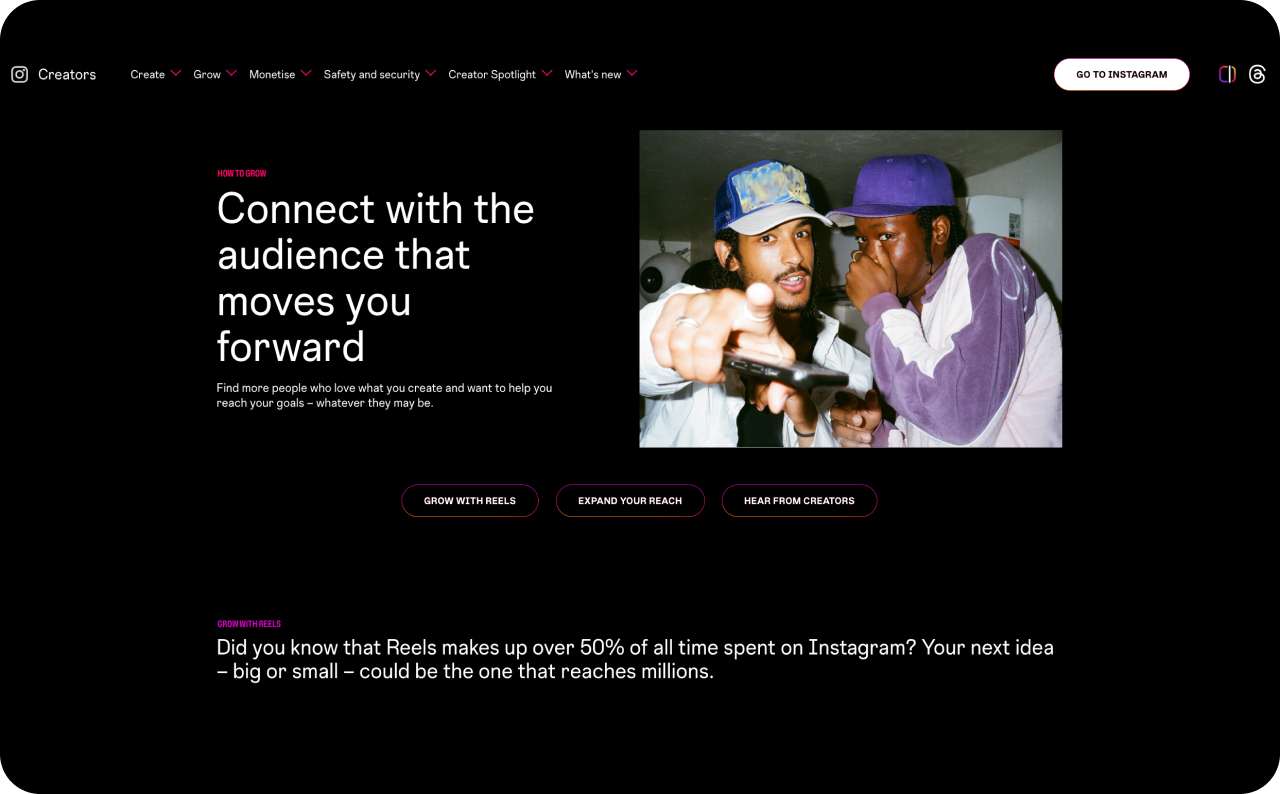
Photo source: Creators
Give people one clear reason to follow
Reach brings people to your profile. Your profile decides whether they stay. Most accounts under 1,000 followers lose people here and never notice, because Instagram does not show you the visitors who left.
Someone lands on your profile with one question: what do I get if I tap Follow? You have about five seconds to answer it.
Write the promise before you touch the bio. Finish this sentence: I help [who] with [what], so they [result]. For a cake business, that might be: I help people ordering a cake for a party choose the right size and flavor without guessing. The sentence itself does not go in your bio. It is the filter you run everything else through.
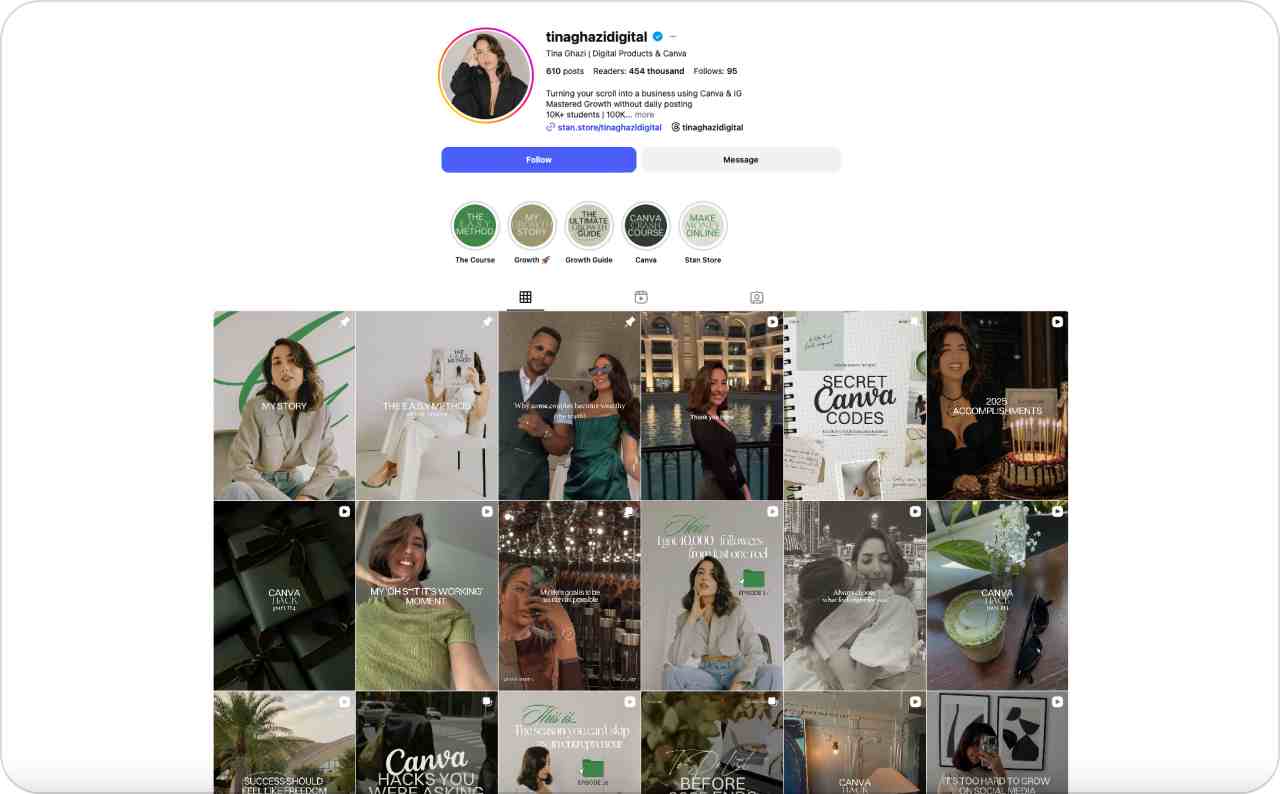
Photo source: @tinaghazidigital on Instagram
Use the name field, not just your handle. The name field is searchable, and most small accounts waste it. Olena tells a stranger nothing. Olena, custom cakes, Kyiv tells them what you do and where you are, and gives Instagram search something to match.
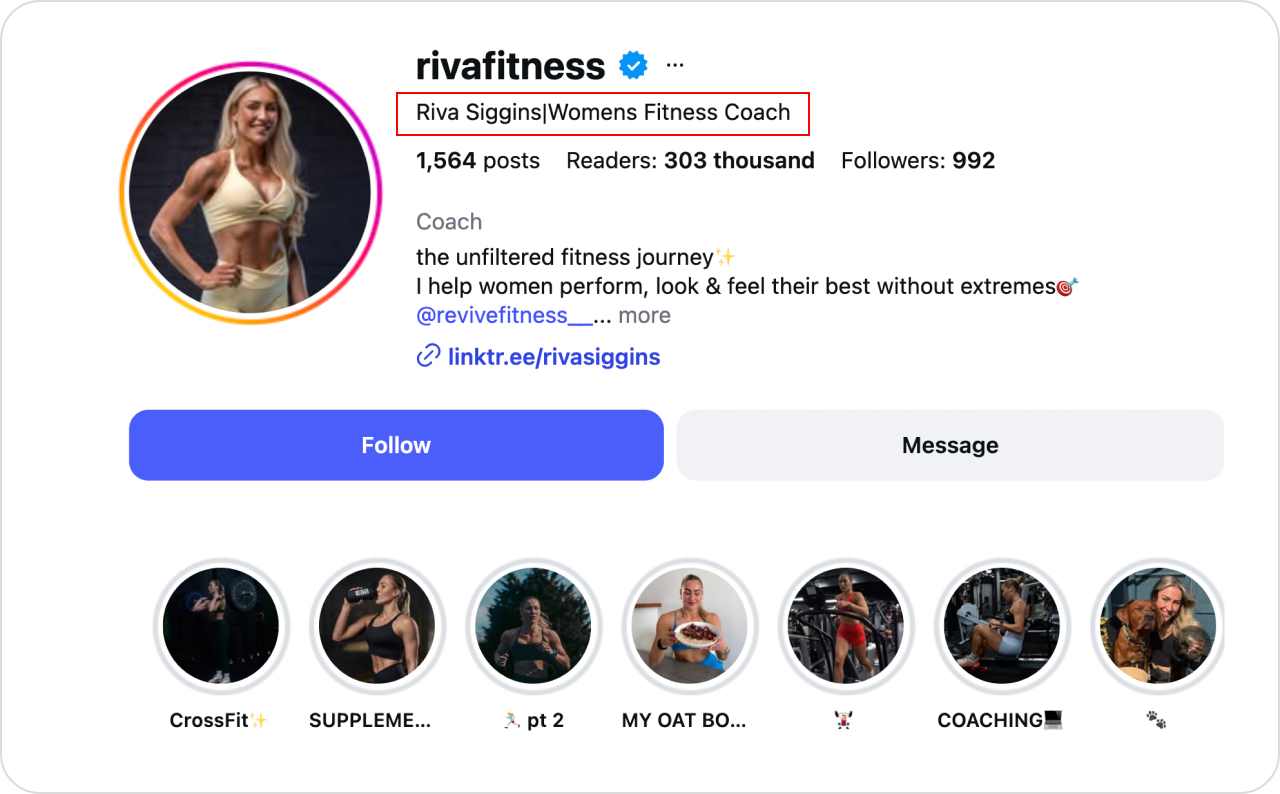
Photo source: @rivafitness on Instagram
Keep the bio to three short lines. Who you help, what they get, what to do next. No hashtag lists, no emoji chains, no quote about following your dreams. Someone deciding in five seconds does not reach line four.
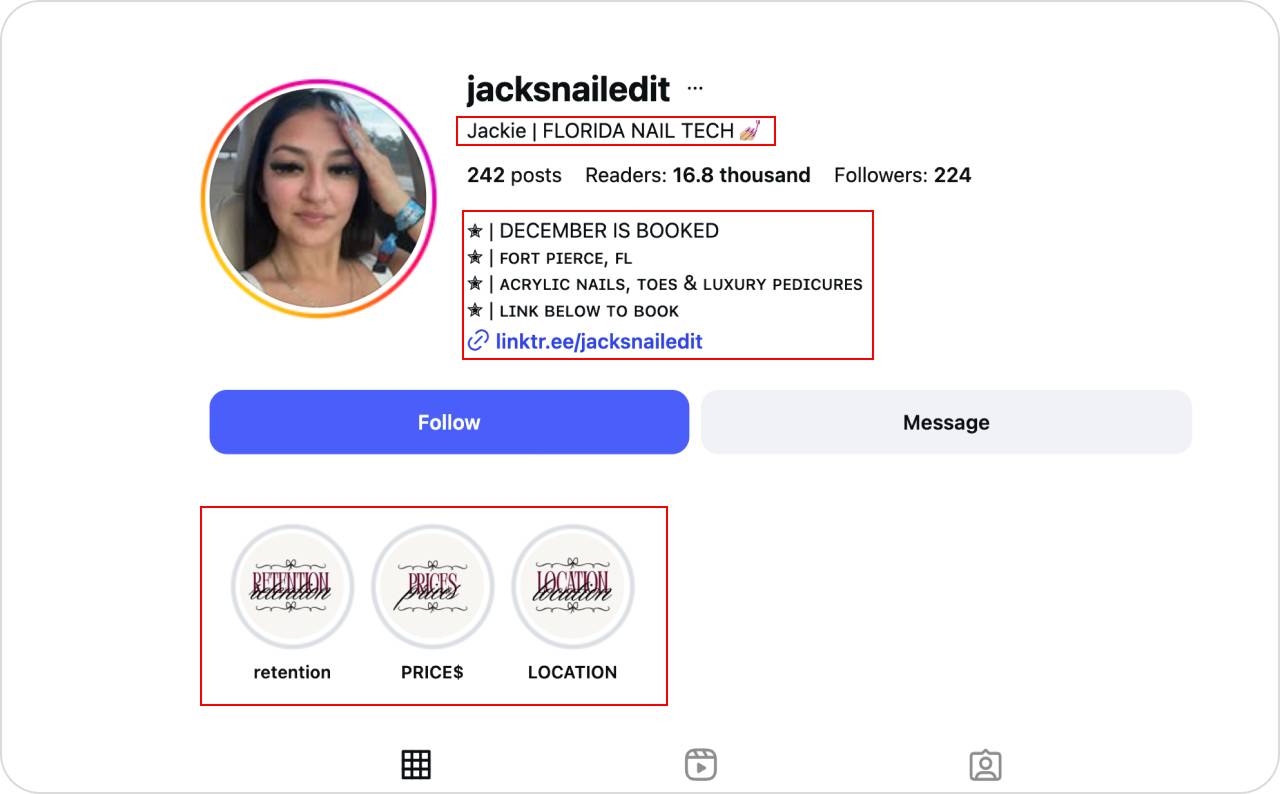
Photo source: @jacksnailedit on Instagram
Pin three posts that answer three questions. Who is this: one introduction. Can they actually do this: one piece of proof, a finished order or a customer photo. How do I get it: one post that names the offer and the next step.
Most profiles pin their three most-liked posts instead. Those likes came from people who already follow you. Pins are for the people who do not, and the two groups want different things.
About the number itself
A visitor who sees 47 followers hesitates, and no amount of bio work removes that. A low count reads as unproven, which is circular and unfair but real.
You cannot fix it with a number, so fix it with evidence. One pinned post showing finished work does more than a thousand followers you bought. A customer photo with their own words underneath does more than a follower count. Small and credible beats large and hollow, and it is the only version that survives someone actually checking.
If a stranger can see that other people have paid you and been happy, the follower count stops being the thing they are judging you on.
Publish content that gives strangers a reason to follow
A post that reaches thousands of people and gains you nobody is not a reach problem. It is a topic problem.
Pick three topics and stay in them
Most small accounts post whatever happened that week. The cake business posts a finished order on Monday, a photo of the dog on Wednesday, a repost about small business struggles on Friday. Each one is fine on its own. Together they promise nothing.
Choose three topics that all serve the same buyer, and let every post come from one of them. For the cake business:
- Choosing. What size for how many guests, which flavors hold up in summer heat, what a realistic budget looks like.
- Behind the order. How a custom design goes from a photo someone texted you to the finished cake.
- Proof. Finished orders, the party they went to, what the customer originally asked for.
A stranger who sees two of these understands what following you gets them. A stranger who sees your dog does not.
Answer the questions you already get asked
Your strongest topics are sitting in your DMs. Write down every question a customer asked you in the last month. Those are your posts, and they beat anything a trending list will give you, because you know the answer and nobody else in your niche answers it quite the same way.
How far ahead do I need to order is a post. Three ways to make a cake work for thirty people on a small budget is a post. Why I do not do fondant is a post.
Build a series instead of one-offs
A single post asks someone to like it. A series asks them to follow so they do not miss the next part.
Take one question and split it into three or four parts. Each part answers one piece and points at the next. Choosing a cake, part one: size. This works better than one long post covering everything, and it gives you three shots at discovery instead of one.
How often to post
More often than you probably do, and less often than the loudest advice suggests.
Buffer analyzed more than 2 million Instagram posts from over 100,000 accounts and found that accounts publishing three to five times a week more than doubled their follower growth rate compared to accounts publishing once or twice. That is a pattern across a large dataset rather than a promise for your account, and it says nothing about what those posts contained. A bad post published five times a week is still a bad post.
Three a week is the number I would aim for. It gives the system several independent chances to find your audience, and it is few enough that you can hold the topic steady and the quality up. Five is better if you can get there without the content thinning out.
One a week is the trap. It feels sustainable, and it produces almost nothing, because each post is a separate test and one test a week takes months to tell you anything useful.
The same research found a penalty for weeks with no posts at all: accounts that skipped a week grew more slowly than their own normal rate. So if a week gets away from you, the fix is one post rather than none, and then back to your rhythm. Missing a week costs you more than posting something modest.
If three a week sounds impossible, that is a production problem rather than an ideas problem. That is the next section.
Put the same words in the video, the caption, and the bio
If the video says cake sizes for a birthday, the caption should say it too, and your bio should already promise that subject. When all three agree, a stranger who just watched knows exactly what they are following. When they disagree, the follow does not happen.
This is also the point where most people stall on production. Three topics and a four-part series is twelve pieces of content, and filming twelve things is not the same job as having twelve good ideas. Batch it: shoot one topic in a single session, then cut it into parts, rather than starting from zero each time you sit down to post.
A note on formats
- Reels are where most strangers will find you
- Carousels are what people save and come back to
- Stories are for people who already follow you
If you are deciding what to make rather than what to say, compare Reels, Stories, and feed posts, and if you have not published one yet, here is how to post your first Instagram Reel.
The format is not the point. What matters is that the topic is narrow enough for someone to want the next one.
Get found outside the app: Instagram SEO in 2026
Two things changed in the last year, and together they turn Instagram search from a hashtag game into something closer to real SEO.
Hashtags now cap at five
In December 2025, Instagram announced that captions are limited to five hashtags per post or Reel, down from thirty.
Two consequences are worth knowing. The limit is shared between your caption and your comments, so the old trick of dumping tags into the first comment no longer works. Go over five and the comment simply will not post. And five targeted tags now do more for you than thirty generic ones, which is what Instagram said the change was for.
For the cake business that means #customcakeskyiv and #birthdaycakeideas, not #love #cake #instagood #foodie #baking.
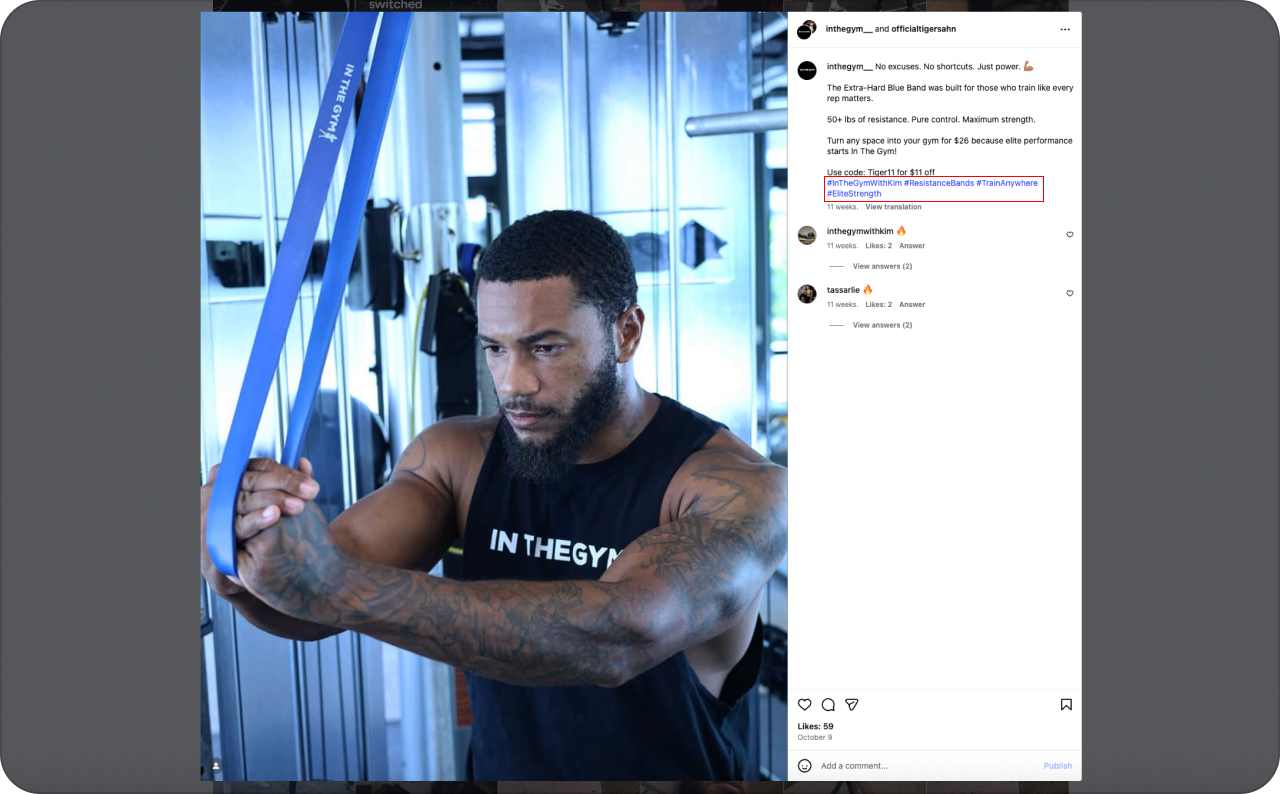
Photo source: @inthegym and @officialtigersahn on Instagram
Put your keywords where they are read
With tags capped, the words that do the work are the ones inside the content. Say the topic out loud in the video, put it on screen, and open the caption with it. Cake sizes for a 30-person party in the first line of a caption does more than any tag will.
Your name field and bio count here too, which is why the profile work in the last section pays off twice.
Write alt text like a sentence
Alt text started as an accessibility feature. It is now also indexable. Describe what is actually in the image in plain language: three-tier chocolate birthday cake with fresh berries, made for a 30-guest party. Not a keyword list.
Your posts can now appear in Google
This is the part most guides have not caught up with. Since July 2025, public content from professional Instagram accounts belonging to people over 18 is available to Google, Bing, and other search engines by default. It applies retroactively to content posted from January 2020. Stories and Highlights are not included.
So a Reel answering what size cake for 30 people can be found by someone who never opens Instagram. That is a second discovery channel you were not using, and it rewards exactly the kind of specific, question-answering content from the previous section.
There is a toggle for it in your privacy settings, in the section covering how your content appears elsewhere. Confirm it is on before you count on any of this.
Reach your first followers through people who already know you
Your first hundred followers almost never come from the algorithm. They come from people you can reach directly, and they matter more than the number suggests, because they are the test group that decides whether your posts travel further.
Start with the customers you already have. If you have sold anything to anyone, you have a follower list you have never asked. Put your handle on receipts, packaging, the confirmation email, the invoice, your website footer, and your Google Business profile. These people already trust you, so they watch to the end and reply. That is the behavior Instagram reads before deciding who else might care.
Collabs, done at your level. A Collab post appears on both profiles and reaches both audiences. The mistake is aiming too high. An account with 100,000 followers has no reason to say yes. An account with 500 to 2,000 followers in a related business does, because the trade is even.
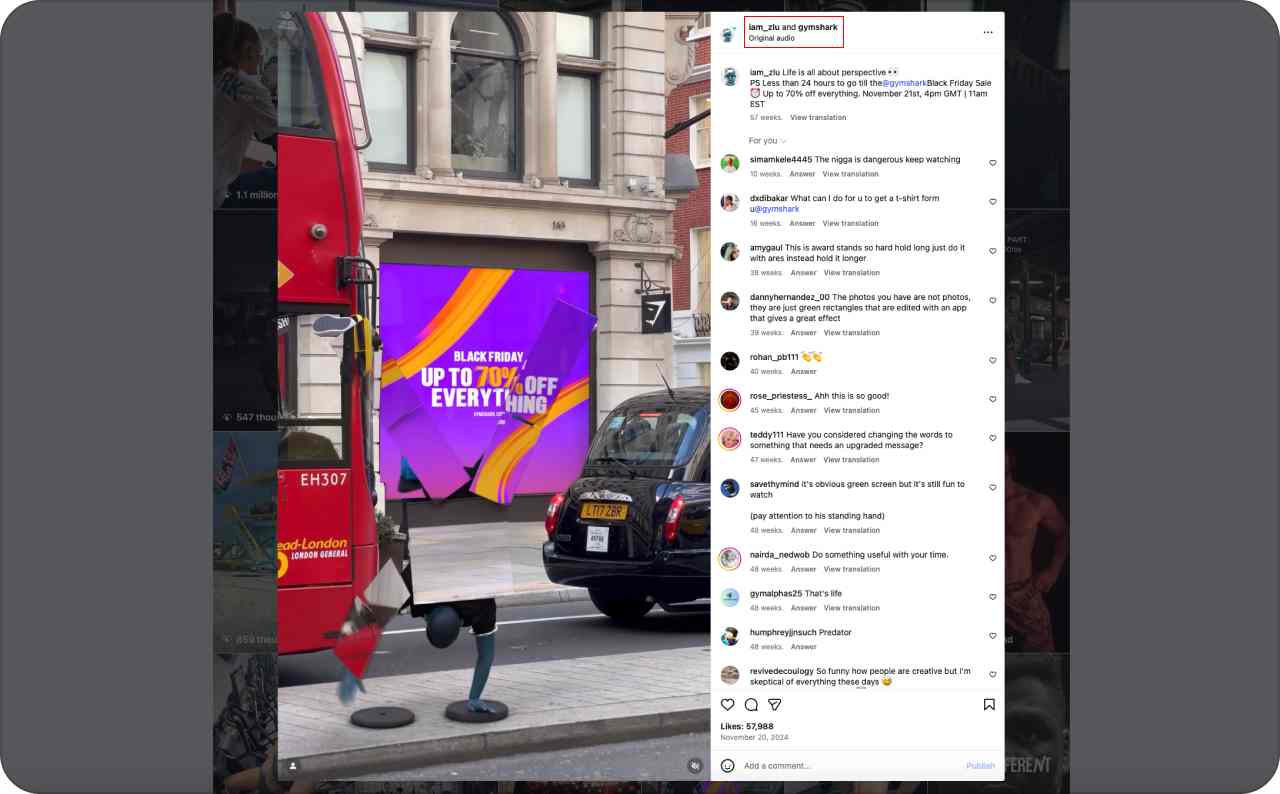
Photo source: @iam_zlu and @gymshark collab
Show up where your buyers already are. Pick ten accounts your customers follow. Not competitors, but the florists, venues, and local pages from the collab list. Leave one real comment a day. Not “great post.” Find a question in the comments you actually know the answer to, and answer it.
This works for the same reason a Collab works. You appear in front of an audience that is already assembled, and you show up as a person who knows something rather than as an ad. The florist’s followers are planning the same party your buyer is planning, and they are already reading that comment section.
Twenty minutes a day covers it, and I would treat it as the highest-value twenty minutes in your week when you are starting out. Your first hundred followers often come from here rather than from anything you published.
Let customers make the content. Ask people who ordered from you for a photo from the party. Repost with permission and tag them. One caution: a customer photo is not your own footage, so add your own context and keep the bulk of your feed on material you made.
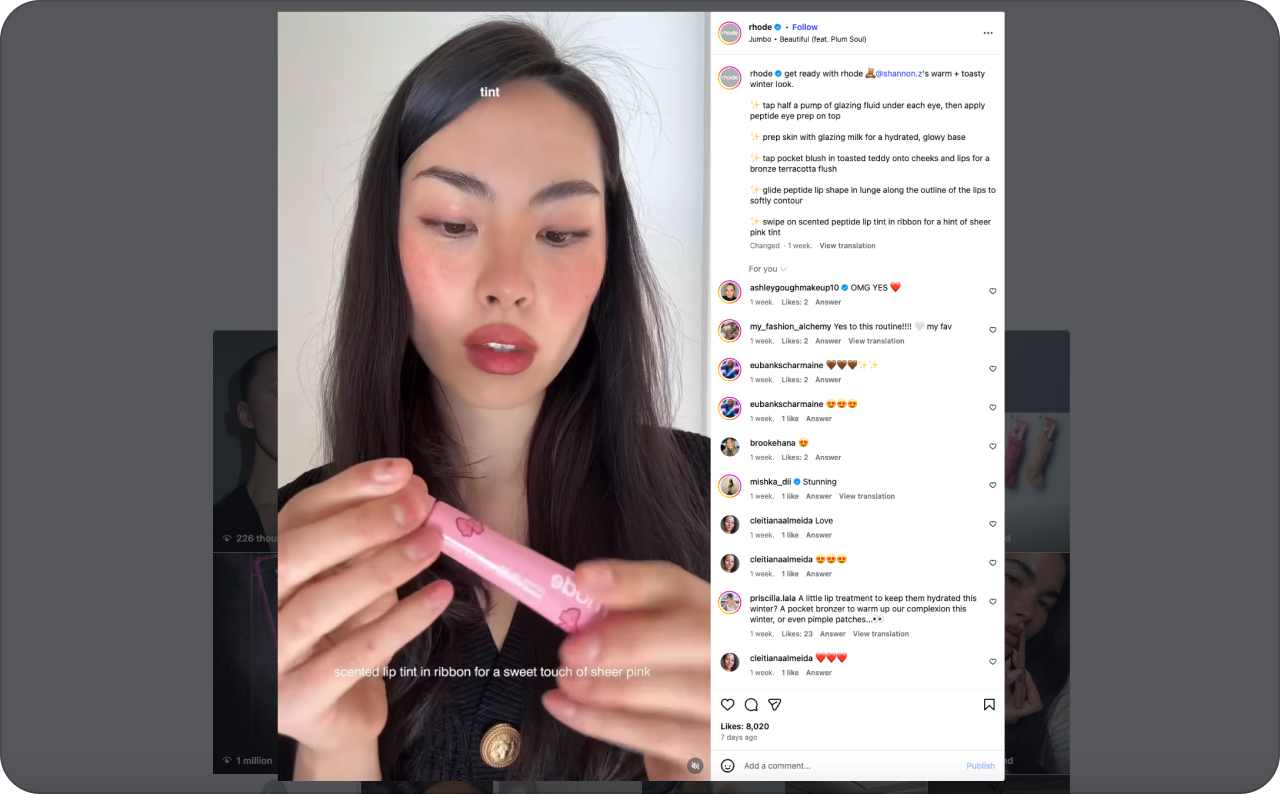
Photo source: @rhode on Instagram
Point your other channels here. An email list, a TikTok, a Facebook page, a shop counter. You do not need a campaign, just your handle where people already find you.
Your first week: set up an account people can follow
You should finish it with a profile that works, a topic you can repeat, and three posts published. Not with a number.
Most days take under an hour.
| Day | What you do | What you have at the end | What to write down |
| 1 | Confirm public and professional account, check originality, pick one audience | One sentence: who you help and with what | Today’s follower count |
| 2 | Rewrite the name field and bio, choose three pins | A profile that answers who is this in five seconds | The three questions your profile now answers |
| 3 | List every question customers asked you this month, group them into three topics | A content list you did not have to invent | Your three topics |
| 4 | Publish the first post, answering one question from that list | One finished piece of content | Topic, format, date |
| 5 | Publish the second on the same topic, different angle | The start of a series | Whether the first post brought any follows |
| 6 | Send one Collab pitch, add your handle to receipts, email, website | One route out to a new audience | Who you asked, and what you offered |
| 7 | Compare the two posts, decide what the next three look like | One decision: repeat, adjust, or change topic | Follows gained, followers lost |
Why you get views but no new followers
This is the most common question I get, and it is usually diagnosed wrong. People assume the hook failed. The hook is what got you the views in the first place.
A follow is a separate decision, made later, by a smaller group, for a different reason. Views tell you the post traveled. Follows tell you someone wanted the next one. Work backward through the chain and the break is usually obvious.
| What you see | Where it breaks | What to change next |
| Views, but almost no profile visits | The post was watchable, not useful. Nobody wondered who made it | Answer a question your buyer actually has, instead of showing something nice |
| Profile visits, but few follows | The profile does not deliver what the post promised | Match the bio and pins to the topic that brought them there |
| Follows that disappear within a week | Your next posts were about something else | Publish a series on one topic instead of one-offs |
| Follows from people who never buy | You are reaching your industry, not your customers | Post about choosing and using, not about how you make it |
Check one thing at a time, and check it across your last ten posts rather than the one that disappointed you. A single post can underperform for reasons that have nothing to do with your account.
A number worth tracking
Instagram Insights shows follows for individual posts. Divide follows by accounts reached, multiply by a thousand, and you have a figure you can compare across posts.
A post that reached 12,000 accounts and brought 24 follows gives you 2 follows per 1,000 reached. That is not a benchmark and I am not going to invent one for you. The point is your own trend. A post sitting at 5 is telling you something a post at 0.5 is not, and the two probably differ in topic rather than in production quality.
If those fields are missing on your account, use weekly net growth instead: followers gained minus followers lost.
The fourth row is the one to watch
Content about technique attracts peers. Content about choosing attracts buyers. Both get views, and the technique posts often get more, which is exactly why this goes unnoticed for months. Only one of the two brings you customers.
You can see this in your own audience data. Insights breaks followers down by location and age. If most of your new followers are nowhere near a city you deliver to, you are building an audience you cannot sell to.
Переглянути цей допис в Instagram
When you run out of content before you run out of ideas
By now you have three topics and a list of questions your customers actually asked. What stops most small businesses is what comes next. The list is still there. The time is not.
That is the only place I would reach for a tool.
With Zeely you start from a product link, a photo, or a single idea and generate up to five variations of one creative. You choose what changes between them: the text, the visuals, the style, or the composition. Same message, different openings. You review every version before anything goes out, and you can publish or schedule the approved ones to a connected Instagram account from inside Zeely.
What it will not do, and I would rather say this now than have you find out later: Zeely does not affect distribution, cannot put you in recommendations, and does not produce followers. Nobody can sell you that. What it changes is how many finished posts you can put in front of the audience you are still earning.
Should you use ads to reach 1,000 followers?
You can reach 1,000 followers without spending anything. Ads belong at the end of this guide rather than the beginning, because they multiply whatever you already have. If your content does not earn follows organically, paying to show it to more people gets you the same result at a larger scale.
The honest sequence is: publish, find the post that earns follows, then consider paying to show that one post to more people like the ones who followed.
A few things to know before you spend anything.
Promoting a post is not buying followers. You are paying for distribution of content you made. Whether anyone follows still depends on the post and the profile.
Attribution is loose. Instagram will tell you what the promotion reached. Connecting that to follows is harder, because someone may see the promoted Reel, look you up two days later, and follow then. Judge it on your weekly net growth, not on the campaign screen alone.
Start small enough that the answer does not matter. A budget you would not miss, on one post, for a few days. You are buying information about whether a topic scales, not buying growth.
If you decide to test it, the setup, objectives, and creative decisions are covered in Zeely’s guide to Instagram Reels ads, and you can build the ad itself with Zeely.e followers, you can remove a few each day. No need to obsess. We just want your future engagement rate to reflect real humans.d record a Reel for each. You do not need perfect lighting. You need clarity, energy, and a promise your viewer cares about.
FAQ
Yes. Everything in this guide works without spending money. The cost is time and consistency rather than budget. Ads can speed up distribution of a post that already works, but they are not required, and they will not fix content that does not earn follows.
No, you cannot get 1000 followers in five minutes, but you can get 1000 followers in just a few days or a week if you will follow all the recommendations and tips in this article.
Reels are where most strangers will find you, so they make it considerably easier. They are not the only route. A specific enough carousel gets saved and sent, and an account with real customers can grow from existing relationships. But if you publish nothing that reaches non-followers, growth depends entirely on people you already know.
Up to five. Instagram capped captions at five hashtags per post or Reel in December 2025, down from thirty. Choose tags that describe the specific post rather than the category it sits in.
Because watching and following are different decisions. A view means the post was worth ten seconds. A follow means someone wants the next one. Work backward through the diagnostic table above to find where the chain breaks.
Reaching 1,000 followers does not trigger a payment. Monetization on Instagram depends on specific programs, eligibility rules, and your region, and those change. The current requirements are covered in how Instagram payouts work.
Emma blends product marketing and content to turn complex tools into simple, sales-driven playbooks for AI ad creatives and Facebook/Instagram campaigns. You’ll get checklists, bite-size guides, and real results, pulled from thousands of Zeely entrepreneurs, so you can run AI-powered ads confidently, even as a beginner.
Written by: Emma, AI Growth Adviser, Zeely
Reviewed on: September 29, 2026