4 B2B video ads that actually teach us something in 2026
Which B2B video ads are actually worth studying in 2026, and what can marketers reuse from them without copying the whole campaign? I pulled together the strongest public B2B campaign examples from 2026 and broke them down into practical lessons Zeely readers can use in their own ads.
The best b2b video marketing examples in this group do three things well. They give the viewer one clear thought, they attach that thought to visible proof, and they keep the video focused on one job instead of trying to do everything at once.
If you search for B2B video ads examples, you usually get a messy mix of brand campaigns, landing pages, and anything with a play button. That is not very helpful when you are trying to learn from real b2b ads. So I kept this list strict. Every example below has a public 2026 time marker and a real public video asset at the center of the campaign.
I also kept the list short on purpose. Public, well-documented business to business advertising examples with actual video assets are still much rarer than in B2C. That is why this article is not a giant roundup. It is a tighter, more honest read on the best public 2026 B2B video work a marketer can study right now.
Best B2B video ads examples
FIS x Marketbridge, “The Money Lifecycle”
If I had to open this article with one true video-led B2B example, I would start here. Marketbridge says its 2026 work for FIS was a multi-touch, multi-channel ABM campaign anchored by a cinematic, three-part video series built with live action, immersive sound, stylized animation, and AI-assisted design. The same release says the campaign was recognized as a Webby Honoree from nearly 13,000 entries, which makes this one of the clearest public 2026 b2b advertising examples with a real video spine.
What makes this campaign worth studying is not just the finish. It is the message discipline. “The Money Lifecycle” is a much better organizing idea than a long fintech feature list. It gives the audience a mental model first, then lets the creative world build around it. That is exactly why the campaign can feel cinematic without becoming vague.
There is also a practical performance lesson here. The public YouTube description for the campaign says it targeted 53 key accounts, delivered more than 7 million impressions, and generated more than 6,500 clicks. That does not tell us everything, but it does tell us this was not just a pretty brand film. It was meant to move named accounts through a real ABM motion.
What I would copy from FIS is simple. Use the video to give the buyer one clean frame for understanding the problem. Once the frame is strong, the production can become more ambitious without losing the audience. That is a much better model for b2b video ads examples than loading the first cut with every product message you have.
Verizon Business, “My Biz Plan: PlanDetails”
https://www.ispot.tv/ad/gjp3/verizon-business-my-biz-plan-plandetails
Verizon’s “My Biz Plan: PlanDetails” is a better example for short-form clarity. iSpot lists it as a 2026 Verizon Business TV commercial, and Verizon’s own product page makes the offer behind the ad very plain: businesses start with one base plan, then customize add-ons for what they actually need. The official page even includes a play-video link and repeats the same core message in text.
I like this one because it does what a lot of business to business ads fail to do in short video. It compresses a complicated pricing and packaging story into one sentence the buyer can actually remember. Your business. Your plan. Choose what you want and pay only for what you need. Verizon says that directly on the page, and that is exactly the kind of message that can survive a 15 to 30 second ad.
This is one of the more useful b2b ad examples for small and midsize business marketers because the lesson is so portable. When your offer has layers, do not lead with the layers. Lead with the control the buyer gets. The ad does not need to explain every add-on. It only needs to make the value of customization feel obvious.
If you are writing or testing video advertising examples for a telecom, SaaS, or services offer with lots of options, this is the move worth studying. Make the first message feel buyer-friendly, not product-team-friendly.
ServiceNow Knowledge 2026 promo videos
https://www.servicenow.com/events/knowledge.html
ServiceNow’s Knowledge 2026 campaign is not a classic product commercial, but it still belongs in a serious article about b2b video marketing because it is clearly a video-led event campaign. The official event page is built around a promotional creative system with sessions, keynotes, event highlights, and a strong value line: “Come for the wow. Leave with the know-how.” It also frames the event around 300+ sessions, hands-on AI, and bold keynotes from May 5 through May 7, 2026.
The reason I kept this example is that event promo videos often drift into noise. They sell scale, energy, and big-name speakers, but they never make the payoff clear. ServiceNow’s line is better than that. It sells spectacle first, then usefulness. That is a more durable promise, and it is one of the better marketing video examples on this page for brands pushing webinars, conferences, partner events, or product launches.
The creative lesson is not “make an event trailer.” The lesson is “sell the exchange.” What will the audience actually leave with? ServiceNow answers that more clearly than most event campaigns do, and that is why I think its promo-video approach deserves a spot here.
So while this is not the same kind of example as FIS or Verizon, it still teaches something useful about business to business advertising examples in video form. The video works because the outcome is clear, not because the page is busy.
PwC, “People & Impact”
PwC’s “People & Impact” is the people-led example in this set. The Vimeo page says the 2026 employer-brand campaign features real employees sharing their experiences around mentorship, growth, and collaboration, and that the work included a film, key visuals, and social ads. That makes it one of the clearest public b2b video ads examples for professional services and talent-heavy brands.
I included this one because in trust-heavy categories, people are often the proof. A consulting brand or services firm can talk about expertise all day, but it starts to feel much more believable when actual employees carry the message. PwC’s film is useful because it treats the people behind the brand as part of the product story, not as background decoration.
This is also a helpful correction to a common B2B bias. Not every strong b2b ad has to feel cold, technical, or heavily product-led. In categories where trust, culture, and expertise matter, a people-centered brand film can still do real business work, especially when it is cut into shorter social assets afterward.
What I would copy from PwC is the decision to make the proof human. If your service depends on the quality of the people delivering it, put those people closer to the camera and closer to the promise.
Why these B2B video ads work
When I look across these four examples, I do not see one winning format. I see one winning habit. Each video reduces complexity before it asks for attention. That fits Google’s ABCD framework well. The official Google Ads guidance says effective video ads are built around Attention, Branding, Connection, and Direction, and says these principles can drive as much as a 30% lift in short-term sales likelihood and a 17% lift in long-term brand contribution.
One clear thought leads each video
FIS gives you a money lifecycle. Verizon gives you a custom plan. ServiceNow gives you wow and know-how. PwC gives you real people doing meaningful work. These are not overloaded concepts. They are easy to repeat, which is exactly why they work better than generic B2B adverts built from claims and jargon.
The proof sits close to the message
FIS ties its story to a named-account ABM campaign and public engagement numbers. Verizon ties its ad to a product page that explains exactly how the plan works. ServiceNow backs its event promise with a visible agenda and 300+ sessions. PwC puts real employees in front of the camera. These are different proof systems, but they all do the same job. They keep the video from floating off into pure brand language.
Each video has one job
This is the quiet advantage in all four examples. FIS builds understanding and account relevance. Verizon simplifies a plan offer. ServiceNow gets people to register for an event. PwC builds trust around people and culture. None of them tries to do awareness, education, objection handling, and conversion in one cut. That makes the message cleaner and the creative easier to remember.
Patterns you can copy from the best B2B video ads
Wistia’s 2026 State of Video says LinkedIn is now B2B’s number one video channel, with 8 in 10 teams calling it their primary place to share videos, and it says over one-third of teams already use AI, most often in pre-production. That matters because it rewards video ideas that are clear, modular, and easy to adapt across cuts.
Start with a frame, not a feature list
This is the biggest pattern across the page. FIS does not start with product architecture. Verizon does not start with pricing tables. ServiceNow does not start with schedule clutter. They all start with a frame that helps the viewer organize the offer quickly. That is the difference between a forgettable e-commerce video ad example and one that actually teaches you something.
Match the video to one buying tension
Verizon addresses the pain of fixed plans. ServiceNow addresses the question of whether an event is worth the time. PwC addresses the trust question behind professional services and hiring. Good b2b advertising examples do not try to solve every objection at once. They pick the tension that matters most and let the video focus there.
Put the proof where the viewer can feel it
FIS has a visible campaign structure and public outcome signals. Verizon gives you a product page with concrete customization language. ServiceNow shows the shape of the event. PwC uses real employees. The proof does not need to look the same every time. It just has to sit close enough to the promise that the video feels grounded.
Build a family of cuts, not one hero file
This is where a lot of b2b video marketing goes wrong. Teams make one polished asset and expect it to handle every channel. The better lesson from these examples is that one message should become multiple useful versions. A longer film can build the world. A shorter cut can sharpen the offer. A social edit can bring the hook closer to the first second.
Common mistakes weak B2B video ads make
They open with information instead of tension
The weakest b2b ads examples tend to start with what the company wants to say, not what the buyer needs to solve. That is the opposite of Verizon and ServiceNow. Both examples make the viewer understand the value first, then let the detail come later.
They confuse polish with persuasion
FIS proves that polished production can absolutely work in B2B. PwC proves that emotional tone can work too. But both still have a clear message under the finish. A polished video with no real center is still a weak ad. Good production helps. It just cannot rescue a muddy idea.
They try to make one video do every job
Google’s video guidance separates creative principles by objective for a reason. The more jobs you force into one cut, the less likely any of them will land. The better video advertising examples on this page all stay focused on one task the viewer can understand fast.
How Zeely helps you turn one idea into more B2B video variants
This is where Zeely fits naturally for me. The lesson from the best b2b video ads examples is not “make one expensive hero film.” It is “find the clearest message, then build more useful versions of it.” Zeely’s Avatar video ads can be created in a few minutes, with rendering taking about 12 minutes for a video ad, and frames the format as a short clip where an AI avatar presents the product while it appears in the background.
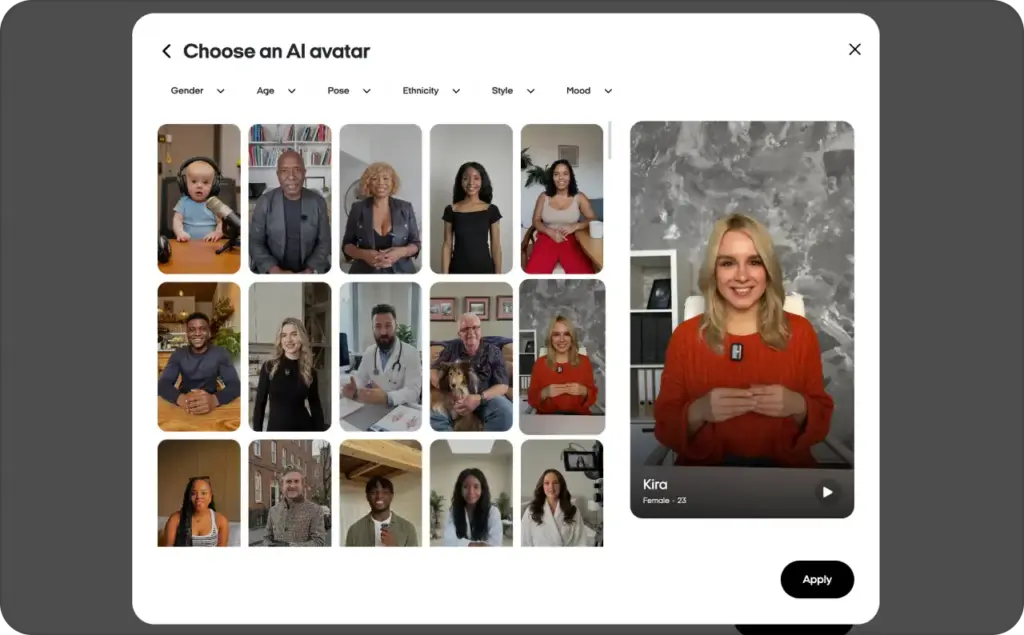
That matters because the best examples on this page all start with one thought that can be repeated. Once you have that thought, you can turn it into several working cuts. Zeely’s Batch mode is built for exactly that kind of variation. Its Batch mode helps you create multiple static ads at once for the same product so you can test, compare, and keep your creative consistent.
Zeely also ties the creative step to campaign action. Its paid-campaign guide says you can launch an ad directly from the app, choose Traffic or Leads as the objective, and run on Facebook and Instagram through Meta’s network. That makes the product fit here pretty cleanly. One message can become an avatar-led video, a static batch of supporting creatives, and a live campaign without forcing you to rebuild the whole idea each time.
For a Zeely reader, that is the real bridge from inspiration to execution. Study the video-led B2B examples above, steal the message discipline, then use Zeely to make more than one version of the idea. That is how you stop treating one polished file as the whole campaign.
Final takeaway
If you came here looking for the best B2B video ads examples, the clearest answer is also the simplest one. The videos worth studying in 2026 are not the ones that say the most. They are the ones that make one business idea feel easier to understand, easier to trust, and easier to remember. FIS does it with a cinematic ABM story. Verizon does it with offer clarity. ServiceNow does it with a sharp event promise. PwC does it with human proof.
That is the standard I would use before making any new business to business advertising example of my own. One clear thought. One visible proof system. One job per video. Everything else should support that.
Emma blends product marketing and content to turn complex tools into simple, sales-driven playbooks for AI ad creatives and Facebook/Instagram campaigns. You’ll get checklists, bite-size guides, and real results, pulled from thousands of Zeely entrepreneurs, so you can run AI-powered ads confidently, even as a beginner.
Written by: Emma, AI Growth Adviser, Zeely
Reviewed on: May 5 2026