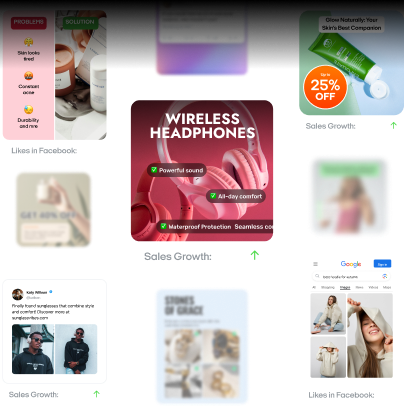
Boost Facebook ad CTR: A 2026 playbook that works
Wondering why people scroll past your ads without clicking? At Zeely, we’ve tested CTR lifts across real Facebook campaigns, and we built this guide from what consistently wins.
To improve Facebook ad CTR, make your first frame instantly clear, write a benefit-led headline, and match the offer to the right audience temperature. Track Link CTR, not CTR All, audit placements, and run clean A/B tests that change one variable at a time. Refresh creative when frequency rises and CTR drops, and tighten message match between ad and landing page. Small changes, like a sharper hook or clearer proof, often cut CPC quickly and raise click volume without increasing spend.
If your Facebook ad CTR is low, you’re paying to be ignored. The fix usually isn’t a bigger budget, it’s clearer creative and cleaner testing. In this guide, I’ll show you how to improve Facebook ad CTR using fast, repeatable changes to hooks, copy, audiences, and placements. You’ll leave with a simple checklist you can apply today.

Why Facebook Ad CTR matters more than people admit
CTR is not a vanity metric if you treat it correctly. It’s a relevance signal, and Facebook’s delivery system responds to relevance. When people click your ad, the platform learns who is most likely to engage with it. Over time, that can lower your cost per result, because the system finds pockets of users that react quickly.
CTR also protects your funnel. I think of it like a door on the front of a store. If the door is hard to find, the inside can be perfect and still empty. A stronger CTR sends you more visitors who already raised their hand by clicking. That usually means:
- More sessions with intent
- Better landing page engagement
- More conversions per 1,000 impressions, if the page matches the promise
One more detail that matters for SEO and reporting: when people say “CTR,” they often mean different things inside Ads Manager. If you benchmark the wrong CTR, you’ll “fix” the wrong problem. You may also like to read an article about Facebook ad benchmarks.
Which CTR to track in Facebook Ads Manager (so you don’t fool yourself)
In Ads Manager, you’ll see several click metrics. The two I care about most:
- CTR (Link Click-Through Rate): link clicks divided by impressions
- CTR (All): any click on the ad unit divided by impressions (likes, profile taps, expand image, comments, etc.)
If you’re optimizing for site traffic, leads on a landing page, or purchases, Link CTR is usually the cleaner indicator. “CTR (All)” can look great while your landing page stays empty, because people are tapping the image carousel or expanding text without leaving Facebook.
Use this quick rule:
- If your goal is off-platform action, watch Link Clicks, Link CTR, CPC (link)
- If your goal is on-platform action (video views, page engagement), “CTR (All)” can still be useful
And here’s the formula, so your team stays consistent:
Facebook ad CTR = (Link Clicks ÷ Impressions) × 100
If you only change one thing after reading this guide, make it this: build a custom Ads Manager column view that includes Link CTR, Link Clicks, CPC (link), CPM, Frequency, and your primary conversion metric.
How to boost Facebook ad CTR with creative that earns the stop
Your creative is your targeting, because most users never read the fine print. If the first frame is generic, the right audience still scrolls.
When I audit low CTR campaigns, I usually see one of these creative issues:
- The ad looks like every other ad
- The ad doesn’t show a clear “what is this” in the first second
- The ad asks people to work too hard to understand the offer
- The visuals and the copy are talking about different things
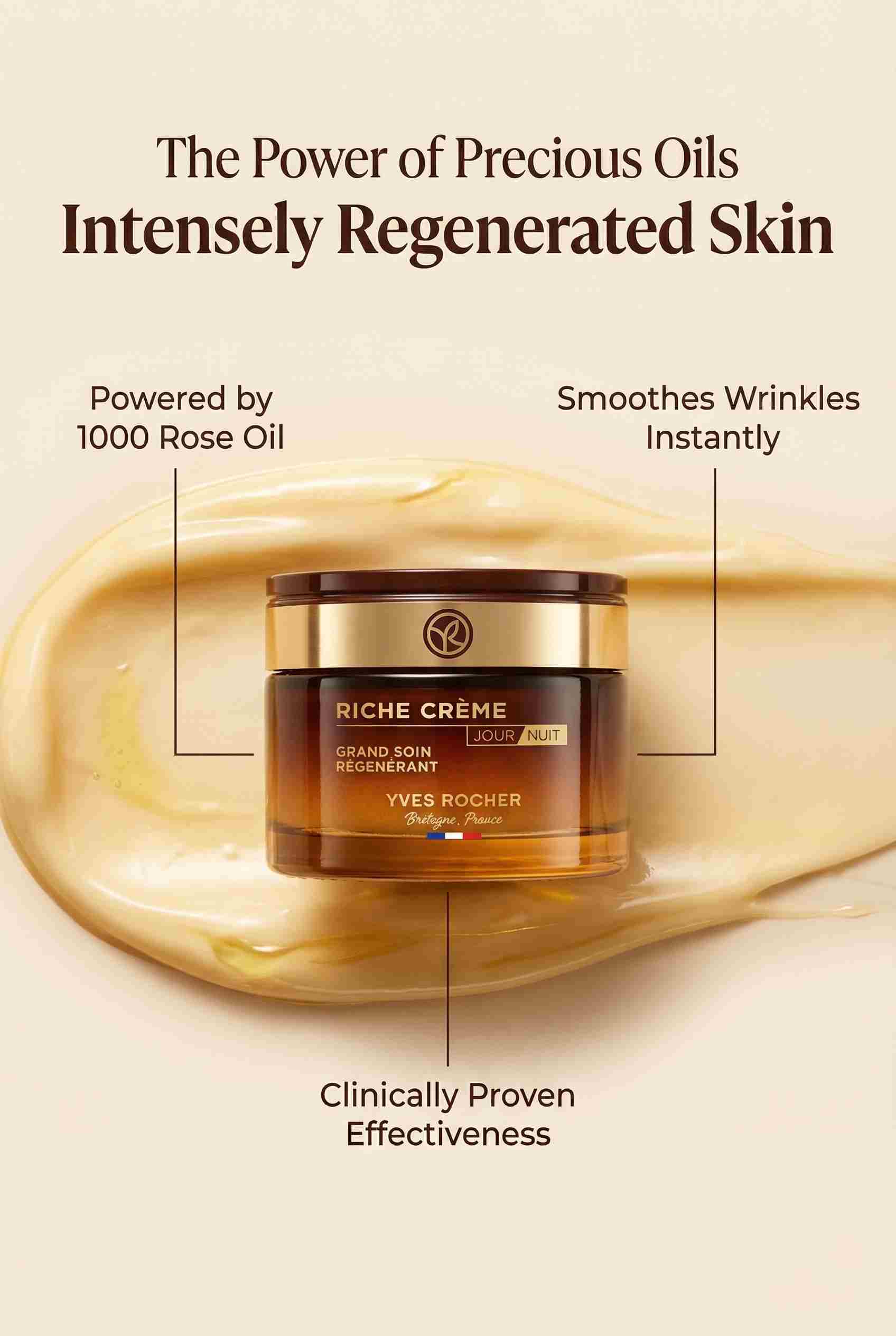
Use visuals that answer “what is it” in one glance
A strong thumb-stopper is not “pretty.” It’s obvious.
For image ads, aim for one clear subject and one clear benefit. For video ads, build the first 1 to 3 seconds like a billboard. People decide fast. You can easily create different ads with the help of the Facebook ad creator.
What usually raises CTR quickly:
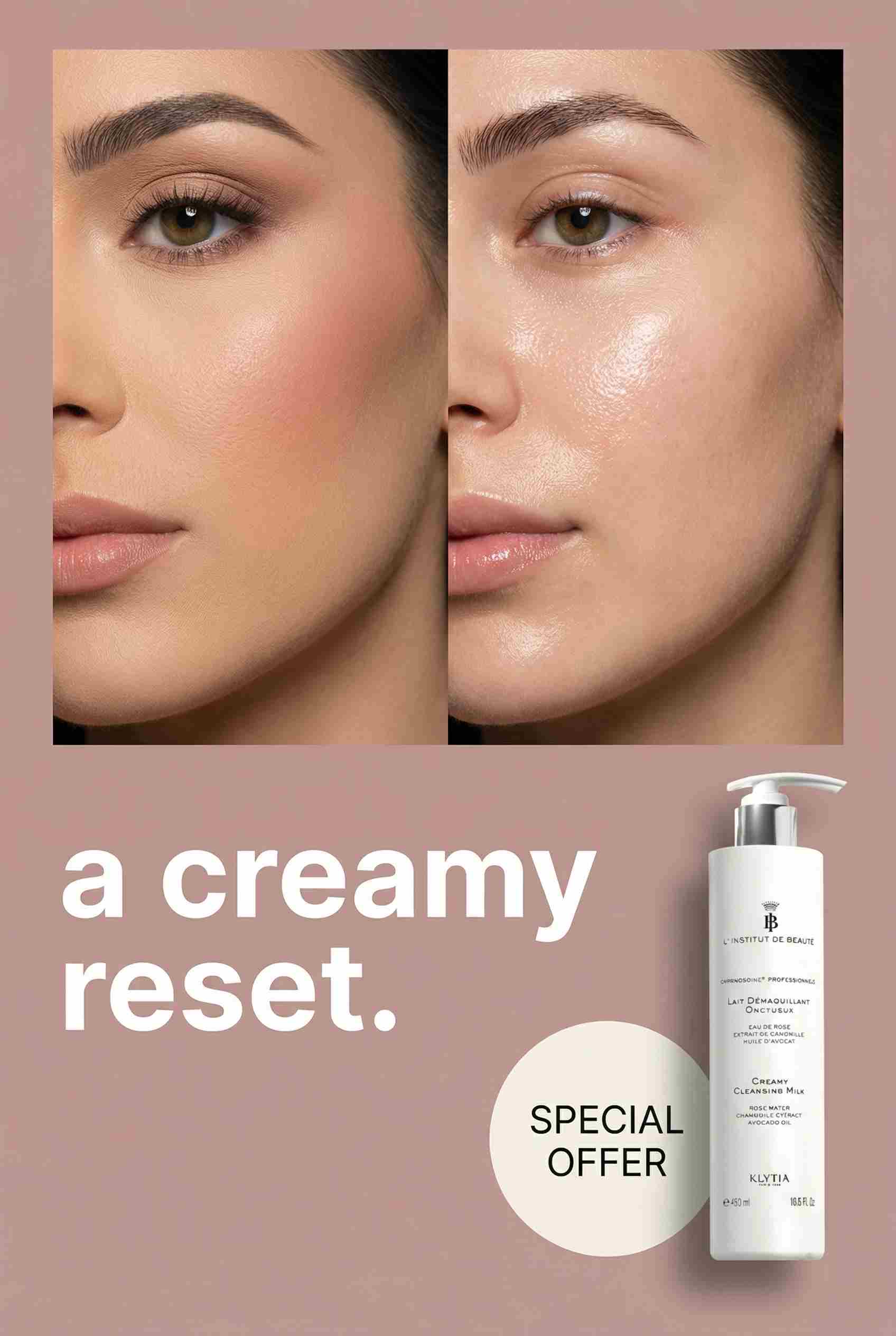
- A close-up product shot with real texture
- A before/after that is easy to compare
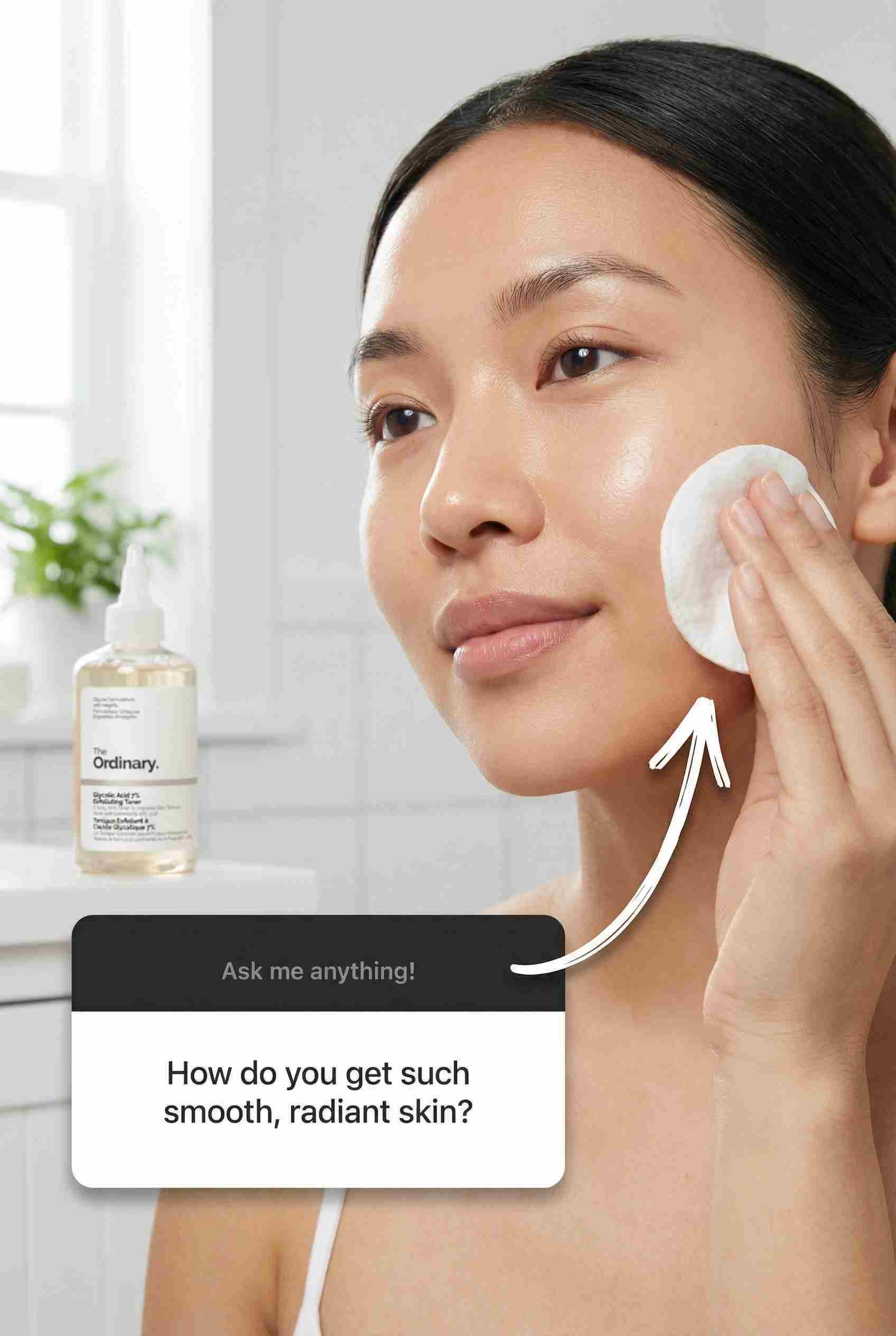
- A person using the product in a normal setting
- A simple on-screen promise that matches your landing page headline
- A strong contrast background so the subject pops in a feed
What usually lowers CTR:
- Collages with too many elements
- Tiny text that can’t be read on mobile
- Stock photos that feel like HR training
- “Brand videos” that take 6 seconds to get to the point
Read an article about Facebook ad mistakes to avoid wasting budget, improve targeting, and increase conversions before scaling campaigns.
Video ads: win the first seconds, then earn the click
Video often gets higher engagement than static creative, but only when it is built for feeds. Many people watch without sound, so captions and on-screen structure matter.
A simple video pattern that keeps CTR healthy:
- Hook (0–2s): name the problem or the desire
- Proof (2–7s): show it working, show a result, or show a quick demo
- Offer (7–12s): price, deal, trial, bundle, free shipping, whatever matters
- Action (last frame): tell people what happens after the click
If your CTR is low, don’t start by making the video longer. Start by making the hook sharper. You can also create AI video ads designed to grab attention and drive higher CTR.
How to improve Facebook ad CTR with copy people actually read
Copy is not decoration. It is the meaning of the visual.
I write Facebook ad copy to do one job: make the click feel like the next logical step. Not a leap of faith. Not a gamble. Read this article to find out more about the average CTR for Facebook ads.
Write headlines that make the benefit concrete
Headlines do better when they answer “why should I care” fast.
Instead of:
- “New Product Launch”
- “Try Our App”
- “Best Quality Guaranteed”
Try:
- “Clear Skin in 7 Days”
- “Plan Meals in 5 Minutes a Day”
- “Get a Quote in 60 Seconds”

Good headlines are specific without being weirdly technical. If you can add a timeframe, a number, or a clear outcome, CTR usually rises.
Primary text: keep it tight, keep it scannable
Most users skim. Make skimming rewarding.
A format I use constantly:
- One line that calls out the person
- One line that states the promise
- 2 to 4 short proof points
- One clear CTA
Example structure:
- “Still paying for clicks that don’t buy?”
- “This ad set uses one offer, three hooks, and clean testing.”
- “Built for mobile first.”
- “Shows price early.”
- “Cuts wasted impressions fast.”
- “Tap Learn More to see the layout.”
Your CTA button should match intent
A mismatch can lower CTR because it creates friction.
- Product page: Shop Now
- Lead magnet: Download
- Explainer page: Learn More
- Trial: Sign Up
- Appointment: Book Now
If your goal is purchases, “Learn More” can still work, but only if your landing page is direct and not fluffy.
Audience targeting that raises CTR without shrinking delivery
Even perfect creative fails if you show it to the wrong people. But the fix is not always “narrow harder.” Over-narrow targeting can spike CPM, which quietly kills scale.
I like to separate targeting into three temperature bands. CTR expectations are different for each.
Cold audiences: earn curiosity, not loyalty
For cold audiences, your job is to be instantly relevant. That usually means:
- Interest stacks that match the product category and the buyer identity
- A clear offer (discount, bundle, trial, free shipping)
- Proof that reduces doubt (reviews, results, demo)
A practical cold targeting checklist:
- Keep age and geography realistic for your price point
- Layer 1–2 strong interests, not 10 weak ones
- Exclude job titles or behaviors that don’t map to buying
- If you have enough data, test broad plus strong creative
Warm audiences: make the next step obvious
Warm audiences are people who already touched your brand. CTR is often higher here, so use that advantage.
High-performing warm segments:
- Website visitors (last 7, 14, 30 days)
- Product viewers (specific product page visitors)
- Add-to-cart users (exclude purchasers)
- Video viewers (25% or 50% viewers)
- Instagram engagers (profile visits, saves, DMs)
Warm CTR gets crushed when the ad feels like a repeat. Rotate angles: new benefit, new proof, new bundle, new objection handling.
Lookalikes: only as good as the source
Lookalike audiences work best when the seed is high-quality. I’d rather build a lookalike from “top customers” than from “all purchasers.”
How I test lookalikes:
- Start with 1% lookalike
- Then test 1–3% if you need scale
- Keep creative stable while you test audience, or results get muddy
Placements that help CTR instead of leaking it
Placements can raise or lower CTR depending on whether your creative fits the space.
If you only run one format and let Automatic Placements do everything, you’re asking Facebook to crop your message and guess your intent. Sometimes it works. Often it wastes impressions.
Start with Automatic Placements, then audit the breakdown
I usually start with Automatic Placements, then I check performance by placement after there’s enough data. If one placement consistently brings cheap clicks but bad sessions, I cut it.
Use Ads Manager breakdowns to check:
- Link CTR by placement
- CPC (link) by placement
- Landing page views (if tracked) by placement
- Conversion rate by placement
Match creative to placement
Quick matching guide:
- Feed: clear subject, readable text, strong headline
- Stories and Reels: vertical video, fast hook, captions, big product
- Right column: only if you have a reason, it’s easy to ignore
- Audience Network: watch quality closely, it can drive low-intent clicks
If you want better CTR in Stories, build a Stories-first creative. A cropped feed image almost always underperforms.
A/B testing that gives real answers
Split testing is the fastest way to raise CTR, but only if you test one variable at a time and give the test enough room to breathe.
What to test first when CTR is low
I use this order because it gives the biggest lifts fastest:
- Hook creative
- Headline
- Offer framing
- Audience
- Placement
Rules that keep tests clean
- Change one element per test
- Keep budgets similar across variants
- Let the test run until you have enough impressions to trust the direction
- Kill losers based on a consistent rule (not a bad morning)
A simple “good enough” decision rule many teams use:
- After 5,000 to 10,000 impressions per ad, pick the winner if it is up by at least 0.2 percentage points in Link CTR, or 20% relative lift, and CPC is not worse.
That keeps you from overreacting to noise.
Ad formats that can lift CTR fast
If your campaign is stuck, sometimes the fastest fix is switching format.
Carousel ads: use them to tell a sequence
Carousel CTR rises when each card has a job:
- Card 1: hook
- Card 2: proof
- Card 3: features
- Card 4: social proof
- Card 5: offer and CTA
If every card is “another product photo,” CTR often stays flat.
Collection ads: good for mobile shopping flow
Collection ads can work well when you have multiple SKUs and a clean catalog. They reduce friction by letting people browse inside Facebook before clicking through.
Lead ads: high intent, low friction
Lead ads can perform strongly because the form is native. If you use lead ads, keep the question count low, and make the thank-you step do real work (booking link, calendar, next offer).
How to diagnose low CTR with a simple fix map
CTR is a symptom. Here’s the way I read it quickly.
Scenario 1: Low CTR + high CPC (link)
Your ad is not resonating.
Fixes that usually work:
- Replace the first frame or main image
- Rewrite headline with one concrete outcome
- Add proof (reviews, demo, result)
- Tighten targeting to match the offer
Scenario 2: High CTR + low conversions
Your ad earns clicks, but the landing page loses trust.
Fixes that usually work:
- Make landing page headline match the ad promise
- Put price or offer terms above the fold
- Improve load speed on mobile
- Reduce form fields
- Remove distracting navigation for conversion pages
Scenario 3: CTR drops over time + frequency rises
You have ad fatigue.
Fixes that usually work:
- Rotate 3 to 5 creative angles per ad set
- Refresh hooks weekly for smaller audiences
- Expand audience slightly if you are too tight
- Add a new offer frame (bundle, bonus, guarantee)
Advanced ways to increase Facebook ad CTR without gimmicks
These are the extras I use after fundamentals are solid.
Use urgency ethically and make it real
Urgency can raise CTR when it is true:
- “Ends Sunday”
- “First 200 customers”
- “Price goes up after launch week”
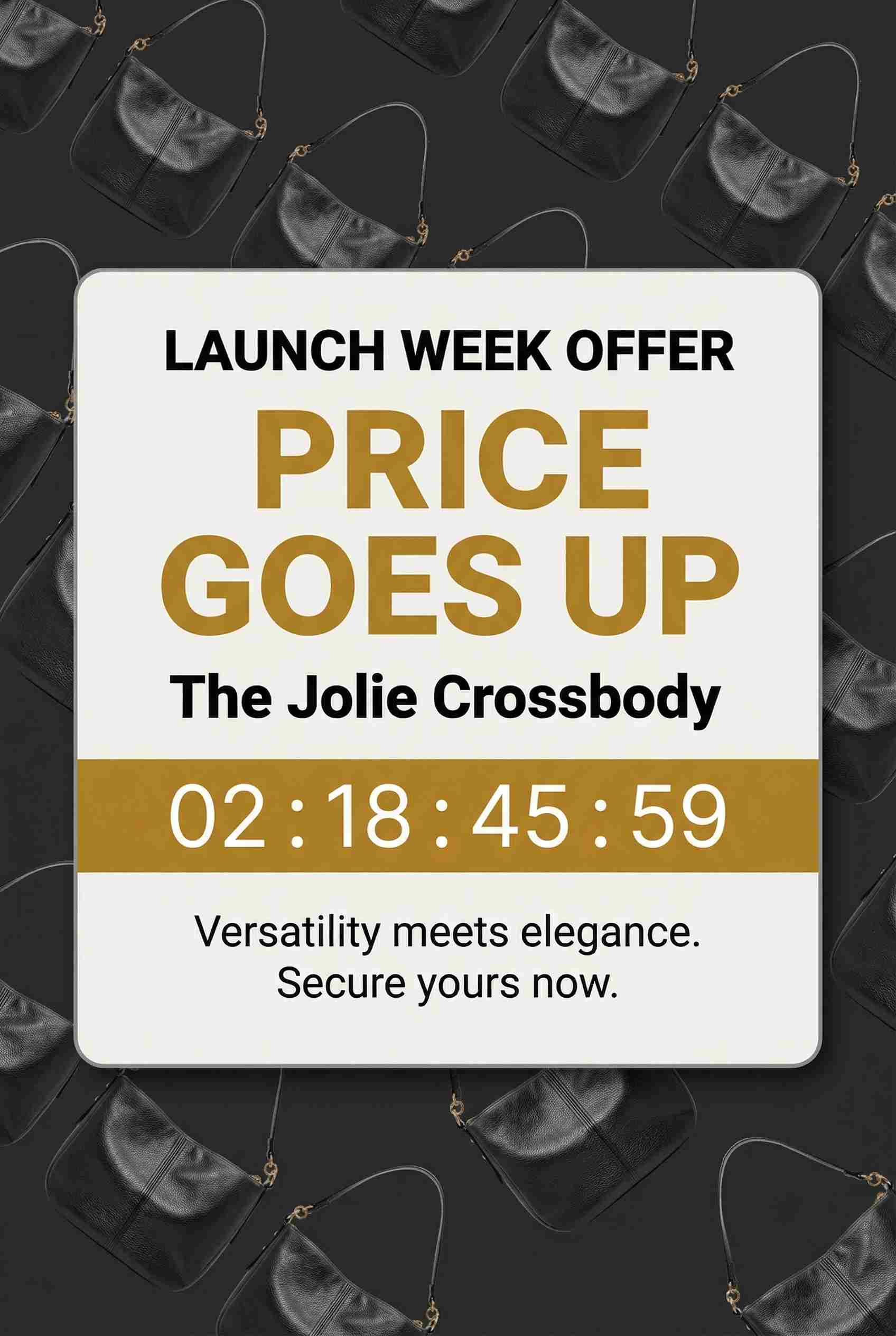
Fake urgency trains people not to trust you. Trust is part of CTR.
Add social proof where people can see it fast
Social proof can live in:
- On-screen text in the first half of the video
- The primary text line 2 or 3
- A quick testimonial clip
- Review stars in a product image
Make the landing page part of CTR improvement
CTR alone does not pay your bills, but landing page quality can feed back into ad performance through better downstream results.
My landing page basics:
- One clear promise above the fold
- One primary CTA
- Proof directly under the CTA
- Mobile-first layout
- No confusing headline swaps
A quick example: what a CTR lift looks like in practice
Here’s a common pattern I see with e-commerce.
Starting point:
- CTR around 0.75%
- Generic product photos
- Broad interest targeting
- Copy focused on the brand, not the buyer
Fix sequence:
- Swap in lifestyle creative showing product in use
- Rewrite headline to a concrete outcome
- Add one proof point (review count or testimonial line)
- Build warm retargeting for product viewers
- Run one clean A/B test: lifestyle image vs short demo video
Result in many accounts: CTR moves into the 1.5% to 2% range for the better variant, and CPC drops because the ad stops wasting impressions.
That’s not magic. It’s clarity plus repetition. Read now how much you should spend on Facebook ads.
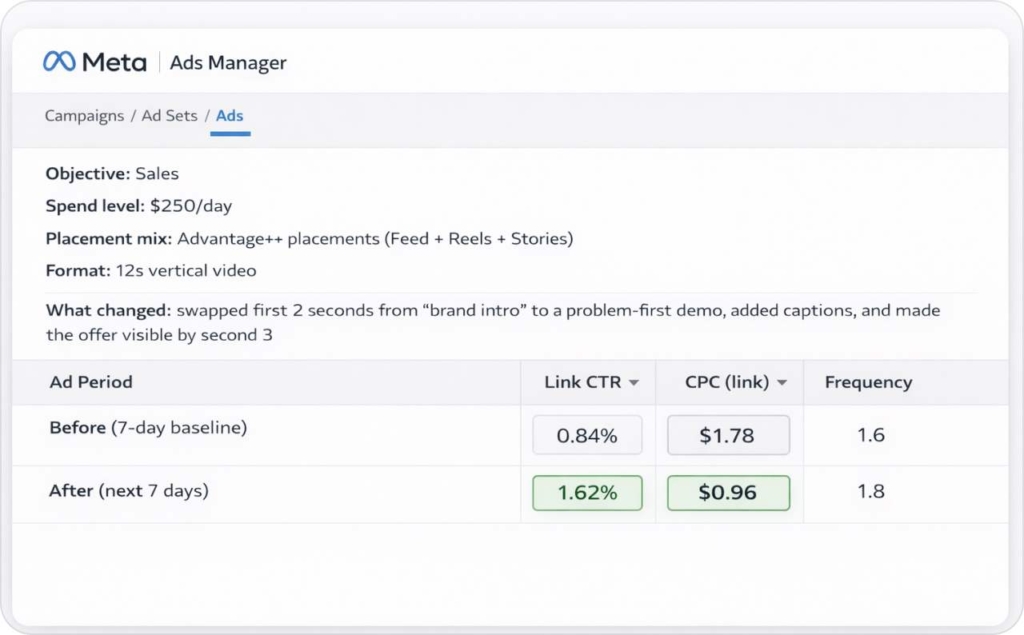
Case study 1: Ecommerce cold prospecting
- Objective: Sales
- Spend level: $250/day
- Placement mix: Advantage+ placements (Feed + Reels + Stories)
- Format: 12s vertical video
- Before (7-day baseline): Link CTR 0.84%, CPC (link) $1.78, Frequency 1.6
- What changed: swapped first 2 seconds from “brand intro” to a problem-first demo, added captions, and made the offer visible by second 3
- After (next 7 days): Link CTR 1.62%, CPC (link) $0.96
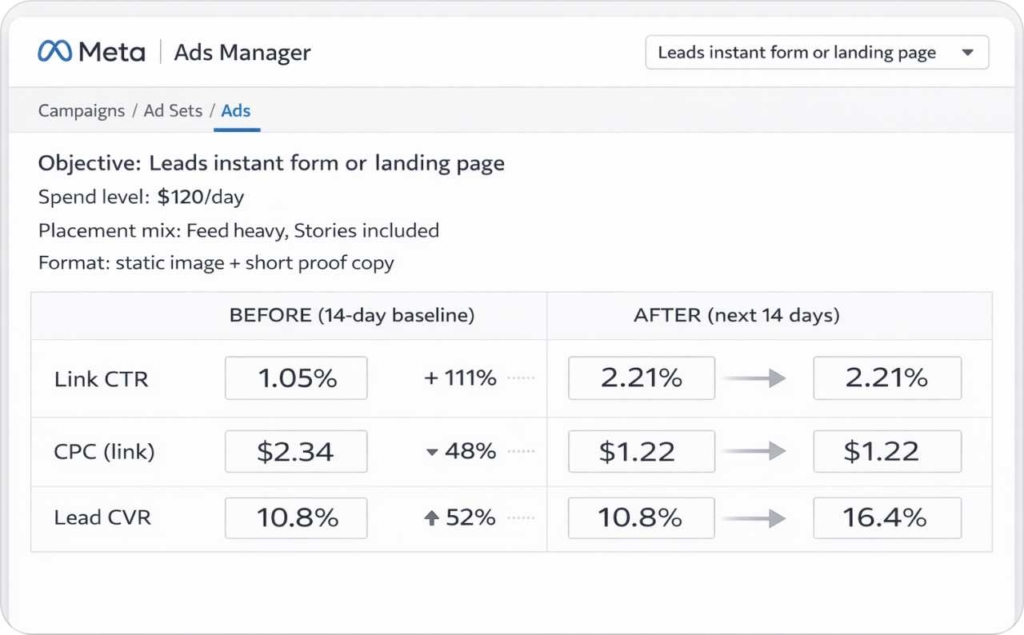
Case study 2: Lead gen cold to warm retargeting
- Objective: Leads instant form or landing page
- Spend level: $120/day
- Placement mix: Feed heavy, Stories included
- Format: static image + short proof copy
- Before (14-day baseline): Link CTR 1.05%, CPC (link) $2.34, Lead CVR 10.8%
- What changed: tightened headline to a single promise, removed extra text, and rebuilt audience from “broad interests” to “site visitors 30 days + engagers 365 days”
- After (next 14 days): Link CTR 2.21%, CPC (link) $1.22, Lead CVR 16.4%
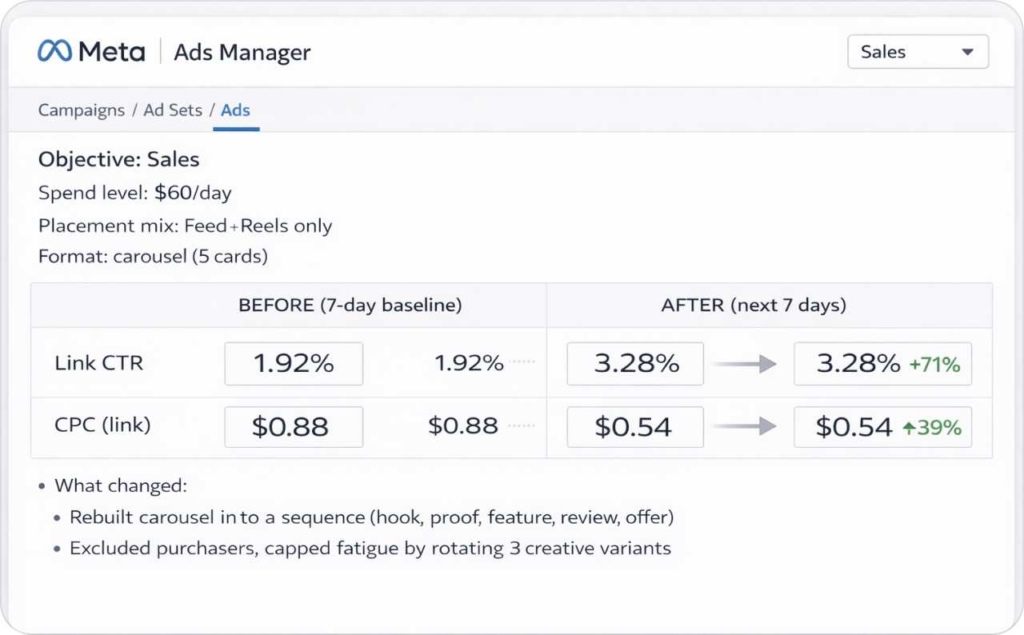
Case study 3: Retargeting product viewers
- Objective: Sales
- Spend level: $60/day
- Placement mix: Feed + Reels only
- Format: carousel (5 cards)
- Before (7-day baseline): Link CTR 1.92%, CPC (link) $0.88
- What changed: rebuilt carousel into a sequence (hook, proof, feature, review, offer), excluded purchasers, and capped fatigue by rotating 3 creative variants
- After (next 7 days): Link CTR 3.28%, CPC (link) $0.54
Frequently asked questions about boosting Facebook ad CTR
It depends on your industry, objective, and audience temperature. As a broad reference, many brands try to beat 1.0% Link CTR on cold traffic. Warm audiences often run higher. Your best benchmark is your own history for the same objective and placement mix.
Refresh when frequency rises and CTR trends down. For small audiences, that can be weekly. For larger audiences, it can be every few weeks. I prefer rotating multiple hooks instead of waiting for performance to crash.
The Pixel does not directly change CTR, but it enables retargeting and lookalikes. Those audiences often click more because they already recognize you.
Clicks (All) counts any click on the ad unit. Link Clicks count clicks that send people to your site or destination. For traffic and sales, Link Clicks is usually the cleaner metric.
Yes. Most CTR lifts come from creative clarity, better hook frames, tighter offer framing, and clean testing. Those changes do not require more budget, just better choices.
CTR = (Link Clicks ÷ Impressions) × 100. Use Link Clicks if your goal is off-platform action.
- CTR (link): is the ad earning clicks?
- CPC (link): are clicks getting cheaper as relevance improves?
- Landing Page Views: are clicks turning into real page loads?
- Conversion Rate: does the page deliver on the promise?
- CPA and ROAS: are you buying results at a sustainable cost?
I wrote this guide from real Meta Ads audits and creative tests we run at Zeely, then had it reviewed by our paid social team for clarity and accuracy. We define CTR using Meta’s metric definitions so you can report the same way inside Ads Manager.
Data used: anonymized performance exports from Zeely-managed accounts and partner audits across ecommerce and lead gen (prospecting + retargeting).
What we measured: Link CTR, CPC (link), CPM, frequency, landing page views, and the primary conversion metric.
What we excluded: ads with broken tracking, low-delivery outliers, and landing pages failing basic mobile load checks.

Emma blends product marketing and content to turn complex tools into simple, sales-driven playbooks for AI ad creatives and Facebook/Instagram campaigns. You’ll get checklists, bite-size guides, and real results, pulled from thousands of Zeely entrepreneurs, so you can run AI-powered ads confidently, even as a beginner.
Written by: Emma, AI Growth Adviser, Zeely
Reviewed on: March 26, 2026