Shopify AI ads: What they are and how to use
Thinking Shopify can just run ads with AI while you nap? Here’s what that really means in 2026, plus the setup that keeps it profitable. My team at Zeely pulled this from real campaign patterns, platform rules, and the tracking details that decide results, even when the ads look great.
Shopify AI ads usually means using AI to generate creatives, optimize targeting and bids, and automate budget decisions, but you still need real ad platforms like Meta, Google, TikTok and clean tracking.
AI performs best when you feed it a solid catalog, clear conversion events, and guardrails for CPA targets, ROAS floors, budgets, exclusions. Start with a full-funnel structure, give campaigns time to learn, fix purchase tracking first, and measure profit with blended KPIs plus incrementality tests.
AI can absolutely make Shopify advertising faster, and also faster at wasting money if your tracking is broken. This guide shows what Shopify AI ads really includes in 2026, what you must still control, and the setup that lets AI optimize toward profit, not just clicks. No fairy dust. Just the playbook.
What people think Shopify AI ads are vs what’s actually true
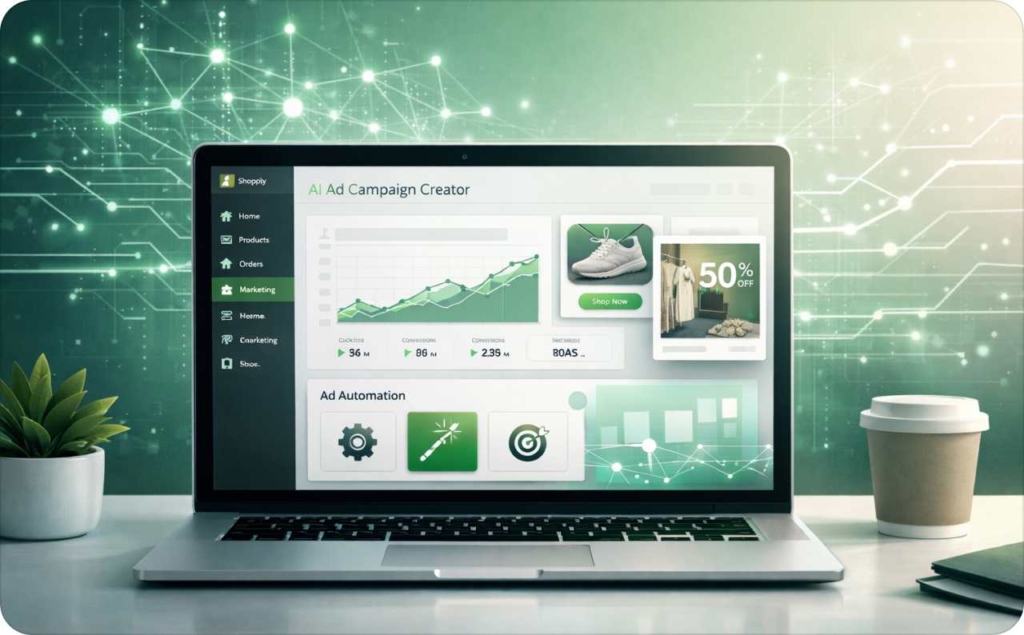
A lot of people think Shopify AI ads mean you flip a switch and sales show up. What’s actually true is simpler and more practical: Shopify is building AI into more parts of the commerce workflow, but you still need real platforms, clean data, and guardrails.
Shopify’s Winter ’26 Editions shipped 150+ product updates, which tells you how serious they are about embedding AI across commerce. The direction is clear. The results still depend on how you set it up.
Here’s the clean way to think about it:
| Bucket | Where AI lives | What it controls | What data it uses | Who owns the account |
| Shopify-native AI | Shopify admin | Store workflows, feeds, some creative helpers | Catalog, orders, storefront events | You |
| Ad-platform AI | Meta/Google/TikTok | Delivery, bids, audiences, placements | Pixel/CAPI, conversions, content signals | You (if set up right) |
| AI ad apps | App layer | Creative, rules, reporting, sometimes automation | Whatever you connect | Varies (watch this) |
Can Shopify run ads automatically without Meta or Google?
No. You still need platform accounts because that’s where the real control lives:
- Billing and refunds happen there
- Policies and ad reviews happen there
- Attribution settings and optimization events live there
- The account is the asset you keep long-term
Make sure the ad account and pixel are owned by you, not an app vendor.
What you can actually run on supported platforms
Most Shopify stores I see are running Meta, Google, and TikTok. Some add Pinterest, especially if they sell seasonal or visual products. Read an article now about the best Shopify apps to boost sales.
But AI looks different on each platform. On Meta and TikTok, it leans heavily into delivery and creative rotation. On Google, it’s more about feed quality and value-based bidding. Same store data, different AI levers. Find out now how to run TikTok ads for Shopify.
| Platform | Best for | AI lever to use first |
| Meta | Broad demand + retargeting | Advantage-style delivery + creative variation |
| High-intent shopping | Merchant feed quality + value-based bidding | |
| TikTok | Discovery + fast testing | Smart campaign types + creative automation |
| Early planners | Catalog + early-season prospecting |
What Shopify ads AI can automate and what you still control
Meta reported AI-driven delivery improvements that produced a 3.5% lift in ad clicks on Facebook and a 3% increase in conversion rates across Instagram surfaces. The models are powerful. Your setup decides whether that power works for profit or just for more activity. I really recommend reading the article on how to boost Shopify sales with Zeel AI generator.
AI is great at:
- Creative variation and rotation across images, video, and text versions
- Audience expansion and prospecting discovery
- Bidding, budget allocation, and placement optimization
- Basic reporting patterns like what moved and what’s trending



AI lever map:
- Creative variations, formats, and rotations
- Targeting with broad discovery and expansion
- Automated bidding toward your goal
- Budget shifting toward what converts
- Reporting with trend detection and performance summaries
What AI cannot decide for you without hurting profit
AI doesn’t know your margins. It doesn’t understand your cash flow. And it won’t protect your brand unless you set the rules first.
Here’s what still requires you:
- Your offer and pricing rules, including when you discount
- Margin and LTV boundaries, so profitable has a real number
- Brand voice and compliance, especially claims and guarantees
- Landing page quality, because no model can fix a weak PDP
If your product page converts poorly, AI won’t solve it. It will just get better at sending you more traffic that doesn’t buy. Explore more about Shopify short video ads with AI.
Prospecting vs retargeting with AI ads for Shopify
Prospecting finds new buyers. Retargeting closes warm ones. Most stores lose money when they mix them with no plan.
Google is basically screaming that discovery placements matter: YouTube is the #1 most-watched streaming platform in the U.S. for nearly three years, which is why top-of-funnel discovery is not optional anymore.
Prospecting is where AI-generated Shopify ads often shine first. You give broad signals and strong creatives, and let the platform find buyers you would never target manually.
TOF done right:
- Hook: call out a real problem fast
- Proof: show it works (demo, review, before/after)
- Product: show the “how” clearly
- Offer: state the deal plainly
- CTA: one action, one step
Start with hero SKUs. Make the offer easy to repeat.
When to use AI for retargeting
Retargeting works best when intent is clean:
- Viewed product
- Added to cart
- Initiated checkout
Set exclusions and watch frequency so you don’t burn your audience. Retargeting works, but it can train the wrong behavior if you’re not careful.
Watch for this:
- Training discount-only buyers who wait for the next code
- Coupon hunters who never purchase at full price
- Creative fatigue from pushing the same angle too long
If your BOF ads only convert when there’s a discount, you’re not scaling. You’re conditioning.
The hybrid that usually wins
The structure that holds up long term is simple:
- TOF runs creative tests and broad discovery
- MOF builds proof with reviews, demos, and comparisons
- BOF closes with a clear offer and cart recovery
Prospecting feeds retargeting. Retargeting converts what prospecting warmed up. That’s how results compound instead of swinging week to week.
Full-funnel structure for Shopify AI ads
If you only run bottom-of-funnel ads, you keep showing ads to the same warm audience. Frequency goes up, costs rise, and growth slows down. It feels like ads “stopped working,” but really you just ran out of new people.
Pinterest’s data makes a strong case for showing up earlier: people on Pinterest are more than 2x as likely as non-users to invest time and effort preparing for seasonal moments.
Here’s a simple structure that works for most Shopify stores:
- TOF (top of funnel) – 70% of budget
Broad targeting. Test creative angles. Goal is attention and demand. - MOF (middle of funnel) – 20%
Target people who engaged. Use reviews, demos, comparisons. Goal is trust. - BOF (bottom of funnel) – 10%
Target cart and checkout visitors. Use clear offers. Goal is conversion.
If you only fund BOF, you’re harvesting without planting.
What should you optimize for?
If you’re not getting many purchases yet, you can temporarily optimize for add to cart. This gives the platform more data to learn from.
But switch to purchase optimization as soon as you can. Otherwise, you train the system to find people who click, not people who buy.
Keep AI focused on quality
Every week, check:
- Placements
- Geo and device performance
- Frequency
- Alignment between ad promise and product page
AI will chase whatever you reward. Make sure you’re rewarding profit, not just activity.
Cold-start plan for a new Shopify store
When a new store’s ads fail, it’s usually for one simple reason: weak signals. Not bad AI. Not bad audiences. Just not enough clean data.
TikTok recommends setting a daily budget at 30 times your historical CPA, and no less than 10 times, and warns that heavy edits in the first 7 days can disrupt learning. The lesson is simple. Stability matters.
Here’s the signal ladder I use:
- Clean your feed first. Titles, variants, pricing, images
- If purchases are too low, optimize briefly for a micro event like add to cart
- Switch to purchase optimization once volume is steady
Before you spend $1, check this:
- Product pages load fast and are easy to read
- Shipping and returns are clear
- One main offer matches ads and PDP
- Pixel and server events fire once
- Images look sharp and on-brand
Budget expectations depend on price. Low-ticket products learn faster. High-ticket items need more time and proof. Consistency beats sudden spend spikes.
Most campaigns need days to a couple weeks to stabilize. Constant edits reset learning and create volatility.
AI creative from your Shopify catalog without looking robotic
Your Shopify catalog can generate creative at scale. Images, product names, prices, variants. That part is easy. What actually makes ads sell is the angle.
TikTok shared a case where Symphony Automation enhancements delivered 50% lower CPA compared to business as usual. The takeaway is not “AI replaces you.” It’s that faster, structured iteration wins.
Here’s how I split the work.
Automate this:
- Variants across hooks, formats, and aspect ratios
- Product callouts like features, bundles, colors
- Localization when you see demand in new regions
Handcraft this:
- The angle. What problem are you solving?
- The proof. Why should someone believe you?
- The offer. Why buy now?
- Brand tone and compliance
Let an AI ad tool generate five headline options. You choose the one that sounds like your brand and matches your product page.
A creative system that compounds
My weekly loop is simple:
3 angles × 3 hooks × 2 CTAs
Keep winners live. Rotate challengers weekly.
Use a quick scorecard: Hook, Proof, Product clarity, Offer strength, CTA, Scroll-stopping quality.
When AI rotates assets automatically, look at spend-weighted results. What got budget? What held CPA steady as spend increased? Where did frequency rise and CTR fall?
Also check alignment. If the ad promises one thing and your PDP says another, AI will still drive clicks. That’s not growth.
Setup checklist: Shopify + Meta + Google
Most messy results trace back to tracking.
Google reports that advertisers who use Enhanced Conversions and bid to conversion value see an average 8% incremental ROAS lift on Search. Clean data improves optimization.
Meta setup basics:
- Connect Shopify to Meta properly
- Verify your domain
- Confirm pixel is attached to the correct domain
- Check ViewContent, AddToCart, InitiateCheckout, Purchase
- Make sure Purchase fires once per order
- Match catalog IDs correctly
- Run a real test purchase
Google + Merchant Center basics:
Treat your feed like a store shelf.
- Accurate titles and variants
- Matching prices
- Correct GTINs when available
- Clean product categories
- Correct shipping and availability
- Fast landing pages
Do you need server-side tracking?
If you want stable measurement, yes. CAPI and Enhanced Conversions improve match quality and reduce signal loss.
In a post-cookie world, you will never see every path perfectly. Strong first-party and server-side signals give platforms better inputs, which leads to better optimization.
Profitability, control, and proving lift
This is the shift from running ads to running a business. Profit is not a platform metric. It’s your responsibility.
Google’s measurement playbook highlights a credibility gap: 83% of CEOs want clear value, yet 45% of CFOs have declined or reduced marketing budgets because they couldn’t see a clear line to value. If you can’t connect spend to profit, scaling gets harder.
The KPI stack for AI ads to watch weekly
| Metric | What it tells you | Common trap |
| MER (blended) | Total revenue ÷ total ad spend | Hiding waste in “other channels” |
| NC-ROAS | New-customer ROAS | Counting returning buyers as “growth” |
| Blended ROAS | Overall efficiency | Ignoring margin differences by SKU |
| CAC payback | How fast ads pay back | Scaling while cash is tight |
| Contribution margin | True profit after costs | Optimizing for revenue only |
The KPI stack I watch weekly
- MER (blended) — total revenue divided by total ad spend. Trap: hiding waste in “other channels”
- NC-ROAS — revenue from new customers only. Trap: counting returning buyers as growth
- Blended ROAS — overall efficiency. Trap: ignoring margin differences
- CAC payback window — how fast ads repay cash. Trap: scaling while cash is tight
- Contribution margin — profit after costs. Trap: optimizing for revenue, not margin
Quick diagnosis:
- MER down: check promo depth and channel mix
- NC-ROAS down: review prospecting creative and exclusions
- CPA up: audit tracking, PDP conversion, and fatigue
Guardrails prevent cheap mistakes
Use budget caps, CPA targets, ROAS floors, SKU exclusions, geo limits, and frequency controls.
Cheap conversions are only good if they’re still profitable.
Measuring incrementality
Incrementality is the extra sales caused by ads, not just credited to them. Use geo splits, holdouts, or platform lift tests. Don’t test if volume is too low. Clean tracking and stable spend come first.
FAQ
Shopify can help you launch and streamline marketing, but ads still run through platforms like Meta, Google, or TikTok. AI can automate many controls, but “automation” is not the same as set-and-forget profit. Read an article about AI marketing tools for Shopify.
Shopify-native tools simplify workflows inside your admin. AI ad apps add layers like creative generation, budget rules, and reporting. The tradeoff is control, so always confirm what the tool can change inside your accounts.
Both can work, but prospecting usually clicks first because AI can find new buyers from broad signals and creative tests. Retargeting performs best when events are clean and your offer doesn’t train discount-only buyers.
Yes, it can generate images, videos, copy variants, and localization. Your job is to supply the angle, keep it on-brand, and keep claims honest. Otherwise you’ll get high-volume “meh” that burns budget fast.
Often days to a couple of weeks, depending on budget and purchase volume. The biggest killer is constant edits. If you change bids, audiences, and creatives daily, you keep resetting learning and your results swing.
If purchases are too rare, start with higher-volume signals temporarily. Graduate to purchase or value as soon as you can. Otherwise you train the system to chase busy users instead of buyers, and profit gets worse.
Three usual suspects: broken purchase tracking, weak product page conversion, or creative mismatch. Fix tracking first, then audit the PDP, then rebuild ads around one clear promise with proof that matches the page.
Scale in layers: expand winners, raise budgets gradually, and keep guardrails like ROAS floors, CPA caps, and exclusions. Add fresh creatives weekly so fatigue doesn’t crush results. Scaling is a system, not a button.

Emma blends product marketing and content to turn complex tools into simple, sales-driven playbooks for AI ad creatives and Facebook/Instagram campaigns. You’ll get checklists, bite-size guides, and real results, pulled from thousands of Zeely entrepreneurs, so you can run AI-powered ads confidently, even as a beginner.
Written by: Emma, AI Growth Adviser, Zeely
Reviewed on: March 17, 2026