22 skincare ads that actually work with proof you can copy
Want skincare ads that convert? Check out 22 examples proven by Zeely AI, with real evidence and actionable ideas you can copy for better performance.
Skincare ads decide whether a brand breaks through or disappears in a crowded beauty feed. People scroll past endless serums, sunscreens, and routines. Most look the same. What gets remembered is an ad that connects a concern to a solution and shows proof in seconds.
Data shows people are actively searching for skincare ads, but very few brands are competing for the term. In the U.S. alone, around 350 people look it up each month, and about 1,000 search globally. That means marketers who publish useful examples here can rise quickly in search. At the same time, McKinsey’s State of Beauty 2025 report shows the global beauty market is still growing at about 7% annually, even as shoppers become more value-conscious.
The opportunity is clear. If you are wondering how to create skincare ads that convert the answer is simple. People want beauty, but they are more selective. This guide doesn’t just list skincare ad examples. It shows why they work, so you can adapt the tactics to your own campaigns and earn both clicks and customers.
What are skincare ads?
A skincare ad is any creative that promotes a product or routine while showing people a clear path: here’s the skin concern, here’s the solution, here’s proof it works, and here’s how to get it. Skincare digital marketing can live in a short video, an influencer post, or even a before-and-after carousel.
The channels that matter most are short-form and social. TikTok, Instagram Reels, Meta Feeds and Stories, and YouTube Shorts drive discovery and purchase decisions. Trends lean into authenticity. UGC-style clips, “no-makeup makeup” looks, dermatologist approvals, and close-up texture shots feel less like ads and more like trusted recommendations.
Performance benchmarks give a starting point. Meta skincare campaigns often see click-through rates around 0.8% to 1.6%. On TikTok, rates run higher at about 1.2% to 2.5%. YouTube Shorts ads are measured by view-through rate, which commonly lands between 15% and 25%. Think of these numbers as a baseline to test against, not a ceiling.
22 best skincare ads
CeraVe — “Developed with dermatologists,” proven in public
CeraVe turned a name joke into a UGC skincare ads moment. The brand seeded influencer clips and creator chatter that hinted Michael Cera “made” CeraVe, then revealed the truth on Super Bowl Sunday with dermatologists front and center. The tactic blended influencer seeding, short-form social, and a TV reveal to restate the core claim: dermatologist-backed.
Why it works
- Aligns curiosity with the product truth: derm-approved moisturizers
- Uses creator speculation to fuel earned reach before paid runs
- Moves viewers from humor to credibility, reducing claim skepticism
- Converts social attention into search and retail lift through a single, memorable story
How to use it in your advertising
Start with a simple, talkable premise tied to your strongest proof. Seed it with creators, then resolve the story in a clear reveal that features experts or clinical receipts. Keep the CTA simple: shop the exact routine viewers just saw.
Starface — acne patches as self-expression, not a secret
Starface reframed acne care as something to show, not hide. The brand’s bright, star-shaped patches turned selfies into UGC skincare ads across TikTok and Instagram, then expanded to clear patches for school and work settings. The result is 200 packs per minute sold, making the sales grow 93% in 2023.
Why it works
- Normalizes acne and builds self-confidence through playful design
- Turns every user into a micro-creator, fueling organic reach
- Bridges online buzz to shelf discovery at Target/CVS
- Momentum validated by mainstream coverage and strong revenue signals
How to use it in your advertising
Pick one bold visual cue tied to your benefit. Invite customers to post it in context (school, gym, commute). Curate the best clips into short paid edits with a clean CTA: “Shop the patches you just saw.”
BYOMA — barrier-first storytelling that drives retail clicks
BYOMA used creator-led TikTok ads to teach “skin barrier” basics and move shoppers straight to Target product pages. The brand mixed Community Interaction campaigns with performance formats to turn UGC into measurable traffic and sales. The result is 147.6M video views in 90 days; 500K clicks to Target.com; CTR +117% vs. benchmark; CPL −229%. ‘Top-performing skincare launch within Target.
Why it works
- Ties education to a single benefit: barrier repair → product fit
- Uses creators as explainers, not just endorsers
- Clicks map to retail where Gen Z/Alpha already shop
- Retail proof loops back into social momentum
How to use it in your advertising
Pick one concern (barrier, acne, SPF) and script 10–15s explainers. Spark the best organic posts, then drive to a single retailer PDP. Recut winners into short carousels that stack routine steps and raise AOV.
MiiN Cosmetics — K-beauty education with catalog + Spark Ads
MiiN blended educational clips and trend hooks, then paired them with TikTok Catalog Ads to surface products and Spark Ads to amplify credible organic videos. The mix positioned MiiN as a go-to curation hub while capturing intent with shoppable placements.
Why it works
- Education builds trust for ingredient-curious shoppers
- Catalog Ads reduce friction from discovery to cart
- Spark Ads borrow social proof from real creators
- Cohesive story across organic and paid raises ROAS
How to use it in your advertising
Shoot bite-size demos that answer one question per clip. Tag products via Catalog Ads, then Spark the best UGC that mentions them. Use lead gen for sampling or a drops list before launches.
SKIN1004 — live and video shopping ads for direct conversion
SKIN1004 leaned into TikTok Shop with Video Shopping Ads and LIVE Shopping Ads, supported by a Shop “Booster pack” event. The setup funneled viewers from short demos to in-app checkout, closing the loop inside TikTok.
The TikTok Shop campaign drove 8.5 times more sales revenue compared to their previous run. Video Shopping Ads delivered a 6.4× return on ad spend with a 2.0% click-through rate. Live Shopping Ads performed even better, hitting a 2.8% CTR and a 4.1× ROAS. Their second live shopping event kept the momentum, reaching a 4.3× ROAS and 8.6 times more revenue than usual.
Why it works
- Live + shoppable video collapses discovery and purchase
- Event incentives lift urgency and repeat visits
- In-app checkout reduces drop-off vs external links
- Clear fit for routine bundles and limited drops
How to use it in your advertising
Build a 3-clip sequence: problem, texture demo, quick results. Go live during promos, pin product cards, and answer FAQs in real time. Retarget viewers with a routine bundle and free mini to nudge first purchase.
Cocokind — measure entertainment, promote what converts
Cocokind paired TikTok content with Dash Hudson’s TikTok Insights to learn which creator clips actually held attention, then amplified those formats in paid. The play is simple: treat “entertainment” as a KPI upstream of CTR and conversion, then scale only the cuts that earn watch time.
Ads with high watch time typically show 1.5–2× stronger click-through rates than short-skipped videos. The approach helped Cocokind stretch spend by focusing only on creatives proven to engage.
Why it works
- Uses quantified attention to pre-qualify creative before spend
- Aligns “UGC skincare ads” energy with proof-first edits
- Builds a repeatable loop: learn → lift winners → retire laggards
How to use it in your advertising
Ship 5–7 short cuts per product. Read retention and replays, then Spark-boost the top two. Re-edit the winner into a routine carousel with a clean CTA to the exact PDP viewers just saw.

Serious skincare — creator partners built for direct response
Serious Skincare used TikTok Creative Exchange to match with a vetted performance partner, producing sales-oriented short videos that mirrored native creator style. The tactic replaced “one-off influencers” with an on-call creative pipeline tuned to CPC and ROAS.
Why it works
- Converts influencer vibes into systematic DR production
- Fast iteration cadence raises the hit-rate of hooks and openings
- Native look reduces ad fatigue and lowers CPMs
How to use it in your advertising
Write a three-beat script: problem, texture proof, callout of a single result. Brief two creators to film variations. Launch the best three as conversion ads; rotate new hooks every 7–10 days.
KraveBeauty — “Waste me not” turns transparency into brand demand
KraveBeauty publicized how it repurposed over $1.5M of unsaleable product, packaging the admission as a story worth sharing. Ads and owned content reframed sustainability from a claim to an action, giving creators and press a fresh angle to amplify.
Why it works
- Radical transparency builds scientific-credibility vibes without lab coats
- A clear, specific number makes the claim memorable
- Values-led narrative fuels earned media and UGC
How to use it in your advertising
Pick one real operational win (waste, refill, sourcing). Show receipts in a 15-second reel: problem, what you changed, measurable outcome. Close with a product that benefits from the change.
Dieux Skin — product-fashion collab as a shareable ad
Dieux’s reusable Forever Eye Mask became a runway-adjacent story through a limited edition with Eckhaus Latta at NYFW. The collaboration fused functionality (reusable, ingredient-agnostic) with cultural cachet, turning PR and creator posts into performance fuel. Collaborations like this often lead to short-term sales spikes (measured in sell-outs) and long-term earned reach from PR.
Why it works
- Reframes “before/after” into “wearable skincare,” boosting novelty
- Collab earns high-authority placements that trickle into social proof
- Sustainability angle supports repeat use and retention narratives
How to use it in your advertising
Shoot a simple sequence: apply serum, place mask, 10-minute time-lapse, peel to reveal. Tag the collab in captions and pin UGC remixes. Drive to a bundle page pairing the mask with the serum shown.
Peach & Lily — unbranded “mystery serum” seeding that turns into education
Peach & Lily mailed creators an unlabeled ampoule and asked for honest testing before any reveal. The stunt primed derms, makeup artists, and educators to explain benefits in plain language. When the brand revealed itself, the content already matched queries like “exosome serum results” and fed short-form UGC skincare ads across TikTok and Instagram.
Why it works
- Curiosity loop becomes social proof before paid spend
- Founder-led science gets simplified by educators, not slogans
- Query-aligned clips capture high-intent search-in-social
How to use it in your advertising
Seed a blank sample tied to one claim. Let experts record simple trials and FAQs. Reveal with a short video that names the ingredient, shows texture, and links to a routine stack.
TIRTIR — shade-expansion narrative that fuels TikTok virality and retail
TIRTIR amplified its viral Cushion by rapidly expanding shades based on creator and consumer feedback, then used TikTok-native formats to demo coverage and wear. Press and platform features reinforced inclusivity and turned creator tests into ongoing conversion assets.
Why it works
- Listens to UGC, then ships updates people asked for
- Inclusivity story earns media and keeps creators posting
- Filter and Branded Mission tools guide users to try-ons
How to use it in your advertising
Run a call for shade-match duets. Pin creator wear-tests in a playlist. Retarget viewers with PDP clips that pair shade try-on plus checkout.
Bubble Skincare — ambassador community that powers retail-ready UGC
Bubble built a large ambassador base and TikTok-first content engine, then pointed attention to mass retail partners. The brand’s bright, approachable packaging plus creator diaries turned “teen acne routine” searches into shoppable moments at Ulta, CVS, and Walmart.
Why it works
- Community posts create constant, low-cost creative variety
- Retail availability converts interest without long funnels
- Gen Z tone matches platform culture and keeps CTR healthy
How to use it in your advertising
Recruit micro-ambassadors around school, sports, and first-job moments. Compile their 8–12 second cuts into paid edits. Use retailer-specific CTAs like “Find it at Ulta today.”
Tower 28 — sensitive-skin credibility that turns into creator-led demos
Tower 28 leans into National Eczema Association approval and “It’s OK to be sensitive” messaging. Short creator clips show SOS Spray and barrier cream as calm, simple fixes, then push to product pages. The credibility hook earns coverage and constant UGC refresh.
Why it works
- Third-party trust mark reduces sensitivity skepticism
- Hypoallergenic story pairs well with close-up texture shots
- Community testimonials sustain organic discovery
How to use it in your advertising
Script 3 beats: trigger (redness), texture demo, calm skin check-in. Feature the NEA approval badge in-frame. Retarget viewers with a two-step routine bundle for first purchase.
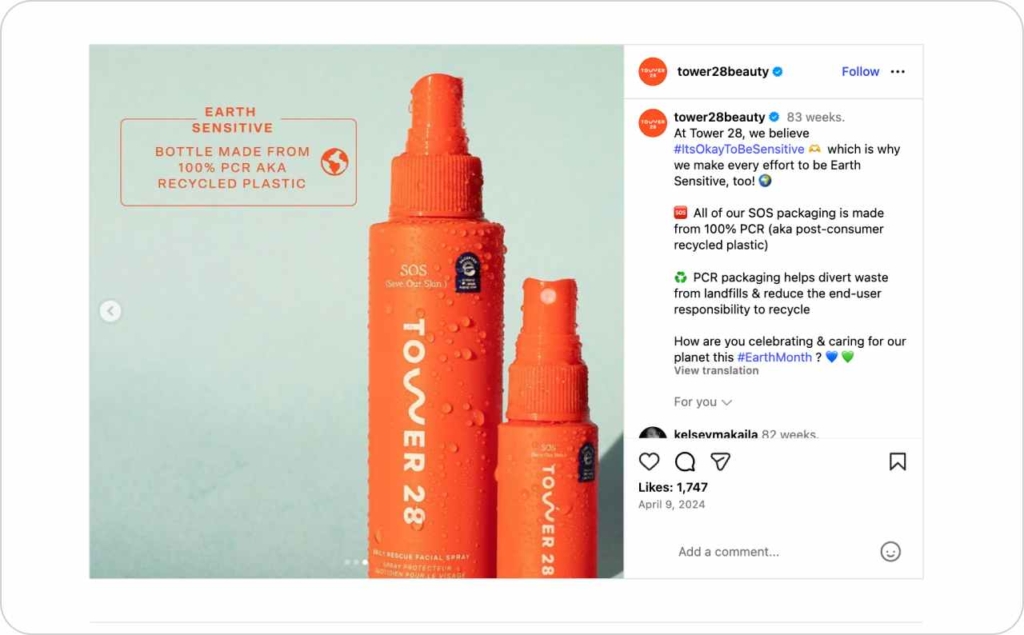
Photo source: @tower28beauty on Instagram
Glow Recipe — turn TikTok traffic into instant checkout
Glow Recipe built a native TikTok Shopping storefront so short clips could jump straight to purchase. The brand integrated Shopify, pushed shoppable videos, and used in-app product tiles to remove friction between UGC views and conversion.
Why it works
- Meets high-intent viewers inside TikTok’s feed
- Short demonstrations + storefront reduce drop-off
- First-time customers discover in social, then repeat on DTC/retail
How to use it in your advertising
Cut 10–12s demos that show texture and result. Tag the exact SKU in Video Shopping units. Retarget viewers with a routine bundle to lift AOV, and mirror the offer on your site for price parity.
COSRX — education-led TikTok that scales into Shop GMV
COSRX turned ingredient education into performance by running creator-led explainers and recurring hashtag challenges, then funneled attention into TikTok Shop and retailer pages. The brand’s TikTok case study and press updates show sustained scale and outsized view volume.
Why it works
- Clear concern → ingredient → proof narrative
- Always-on community challenges refresh UGC
- Shop integration closes the loop in-app
How to use it in your advertising
Script three micro-lessons per SKU: concern, demo, routine pair. Launch with creators who already answer skin questions. Pin product cards and run a follow-up live to convert browsers.
ManCave — “Budget burst” with in-feed video and display cards
Men’s skincare brand ManCave concentrated spend into a nine-day TikTok push using In-Feed Ads and Display Cards, rather than a long, thin flight. The compressed window created momentum and clear sales attribution.
Why it works
- Tight flighting spikes reach and recall
- Display Cards keep the offer visible during playback
- Easy to match to promo calendars and retail events
How to use it in your advertising
Pick one tentpole week. Cut three hooks for the same offer. Use Display Cards with a single CTA. Post-campaign, retarget engagers with a “routine stack” carousel to lift attachment rate.
Black Girl Sunscreen — education as acquisition, parents as influencers
Black Girl Sunscreen leans into sunscreen education and community storytelling across social and retail, with the founder spotlighting norms and habits that drive daily SPF use. The brand frames parents as credible messengers for Gen Alpha/Gen Z and builds trust before the click
Why it works
- Behavior change narrative (daily SPF) → repeat purchase
- Founder voice humanizes science and shade concerns
- Community advocates outperform generic influencers
How to use it in your advertising
Pair 8–10s “why SPF daily” clips with creator testimonials shot outdoors. Use question overlays “Will it leave a cast?” and answer on-screen. Drive to a shade-inclusive PDP with a simple quiz.
Paula’s Choice — myth-busting with derms to win trust
Paula’s Choice ran a six-week TikTok campaign built around debunking skincare myths (#BeautyBeginsWithTruth), featuring board-certified dermatologists and 1,500 seeded creators. The tactic turned education into UGC skincare ads that felt native to TikTok.
Why it works
- Science-first clips lower skepticism for sensitive-skin and anti-aging claims
- Derm POV creates authority without heavy production
- Seeding builds social proof before paid amplification
How to use it in your advertising
List five myths your customers repeat. Script 10–12s derm answers with one proof point and a quick texture demo. Spark the best creator videos, then retarget viewers with a routine stack page.
Myra Philippines — Reels + Partnership Ads lift add-to-cart
Myra added Instagram Reels Ads and Partnership Ads to its Collaborative Ads mix to push skincare shoppers from social to cart. The brand ran creator-led videos, then amplified the best clips with paid placements across Facebook and Instagram. Result: a 3× increase in incremental add-to-cart events.
Why it works
- Creator credibility lowers friction for first purchase
- Reels captures discovery; Partnership Ads extend reach with the same asset
- Collaborative Ads shorten the path to retail checkout
How to use it in your advertising
Seed 3–5 creator clips around one concern. Promote the top two as Reels and Partnership Ads. Use Collaborative Ads to send buyers to a stocked retailer PDP and track add-to-carts.
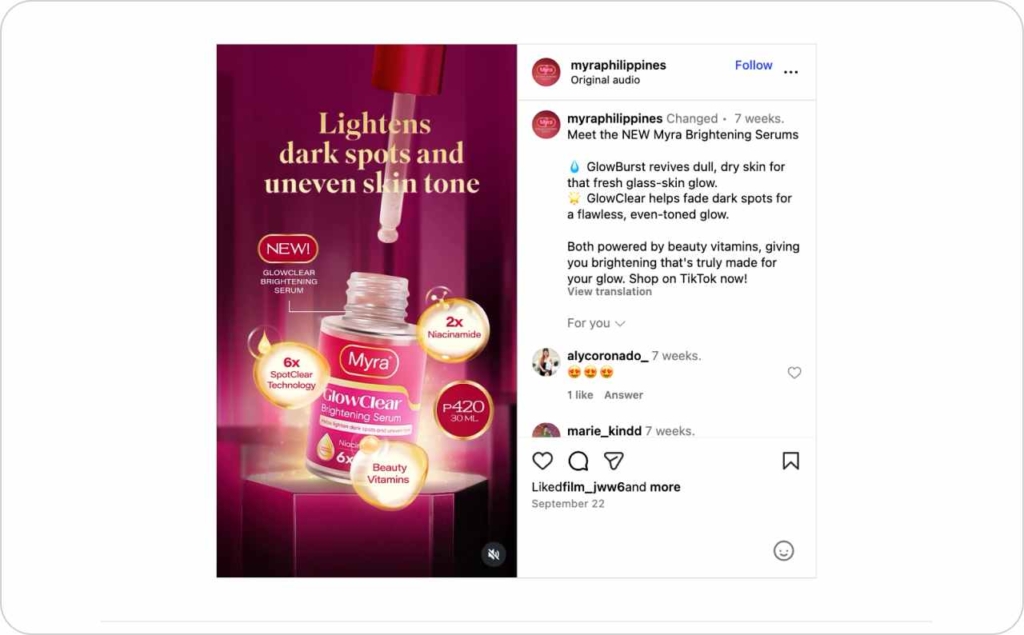
Photo source: @myraphilippines on Instagram
Amazon checkout via Meta ads — U.S. retail handoff for skincare
Meta and Amazon enabled U.S. shoppers to buy directly from Instagram/Facebook ads with live price, Prime eligibility, and delivery estimates. For skincare, this lets you convert IG interest into Amazon purchases without opening a browser tab.
Why it works
- Collapses discovery and checkout for Prime-accustomed buyers
- Adds trust (reviews/Prime) to new-to-brand skincare
- Improves attribution on retailer sales you already drive
How to use it on Facebook/Instagram
Run Reels and Feed ads that demonstrate one result, then deep link to Amazon checkout in-app. Mirror the offer on DTC for parity. Retarget product viewers with a “routine bundle” to lift AOV.
Supergoop! — Reels and shoppable video that follows the sun
Supergoop leans into seasonal SPF demand with video-first creative across Instagram, pairing short demos with shopping rails and influencer-led storytelling. The brand publicly credits Instagram/TikTok video as a growth driver in the U.S.
Why it works
- Seasonal messaging makes IG creative feel timely and useful
- Texture demos fit Reels behavior; product tags remove friction
- Consistent social video compounds recall
How to use it on IG/FB
Cut 8–12s texture clips for “daily SPF” and “sport/outdoor” use. Tag SKUs in Reels and posts. Mirror offers in DTC and retarget with a routine bundle.
Cetaphil — celebrity-led launch with science-first creative
Cetaphil’s new Skin Activator line launched with Mariska Hargitay as the face, emphasizing derm-developed formulas and fast results. Social assets and press seeded U.S. awareness and IG conversation around “hydrating and firming” benefits.
Why it works
- Celebrity story humanizes a science-based product narrative
- “Derm-developed” and sensitivity cues align with skincare buyer trust
- Clear benefit language fuels Reels hooks and captions
How to use it
Film 10s before/after-inspired clips with an on-screen benefit (“firmer in X weeks,” compliant wording). Use creator close-ups and pin product tags to the exact variant.
Psychology behind great skincare ads
Skincare ads persuade when they raise self-confidence and show real transformation. Anchor each creative to one concern and one outcome. For acne ads, show a calmer face in daily settings. For anti-aging ads, show smoother texture in natural light. For hyperpigmentation, show tone evenness across multiple skin tones.
Use visual language that reads as truth. Soft, natural tones. Macro close-ups of product textures on real skin. Gentle routine motions with hands in frame. Avoid glam lighting that erases pores. That gap breaks trust.
Let copy balance science and empathy. One benefit and one proof line is enough: “dermatologist tested,” “clinically shown in four weeks,” or “91% saw improved hydration,” with compliant wording. Then a clear action.
Audience behavior and spend signal matter. Nielsen’s 2025 report shows Asian American, Native Hawaiian, and Pacific Islander audiences are reshaping digital media and beauty trends, with strong skincare spending and high digital engagement. Build creatives that meet these behaviors in short-form video and shoppable feeds.
What are some common mistakes in skincare advertising?
Overpromising results. Ads that promise “instant cure” or “wrinkle-free overnight” break trust and invite regulatory trouble.
Ignoring skin diversity. Showing only one tone, type, or age makes ads feel out of touch. Audiences expect inclusivity, especially in beauty ads.
Over-polished visuals. Filters and glam lighting erase pores and texture. Skincare ad examples that look too perfect make proof shots feel fake.
Skipping proof. Without dermatologist-backed claims, clinical wording, or clear before/after content, credibility collapses fast.
Weak calls to action. Generic CTAs like “Learn more” stall conversions. UGC skincare ads that close with direct actions — “Shop now,” “See results,” “Try it free” — guide people clearly.
Answer: The best skincare advertising avoids these traps. Each ad focuses on one concern, one outcome, and one proof point. That simple formula feels authentic, stays FTC/FDA safe, and turns short social clips into ads people trust and act on.
Skincare ad tips for brands
UGC ads vs. traditional ads. Run both side by side. Launch three UGC skincare ads against one polished traditional studio cut per SKU. Let the numbers decide — CTR, saves, and adds to cart. Switch hooks every week to keep attention fresh.
Target by concern, not by age or gender. Acne, aging, hydration, hyperpigmentation, SPF — each needs its own creative. Acne ads earn trust with clear before/after carousels. Anti-aging works best with dermatologist-backed POV. Sunscreen ads win when they show a real finish in daylight.
Show results the eye can confirm. Hydration? Capture same-day texture shots. Sunscreen? Time-lapse protection outside. Retinol? Weekly progress in identical lighting. Always pair with on-screen disclaimers so your skincare advertising stays FTC/FDA safe.
2026 priorities. HubSpot’s latest report shows paid social and social shopping tools are now top ROI drivers for B2C brands. Skincare marketers should lean into shoppable formats — Catalog Ads, product tags, and direct retail handoffs — to shorten the path from scroll to checkout.
CTAs matter. Keep them simple and specific. “Shop now” for bundles. “See results” for before/after pages. “Try it free” for samples or minis. Match pricing and stock across PDPs, Instagram Shop, and retail so buyers never hit a dead end.
UGC vs. studio ads in skincare advertising
| Format | Strengths | Trade-offs | Best use case | Example creative |
| UGC skincare ads | Feel authentic, blend into TikTok/Instagram, lower cost, high engagement | Quality varies, less brand polish | Early funnel, building trust, social proof | Creator diaries, acne patch routines, everyday skin checks |
| Studio beauty ads | Crisp visuals, strong branding, controlled story | Higher cost, can feel less relatable | Product launches, premium lines, retail campaigns | Macro texture demos, dermatologist clips, clinical before/after shots |
Why do you need an AI ad generator for skincare ad creation?
Skincare is one of the most competitive categories in beauty. Every brand runs campaigns across Instagram, TikTok, Meta, and YouTube — yet most ads look alike. To stand out, you need a constant stream of high-converting ads built around proof, speed, and relevance. That’s where the Zeely app, an AI ad generator, comes in.
Advertisers who uploaded both video and image assets to Demand Gen saw 20% more conversions at the same CPA than those who uploaded video only. This is why Zeely helps automated ad creation. It generates static ads, short-form video ads, and even full campaigns from a single product link. No editing background, no agency overhead. Just plug in your skincare product and get ads that fit TikTok, Instagram Reels, Meta Feeds, and YouTube Shorts.
You may also like

Benefits of using Zeely’s AI ad generator for skincare ads
- Save time: Generate ad-ready creatives in under a minute
- Boost ROI: Create high-converting skincare ads tailored to acne, aging, or hydration concerns
- Scale easily: Produce dozens of ad variations at once to test hooks and formats
- Automated video ads: Build UGC-style demos, dermatologist POV clips, and before/after carousels with AI scripting
- Seamless Meta and Shopify integration: Push ads directly into Meta Ads Manager and sync with Shopify for consistent pricing and inventory
- Data-backed creative testing: Launch multiple versions, track CTR and saves, then keep scaling winners
- Simple workflow: From URL input to export, every step is streamlined for marketers without design or editing skills
An AI ad generator is no longer optional in skincare marketing. It keeps your brand visible in crowded feeds, ensures fresh creatives before fatigue sets in, and helps you build trust with clinical proof and real-life demos. The Zeely app gives you that edge — fast, scalable, and easy to use.
Ready to simplify your ad creation and see results? Zeely makes it effortless.