20 technology ads examples worth studying in 2026
What are the best technology companies doing with their ads right now? I broke down 19 campaigns from 2025 and 2026, from Super Bowl spots to AI-generated commercials, and pulled out the creative decisions worth stealing.
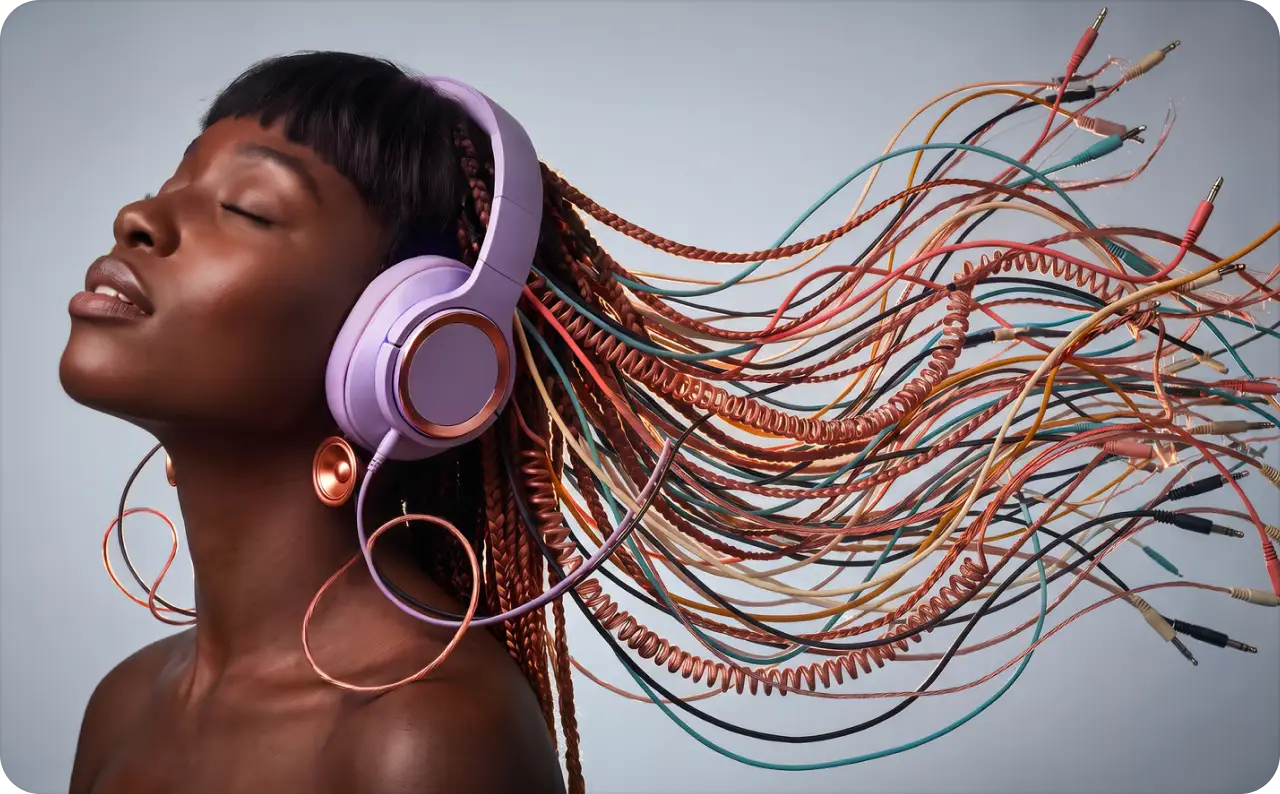
Technology advertising has a basic problem. The product is usually invisible. Try photographing a cloud migration. Try putting a face on an AI assistant. A privacy setting lives in a menu. A SaaS dashboard is rectangles on a screen.
Key takeaways
- One feature per ad, shown through a scene the viewer already knows. Google filmed a dad rehearsing for a job interview with Gemini. Apple just gave people the phone and published the photos. Zero specs mentioned in either
- The big AI labs opened their wallets. OpenAI bought Super Bowl time. Anthropic bought Super Bowl time. Google and Microsoft ran sustained campaigns across TV, streaming, print, and OOH. Not one of them led with the technology itself
- AI-generated ads went from novelty to production method. Kalshi ran a fully AI-generated spot during the NBA Finals. Samsung caught backlash for AI social ads with obvious quality problems. Adobe shot its own campaign using nothing but Firefly
- The B2B entries that named a customer problem outperformed the ones that named a product category. HubSpot’s “you use 20% of your data” hits harder than any CRM features page
- Duolingo killed its mascot on social media. 47 million views on one X post. Netflix, the WHO, and dozens of other brands played along. Total paid media spend on the stunt: zero
The 19 ads below all solved that problem differently. For a closer look at how AI is changing advertising production, my guide covers the tools side. Every example is from 2025 or 2026. Not every approach will fit your business, but every entry has at least one creative decision worth taking.
AI company brand campaigns
OpenAI, Anthropic, Google, Microsoft. All four started running real ad campaigns in 2025 and 2026. The shared problem: most people have never touched the product, and plenty of them do not want to.
1. Apple: Shot on iPhone
Ten years old in 2025. Grand Prix for Creative Effectiveness at Cannes the same year. Still going in 2026 with two fresh executions. “Shot on iPhone Duo” commissioned professional photographers and launched in October. “Kairo” let concert attendees film Berlin duo Brutalismus 3000 entirely on iPhone 17 Pro Max, then TBWA\Media Arts Lab London stitched the footage into one continuous music video. August 2026.
The idea has not moved in ten years. Prove the camera by showing what real people do with it. No voiceover about megapixels. Just the output. That simplicity is why it still works.
2. Google: Gemini Dream Job
Google bought a 60-second Super Bowl LIX slot for a spot about a father using Gemini Live on his Pixel 9 to practice for a job interview. He draws on his parenting experience as transferable skills. The longer cut runs past two minutes on YouTube. Henry-Alex Rubin directed. Smuggler produced. Google also quietly ran 50 local 30-second ads, one per state, each showing a small business using Gemini.
The AI is not the point. The father is. Gemini just helps him get where he already wants to go. That framing sidesteps the biggest problem in AI advertising right now: people find the technology more threatening than helpful.
3. OpenAI: ChatGPT brand campaign
Late September 2025, OpenAI put its first real brand campaign into the world. OOH, TV, streaming, social. US, UK, Ireland. In “Pull-up,” a guy finally nails his fitness goal after following a ChatGPT workout plan. In “Dish,” a couple pulls off an impressive dinner for a date night using a ChatGPT recipe. Director Miles Jay shot both on 35mm film through Smuggler. OpenAI’s in-house team built the campaign with agency Isle of Any. Samuel Bradley handled the OOH photography. Placements included NFL Primetime, ITV, Sky, Channel 4, and Piccadilly Lights in London.
Trade press called it OpenAI’s first large-scale brand campaign. OpenAI had every reason to show ChatGPT curing diseases or writing code. They went with a pull-up and a dinner recipe. Daily habit, not science project.
4. Anthropic: Keep Thinking
Anthropic went first with “Keep Thinking” in September 2025. Mother made it. Daniel Wolfe directed the 90-second hero film through Love Song Films. The premise: Claude is a thinking partner, not a shortcut. The ad followed coders, researchers, and creative workers actually using it. It ran during live sports, on Netflix and Hulu, in the Times and the Journal, and across OOH featuring real Claude users. Initiative handled media.
Then came February 2026 and the Super Bowl. Four satirical spots directed by Jeff Low through Biscuit Filmworks. Each one parodied an AI chat getting derailed by targeted ads. The line: “Ads are coming to AI. But not to Claude.” Sam Altman called the ads “clearly dishonest” on X, which only pushed them further.
Anthropic built the entire creative around a single product decision: no ads in Claude. September established the brand. February turned that position into the punchline.

SaaS and software ads
Same invisibility problem as AI, plus a bonus: nobody cares about productivity tools until something breaks.
5. HubSpot: All the data
Arts & Letters Creative Co. built HubSpot’s 2025 campaign around one claim: most businesses use only 20% of their data to make 100% of their decisions. The spots hit YouTube, Netflix, Hulu, Amazon Prime Video, Paramount+, LinkedIn, and DAZN. They also papered San Francisco with more than 700 OOH boards during Inbound, HubSpot’s annual conference.
One statistic. One knowledge gap. That is the entire creative. HubSpot could have listed CRM features. Instead they found a number that makes every business leader feel slightly behind.
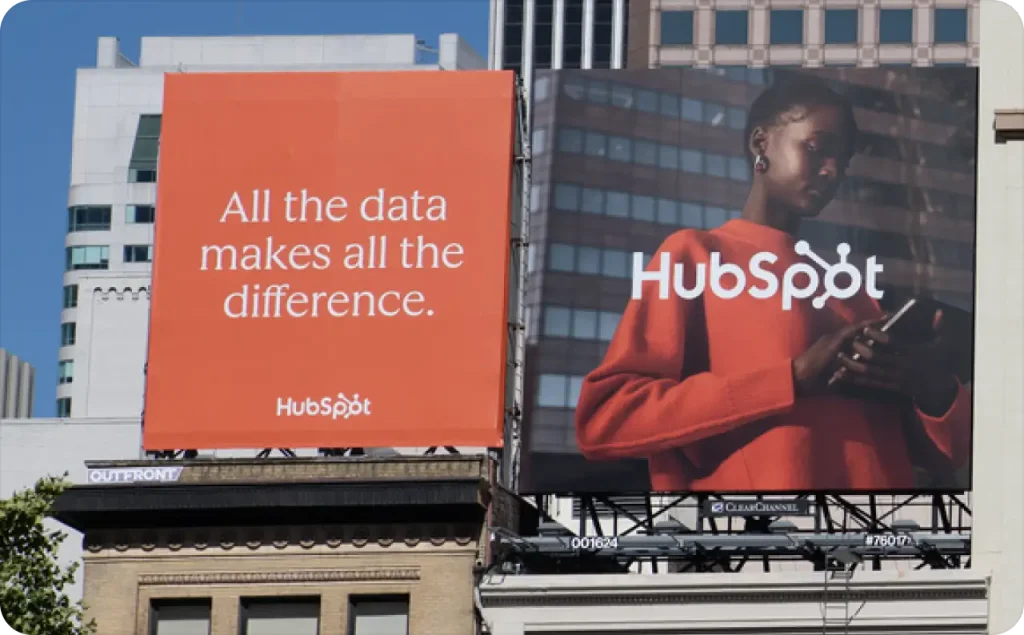
Photo source: MediaPost
6. Squarespace: A Tale As Old As Websites
Barry Keoghan rides through the Irish countryside delivering websites door to door like a newspaper boy. Steve Rogers directed. Squarespace’s in-house team created the whole thing. There is also an extended cut, a few shorts of Keoghan helping local businesses, and a separate comedic film called “Barry and Moseley.”
Eleven years in a row at the Super Bowl. That streak is its own strategy. Squarespace no longer needs to explain what it does during the game. It can just be entertaining.
7. GoDaddy: Act Like You Know
GoDaddy came back to the Super Bowl after disappearing for eight years. Walton Goggins walks viewers through GoDaddy Airo by launching a completely fictional eyewear brand on camera. “Walton Goggins Goggle Glasses.” The AI tool builds logos, a website, and social content while Goggins watches. Quality Meats Chicago produced it. Cannes gave it the Grand Prix for Creative B2B in 2025.
Goggins at one point says he has no idea what he is doing, but GoDaddy Airo does. Every small business owner has felt that exact thing. Wrapping a product demo inside a comedy performance is genuinely difficult, and the Cannes jury clearly thought they pulled it off. If you want to study how a single line of copy can do that much work, our scroll-stopping hooks guide breaks down the mechanics.
8. Zoom: Zoom Ahead
Bowen Yang from SNL plays a dictatorial IT manager who insists on a terrible meeting tool while employees stage a rebellion. Colin Jost’s production company No Notes made it with director Mike Diva. The ad references Apple’s 1984 spot and Dead Poets Society. First aired New Year’s Eve during the College Football Playoffs. Ran again during the Super Bowl pre-show in February 2026.
Zoom pivoted from selling to IT buyers to selling directly to the people who actually sit in meetings. And they officially used “Zoom” as a verb for the first time in their advertising. Rather than fighting what everyone already says, they leaned into it. For more campaigns that nailed the format choice, see our curated video ads examples.
B2B and enterprise technology ads
Most enterprise tech ads talk to a conference room. The one below talks to a guy fixing cars. That choice is the whole lesson.
9. Microsoft: Copilot small business series
Panay Films followed small business owners using Copilot AI in their actual work. First up was “Pete,” an auto shop owner trying to manage parts costs, which went live globally on June 11, 2026. Then “Hank,” “Jimmy,” “Georgia,” and “Erin,” each running a different kind of business. Hulu and Paramount+ carried the placements.
No corporate conference rooms. No enterprise jargon. Just Pete trying to keep his auto shop profitable. The series format is the smart part: Microsoft gets to show Copilot doing five different jobs across five episodes instead of speed-running all of them in one 30-second spot nobody retains.
Consumer electronics and hardware ads
Hardware has one built-in advantage over software: you can hold the product.
10. Samsung: Galaxy S26 AI social ads
Samsung pushed social ads for the Galaxy S26 with the tagline “Can your phone do that?” aimed at iPhone users. The ads promoted AI features like Nightography video brightening. Then people noticed the ads themselves looked AI-generated. Rendering artifacts. Uncanny textures. The backlash spread quickly.
Your ad promises incredible AI. The ad itself looks like it was made by mediocre AI. That contradiction kills the message before the viewer finishes reading the first line. Have someone outside your team look at AI-generated creative before you publish it.
11. Google: Pixel 10 Soon
This pre-launch Pixel 10 ad asked a pointed question: “If you buy a new phone because of a feature that’s coming soon… but it’s been coming soon for a full year… you could change your definition of soon. Or you could just change your phone.” Apple is never named. Everyone knows who Google means.
Most competitive ads sound desperate. This one does not, because Google is pointing at something Apple’s own users have noticed: Apple Intelligence keeps getting pushed back. That is not an opinion. It is a fact you can verify on Apple’s own support pages.
12. Ray-Ban Meta: You Ain’t Seen Nothin’ Yet
Global campaign for Ray-Ban Meta Gen 2 smart glasses. Doja Cat and Teyana Taylor star. Lope Serrano directed. William Arcand shot the stills. Larkin Seiple and Chris Ripley handled cinematography. You see hands-free photos being taken mid-dance. Live Translation happening in conversation. Meta AI answering questions on the move. A Times Square billboard just says “HEY META, TAKE A PHOTO.”
Try selling smart glasses. They look like regular glasses. Nothing about them screams “I have a computer on my face.” So Ray-Ban and Meta stopped trying to explain and just showed people wearing them while doing interesting things. The technology disappears into the lifestyle.
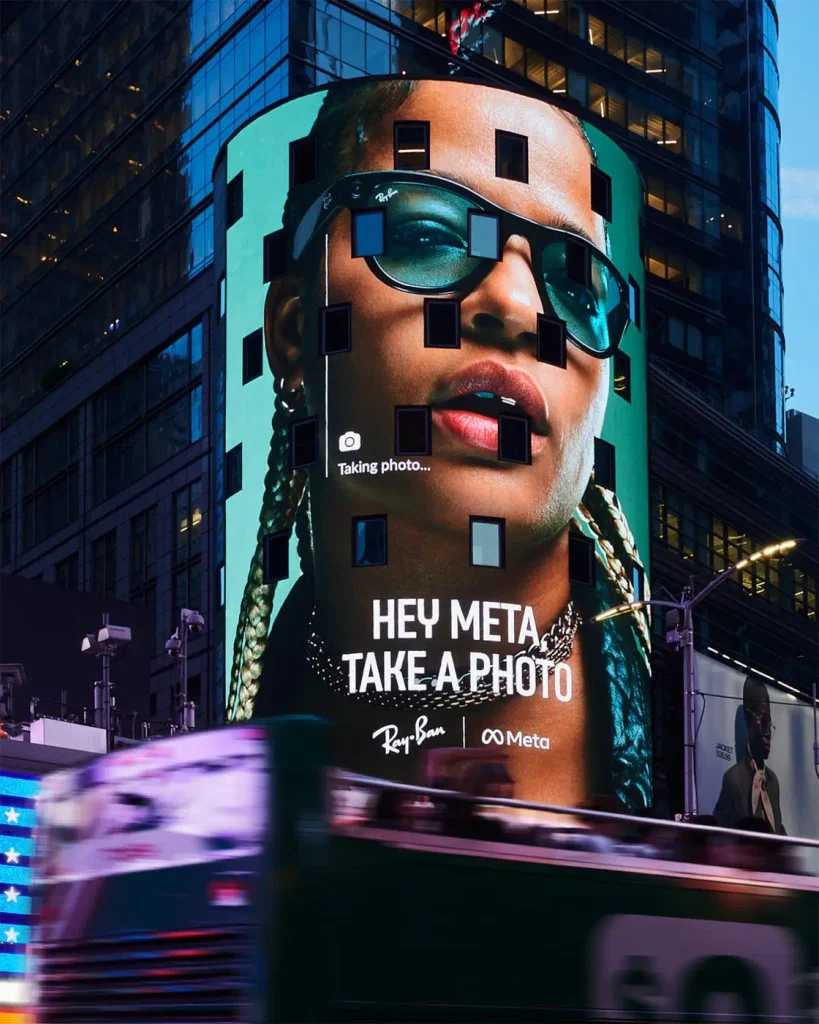
Photo source: Visie
13. Nothing: Phone 3 mixed reality print
Nothing ran a newspaper ad in the UAE’s Khaleej Times on August 6, 2025. Print ad with a QR code. Scan it and the Nothing Phone 3 pops out of the page in augmented reality, transparent back panel and all. Flam agency in India made it.
One market. One newspaper. One clever idea. Creative innovation does not require a Super Bowl budget. AR and print is a combination most brands overlook.
Video source: Ads of the world
Gaming
Gaming ads have one unfair advantage: the product already looks cinematic. PlayStation used that to blur the line between what happens on screen and what shows up in your city.
14. PlayStation: It Happens on PS5
Adam&eveDDB built Sony’s global holiday campaign around impossible moments from PS5 games bleeding into the real world. A truck on top of a skyscraper. Monstrous creatures loose in a city street. Three hero spots went out in over 20 countries. TV, cinema, billboards, digital, social.
Then came the physical activations. A life-size crashed spaceship in Brisbane. Another spaceship in Madrid’s Puerta del Sol station. Mysterious creatures appearing in cities across Mexico, Italy, and the UK. The installations generated their own social content and press coverage, extending the campaign well past the paid media.
Fintech and crypto ads
Money makes people nervous. Try running an ad that asks someone to trust you with theirs.
15. Coinbase: Everybody Super Bowl
A karaoke ad reworking the Backstreet Boys’ “Everybody” to sell crypto as a mainstream thing now, not a niche experiment. Coinbase also took over Times Square and lit up the Sphere’s Exosphere in Las Vegas.
Four years after their silent QR code Super Bowl stunt, Coinbase went the opposite direction: loud, celebratory, mass market. Same company, totally different creative strategy, both right for their moment.
16. Kalshi: AI-generated NBA Finals ad
Prediction market Kalshi bought a 30-second slot during the YouTube TV stream of Game 3 of the NBA Finals on June 11, 2025. AI filmmaker PJ Accetturo made the entire commercial with Google’s Veo 3. The result is deliberately unhinged: AI-generated characters in surreal scenarios making picks for the NBA title. Accetturo said he was hired to create “the most unhinged NBA Finals commercial possible.”
Accetturo told reporters the production cost was approximately $2,000. Kalshi would not confirm the figure. Several outlets called it the first entirely AI-generated commercial during a major US sporting event, though earlier ads had used AI tools in production.
Kalshi did not pretend the AI video looks real. They told the filmmaker to make it weird on purpose. Samsung’s AI artifacts felt like a mistake. Kalshi’s felt like the whole point. For a deeper comparison of when AI creative works and when it does not, read AI UGC vs real UGC.
Apps, platforms, and creator tools
Apps live on your phone. The best app ads live on your feed. These three turned their product into a social moment people wanted to share, not skip.
17. Duolingo: Death of Duo
February 11, 2025. Duolingo announced on X and Instagram that its owl mascot Duo was dead. The app icon changed to show Xs over the owl’s eyes. A separate video showed a Tesla Cybertruck hitting the mascot. A Duolingo spokesperson confirmed to CBS News that yes, this is a marketing campaign.
Then the internet did its thing. Netflix, Crunchyroll, the World Health Organization, and dozens of other brands jumped in publicly. Dua Lipa posted “Til’ death duo part” on X. The original announcement pulled over 47 million views in a day. Duolingo then added a twist: a public tracker at bringback.duolingo.com challenged users to collectively earn enough XP through lessons to resurrect the owl. Duo came back on February 24. “Legends never die.”
The resurrection mechanic is the part worth studying most carefully. To bring back the mascot, users had to do exactly the thing Duo always nagged them about: finish a lesson. The campaign created entertainment and product usage at the same time. If social-first creative is your focus, my TikTok ad hooks guide covers native openers for short-form platforms.
18. Spotify: Wrapped 2025
Wrapped went bigger in 2025 than any previous year. A “visual mixtape” design referencing pre-streaming analog culture. Fifty physical “fan destinations” around the world: a giant paw on Copacabana Beach for Lady Gaga fans, an 800-foot red hair cascade in Union Square for Chappell Roan fans. More than 30 markets. FC Barcelona partnership.
Wrapped requires almost no paid media. Users share their results because the results say something about their identity. Spotify did not build a campaign for people to watch. They built a campaign people participate in.
19. Adobe: Firefly product campaign
Adobe shot its campaign video using only Firefly. Every clip, every visual, every element came from the AI tool being advertised. The tagline they landed on: “The world is what you make it.”
If the video looks good, Firefly made it. You just watched a live demo disguised as an ad. If the video looks bad, well, that is also a demo. Adobe bet that it looks good. When your product creates visual output, letting the product speak for itself beats explaining it every time.
20. A Zeely example: Try it for your ad
Here is a 15-second video ad for wireless noise-cancelling earbuds, built inside Zeely AI.
What this video does for your business:
- Stops the scroll in under 3 seconds. The visual shift from a noisy coffee shop to total calm is instant and obvious. Your viewer decides to stay before they turn the sound on
- Works on mute. Most people watch Meta feed video without audio. The noise-to-silence transition reads entirely through the visuals, so the ad performs whether the sound is on or off
- Shows the product at the right moment. The earbuds appear at 7 seconds. Early enough to hold attention. Late enough that the viewer already feels the problem and wants the solution
- Proves the benefit without saying it. Four quick scenes, coffee shop, train, plane, office, show the earbuds working in every environment. Your viewer draws the conclusion themselves. People trust what they figure out more than what they are told
- Closes without a word. The earbud-out moment at the end restates the entire product benefit in three seconds. Noise floods back. She puts the earbud in. Smiles. No voiceover needed
- Converts on the final frame. The $79 price and “Shop now” appear at the end, giving the viewer a reason to act immediately instead of saving the post and forgetting about it
To build this in Zeely: import the product page. Zeely pulls in images, name, price, and description. Write the scene prompt describing the coffee shop setting, the noise-to-silence transition, and the quick-cut locations. Choose the AI model and resolution. Generate the start image, review it, then render the full video. Add captions, headline text, and the price CTA. Launch the Meta campaign directly from Zeely.
What separates good technology ads from forgettable ones
Pick one thing. Apple proves camera quality. Google shows AI through a human story. The ads that try to communicate “platform” or “ecosystem” or “suite” tend to vanish. Your viewer has one thumb and a lunch break. Respect both.
Put the proof inside the creative. The strongest ads carry their evidence visually. A side-by-side photo. A physical installation you can walk past. An ad that claims results without showing them reads like marketing. An ad that shows results reads like proof.
Do not pick a format by habit. HubSpot needed one number on a billboard. Google needed two minutes to tell a father’s story. Duolingo needed X and Instagram because that is where its users already scroll. I have watched too many brands pick “short-form vertical video” because it worked last quarter, not because it fits what they need to say right now.
Sources
- Cannes Lions — Creative Effectiveness Grand Prix
- 9to5Google — Pixel 9 Gemini Live Super Bowl ad
- LBBOnline — Isle of Any and OpenAI ChatGPT brand campaign
- Creative Review — Anthropic Claude Keep Thinking campaign
- MediaPost — HubSpot All the data campaign
- iSpot.tv — GoDaddy Act Like You Know Super Bowl ad
- CreativeBloq — Samsung Galaxy S26 AI social ad backlash
- PhoneArena — Google Pixel 10 Soon competitive ad
- PlayStation Blog — It Happens on PS5 campaign
- Coinbase Investor Relations — Everybody Super Bowl campaign
- eWeek — Kalshi AI-generated NBA Finals ad
- CBS News — Duolingo owl mascot death campaign
- Spotify Newsroom — Wrapped 2025 campaign
- The Guardian — H&M AI digital twins of fashion models
- CrowdStrike — Charlotte Super Bowl press release
- Klarna — Snoop Dogg Smoooth Dogg press release
Fact checked by Anastasiia Stovpova
FAQs
Turn the invisible thing into something you can see. Apple showed strangers physically following a man to explain data tracking. Google put a nervous dad on screen to explain Gemini. Nobody read a spec sheet in either ad.
Start with what the person feels, then show the feature fixing it. Google’s Super Bowl ad is really about a father’s anxiety, not about Gemini. Save the feature-first approach for buyers who already know what they want and are comparing two products side by side.
Depends entirely on the message. HubSpot bought 700 billboards for one statistic. Duolingo faked a death on X. I cannot give you one answer here because nobody can. More format examples in my Facebook video ads guide.
OpenAI, Anthropic, Google, and Microsoft all ran big campaigns in 2025 and 2026. The pattern I noticed: every single one led with what a person did using the tool, not with the tool itself.
The guy who made Kalshi’s NBA Finals spot says it cost him $2,000. You do not need a big budget. You need better creative tested faster. Zeely handles production and campaign launch without an agency in the middle. See my Instagram ad examples for proof that smaller brands win on quality, not spend.