Is Zeely worth it in 2026? AI for small businesses
If you are wondering whether Zeely is truly worth it in 2026, you’re not alone. I break down what the data shows, how AI ads perform this year, and which types of businesses see the most value from using Zeely.
Zeely is worth it if you rely on social ads to get customers. It helps you make good ads fast and launch campaigns without outside help. If you already spend $500–1,000 a month on ads, the time saved and extra testing can pay for the tool quickly. If ads aren’t a big part of your business, you may not need it yet.
AI marketing tools exploded in 2026. Most “best AI tools” lists throw 20+ platforms at you and still do not answer one simple thing: is a specific tool worth it for you.
Here I look at Zeely as an AI ad creative and advertizing platform, not as a generic AI toy. I use Zeely’s own data, real customer results, and fresh 2026 benchmarks to show when Zeely pays off and when another tool might fit you better.
Before you read on, do this: write down your current average CTR. If you do not have them, write “I don’t know yet.” We will come back to this at the end.

How to decide if an AI marketing tool is “worth it” in 2026
When people ask me “Is Zeely worth it,” they often skip one step. They never define what “worth it” means for their business. So I start here, before talking about any features.
In 2026, AI marketing is not fringe anymore. Global AI marketing spend is estimated around $47.3 billion, and about 88% of marketers say they use AI in daily work according to seo/com. That means you are not testing a toy. You are deciding which AI tools actually move your numbers.
For any AI marketing tool, including Zeely, I look at three pillars:
- Revenue lift
- Time saved
- Risk and learning curve
If a tool does not give you something clear in at least two of these, it will feel like a cost, not a lever.
Key value pillars: Revenue, time, creative output
Let’s make this practical.
When I say revenue lift, I usually mean: at least a 20–30% improvement in one of these within 30–60 days of focused use:
- Higher CTR – how many people click after seeing your ad
Time saved is the second pillar. Many Zeely users tell us they used to spend entire evenings editing videos or begging freelancers for edits. With AI tools, I look for at least:
- 50–70% less time on creative production
- More ad variants per week without overtime
The last pillar is creative output quality. With AI ad tools, “worth it” often means:
- You can launch 5–10 decent variations quickly
- You finally test hooks, visuals, and audiences instead of reusing one “safe” ad for months
If Zeely cannot help you move at least one of those pillars, it is not the right tool for you.
Risks specific to AI ad tools and how to mitigate them
AI helps you move faster, but it also makes it easier to move fast in the wrong direction. Here are common risks I see:
- Generic creatives: AI can produce ads that feel polished but not specific to your audience
- Policy issues: Platforms like Meta and TikTok reject ads that break their rules. An AI tool will not magically bypass that
- Over-automation: If you never review creatives or results, you can burn budget while thinking “the AI will fix it”
- Data and tracking gaps: Without proper tracking, you cannot tell if your “smart” ads actually sell
Simple safeguards:
- Start with limited test budgets for 2–4 weeks
- Keep manual review in place. You still approve creatives and final targeting
- Make sure your tracking is set up for CTR before you trust any tool
You will see me use this same lens later when I talk about Zeely’s real-world performance. Read our detailed article on why Zeely is NOT a scam.
Zeely in one minute: What it is and who it’s built for
Let me put Zeely in plain words.
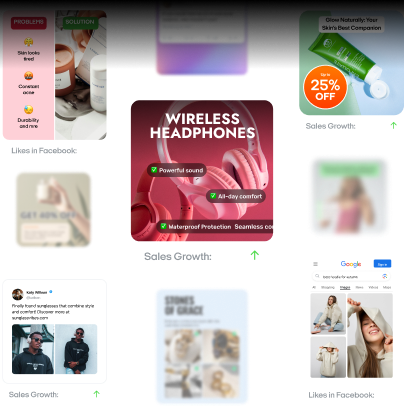
Zeely is an AI ad creative and campaign automation platform. It generates UGC-style video ads, static ads, and helps you launch and optimize campaigns on Facebook, Instagram, TikTok, and Google from one place.
You give Zeely a product link or basic info. The app pulls images and text, builds scroll-stopping creatives with AI video avatars and templates, and guides you through launching campaigns that AI then monitors and adjusts.
Who it is built for:
- DTC e-commerce and dropshippers who live on social ads
- Shopify and other online store owners who need constant fresh creatives
- Small agencies and marketers who manage multiple accounts without a big in-house studio
Who it is not mainly built for:
- Email-only businesses that almost never run ads
- Complex B2B funnels with multi-step lead scoring and sales teams
- Enterprises that need a full CRM and custom data pipelines
This matters because you cannot judge “worth it” without asking “worth it for whom.”
Best-fit users: Small businesses, e-commerce & agencies
Here is how I see the best-fit profiles.
- New Shopify owner with under $5k per month in ad spend
You do not have a creative team, but you need TikTok and Instagram ads that do not look homemade. Zeely gives you templates and avatars so you can launch fast and test.
- Growing DTC brand with 5k–30k dollars per month in ad spend
You already run ads, but creative production is a bottleneck. Zeely boosts creative volume and testing so you can find more winners without paying extra editors.
- Boutique agency with 5–15 e-commerce clients
You handle strategy and reporting, but you need a faster way to produce client creatives and variations. Zeely becomes your creative and testing engine.
In most of these cases, I start recommending Zeely when you are already spending at least $500–1,000 per month on ads and are ready to test multiple creatives per product or offer.
What Zeely actually replaces in your marketing stack
Let’s talk about your stack. Most owners I talk to use a messy mix of:
- Canva or similar design tools
- A freelance video editor
- Meta Ads Manager, Google Ads, TikTok Ads
- A notes app or spreadsheet for “ideas”
Zeely is designed around three jobs:
- Creative studio for video and static ads
- Media buyer for building and optimizing campaigns
- Testing lab for running many creative variations without drowning in files
On the homepage and feature pages, Zeely highlights over 650,000 businesses using the platform. These are claimed averages, not guarantees, but they give you a sense of what the tool aims to replace. Read this article where Zeely is explained in a complete guide.


Creative studio: UGC-style video & static ads
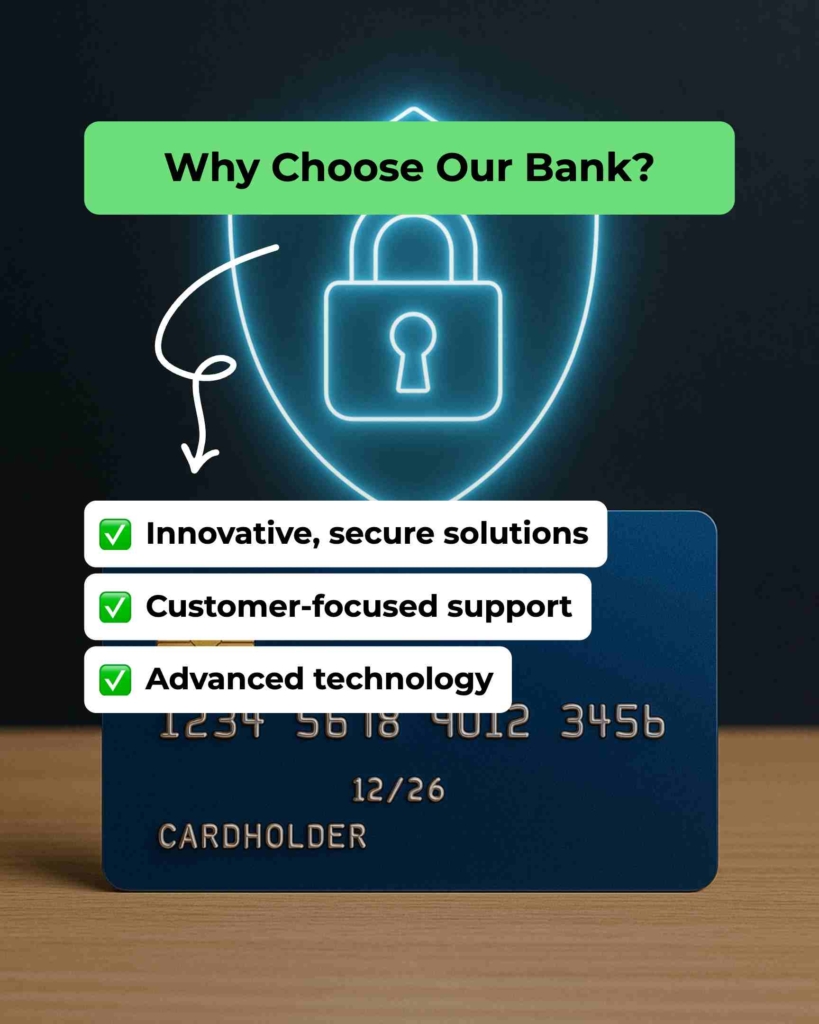
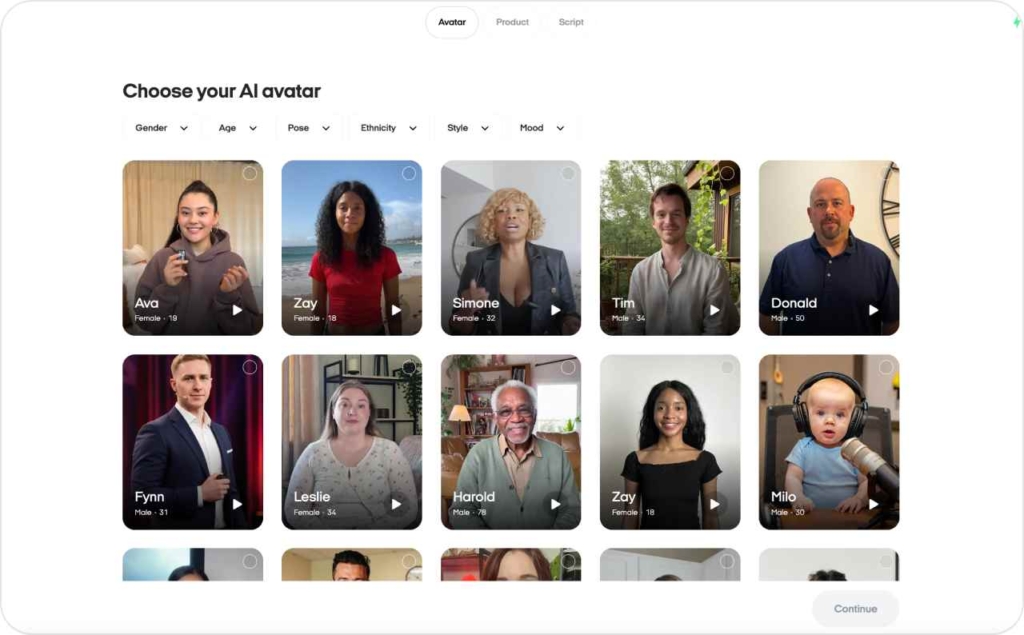
Zeely pulls your product data and lets you pick from UGC-style video templates and static ad layouts. You can plug in AI avatars, AI scripts, captions, and product scenes without filming.
Compared to traditional editing tools, the advantage is not Hollywood quality. It is speed and volume.
In a typical session, you move from “no assets” to several video ads and static variations in under an hour. For most small businesses, that is already a 5x improvement in creative throughput.
Always-On Media Buyer: Campaign Setup, Targeting & Optimization
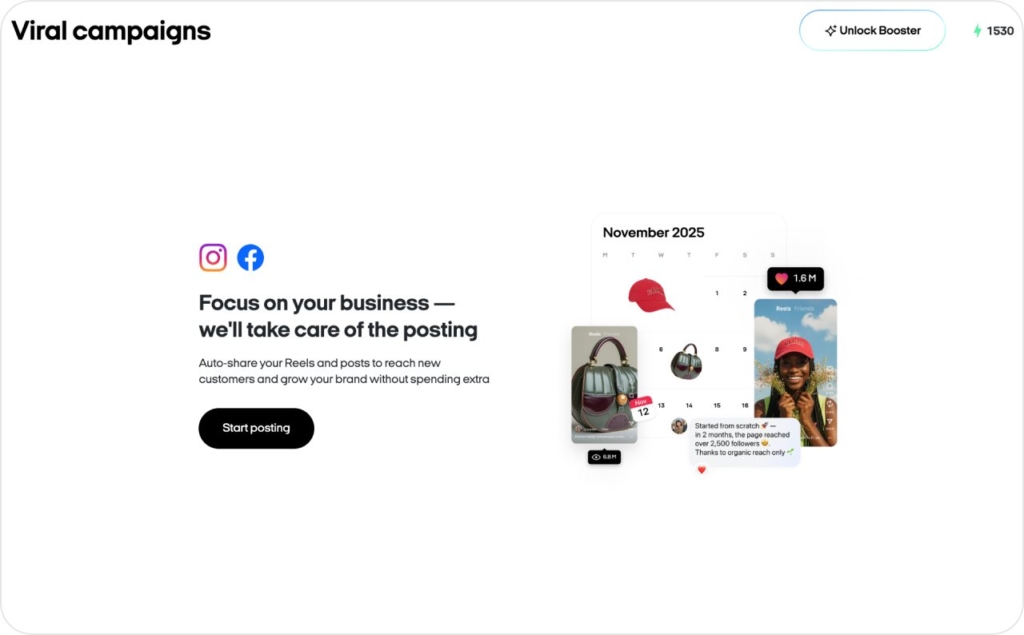
Once you have creatives, Zeely helps you set up campaigns on Meta. You pick your goal, define budgets, and set audience targets – age, gender, location. The AI layer helps with bid ranges, and budget distribution, then monitors performance.
You still approve campaigns and can adjust, but you are not manually tweaking every setting.
I like to frame it this way: Zeely will not fix a bad offer, but it will stop you from wasting hours on setup screens.
Testing lab: Templates, bulk creatives & experiments
This is where many users see the biggest difference.
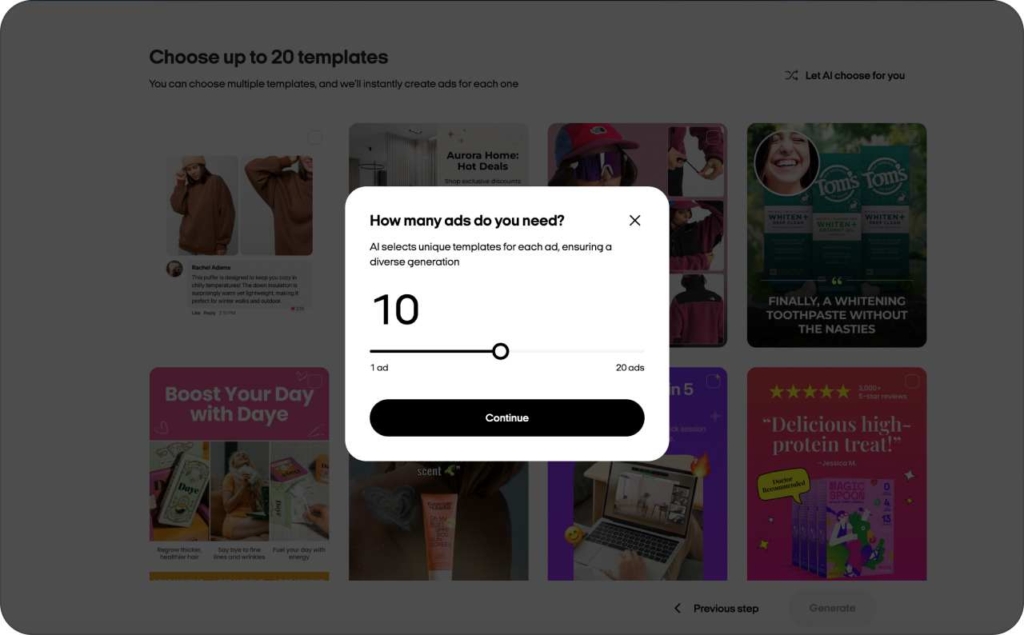
Zeely lets you generate multiple creatives from one product link, test up to 10 videos or static ads in a campaign, and quickly spin off new variants from winning templates.
More tests mean you find winning combinations faster. If your current process lets you test 2 creatives per week and Zeely gets you to 10, you increase your odds of hitting profitable angles without multiplying your workload.
How fast can Zeely pay for itself?
Zeely offers monthly and annual plans starting around $29/month, depending on your usage needs. See full pricing breakdown here for latest tiers and billing options.
A simple scenario.
- Your store spends $2,000 per month on ads
- Your current ROAS is 2.0 – you make $4,000 in revenue from that spend
- Your average gross margin is 40%
That gives you $1,600 in gross profit on those ads. If Zeely helps you raise ROAS from 2.0 to 2.4, that same budget brings $4,800 in revenue and $1,920 in gross profit. That is $320 extra.
If your Zeely plan costs less than that and saves you evenings of manual editing on top of it, the math starts to feel comfortable.
This is not a guarantee. It is a simple way to check “what needs to change for this to be worth it.”
Top-rated AI platforms for marketing automation in 2026
You will often see Zeely mentioned in the same breath as “AI marketing automation tools.” That is partly true. Let me explain.
In 2026, the AI marketing landscape has a few big groups:
- Creative and ad tools: Zeely, video generators, display ad builders
- CRM and email automation: tools like HubSpot, Encharge, Klaviyo that run email flows and customer journeys
- Analytics and attribution tools that help you read results: Google Analytics 4, Triple Whale, Northbeam, Mixpanel
- AI agents and workflow tools that glue everything together: Zapier AI, Make.com, Airtable AI, Notion AI, Shopify Sidekick, Microsoft Copilot
Most marketers I talk to do not use one platform. They use a stack. Zeely lives in the creative plus paid social ads slot.
Short-form video and social media have become some of the highest ROI channels, especially for Gen Z and Millennials, who often discover products inside social feeds. That is exactly where Zeely operates.
Main categories of AI marketing platforms in 2026
To keep this clean in your mind, think about it like this:
- If you want more leads and customer nurturing, you think about marketing automation platforms like HubSpot or ActiveCampaign
- If you want better ad creatives and campaign execution on social, you think about tools like Zeely
- If you want better measurement, you look at analytics, attribution, and reporting tools
You can absolutely use all of these together. The key is knowing which problem you are solving today.
How Zeely compares to all-in-one suites and email platforms
Zeely is not a CRM. It does not try to replace your email tool.
Compared to all-in-one suites, Zeely is narrow on purpose. A suite like HubSpot covers email, forms, CRM, and more. Zeely focuses on helping you create and run high-performing ads without an agency.
Compared to email platforms like Encharge or Klaviyo, Zeely is complementary. Email tools handle sequences, segmentation, and lifetime value. Zeely brings you the traffic and new buyers through paid social.
Real-world Zeely workflows for different teams
Let me walk you through three simple workflows. If you see yourself in one of these, Zeely is more likely to be “worth it” for you.
In 2025, there were billions of social media users and social ad spend is climbing toward hundreds of billions of dollars globally, with short video content leading the way. That means your ads need volume and quality, not perfection.
Solo founder or creator: Launch your first profitable campaign
If you are running everything alone, here is a realistic first campaign path:
- Pick one product or service that already sells at least a bit
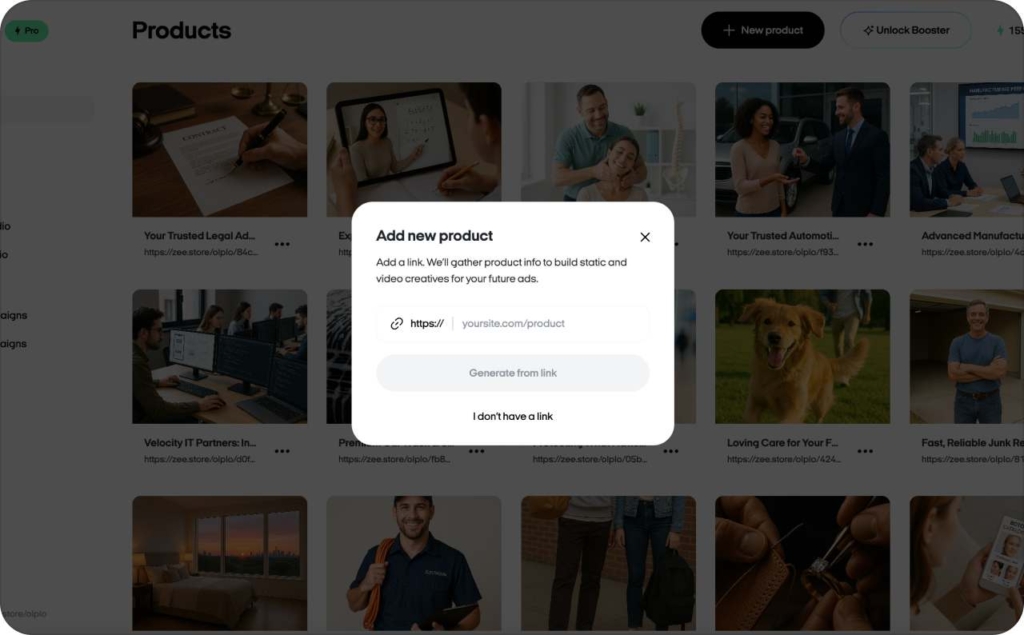
- Paste your product link into Zeely or enter the details
- Generate a few UGC-style videos and static ads
- Choose 3–5 you like, tweak text so it sounds like you, and approve
- Use Zeely’s guided flow to launch a Meta campaign with a small daily budget, for example 10–20 dollars
If you do this in one sitting, you can often go from “no ad” to “live test” in under an hour, even on your first try. You may also like reading how to set up your first Zeely project.
E-commerce & dropshipping brands: Scale social ads fast
If you run a store with several products, your biggest risk is creative fatigue. The same ad repeated for months will slowly die.
Here is how I see many Zeely users handle that:
- Import or enter several products
- Use bulk creation to generate multiple variants per product
- Launch tests for a few products at a time, not the whole catalog
- Shift more budget into the creatives and products that hit your target
Because Zeely makes it easier to create 10 or more creatives per product, you can always have something new to show your audience without burning out.
Limitations, trade-offs and when Zeely isn’t worth it
No tool is perfect. Zeely included. I want you to see both sides.
Zeely hides some advanced complexity to protect beginners. That is great if you are new. It is less great if you want deep manual control over every bid rule and field.
All of this sits in a bigger 2026 reality. As McKinsey claims, almost nine out of ten companies report using AI somewhere in the business, but many still struggle to translate AI into clear financial gains. Tools by themselves do not generate profit. How you use them does.
Use Cases Where a Different Tool Makes More Sense
Here are a few times when I usually say “Zeely is not your first tool.”
- You run a B2B service where most sales come from referrals and long email nurturing. A strong CRM and email platform should come first
- You invest heavily in organic content and want more blog traffic. SEO and content tools will be more important than ad creative tools
- You rarely run ads and do not plan to spend even $150-200 per month on them. It may be too early to invest in a dedicated ads tool
You can always add Zeely later once your traffic and testing volume grow.
How to test Zeely without burning budget
Here is how I recommend testing Zeely in a low-risk way.
- Choose a 14, 28 or 56 days trial
- Pick one or two products that already have some sales
- Set a clear test budget and success targets for CTR
- Commit to testing at least 5–10 creatives during that window
If you do not see any movement in those metrics after a focused test, Zeely might not be the right fit for your business today.
Is Zeely worth it for you? Quick decision checklist
By now you have seen both the strengths and the limits. Let’s make this very simple.
5 signs zeely is a strong fit
Zeely is worth a serious test if most of these feel true:
- You rely on paid social or want it to become a core growth channel
- You do not have an in-house creative team, or they are already overloaded
- You are comfortable spending at least $200-400 per month on ads
- You are willing to test multiple creatives instead of clinging to one favorite ad.
- You want one tool to handle creative production and campaign automation without hiring an agency
If this is you, Zeely often pays for itself quickly through faster testing and more stable performance. Read more about how Zeely works.
5 signs you should look elsewhere
You may want to start with other tools if:
- Your main channel is email or SEO and you rarely run ads
- You need deep CRM flows, complex lead scoring, or large sales teams
- You run very small ad budgets, for example under $150 per month
- You want full manual control over every bid and setting inside native ad platforms
- You want a free forever solution and are not ready to invest in paid tools yet
In these cases, Zeely will not feel “worth it,” because it will sit unused or feel like a restriction.

Emma blends product marketing and content to turn complex tools into simple, sales-driven playbooks for AI ad creatives and Facebook/Instagram campaigns. You’ll get checklists, bite-size guides, and real results, pulled from thousands of Zeely entrepreneurs, so you can run AI-powered ads confidently, even as a beginner.
Written by: Emma, AI Growth Adviser, Zeely
Reviewed on: January 14, 2026