Creative testing for video ads and a simple experiment plan
Creative testing works when you change one meaningful variable at a time and tie it to a clear outcome. This guide shows you how to run a cleaner A/B test for video ads, write a stronger creative hypothesis, and build an ad testing plan you can repeat every week.
- Start ad creative testing with the part most likely to change attention fast: the hook
- Write every creative hypothesis as a cause-and-effect statement
- Keep audience, budget, landing page, and CTA stable when you test hooks
Native ad creative testing platforms like Meta Experiments,Google Ads video experiments, and TikTok Split Testing are built to keep test groups separated so your read is cleaner
Don’t launch ten versions at once unless you already have enough spend and volume. Two clean variants usually teach you more than six messy ones. Read results in order: attention, click intent, landing page behavior, then conversion.
Most teams say they’re doing creative testing. In reality, they’re launching a pile of edits at once and hoping one ad saves the account.
That’s not testing. That’s guessing.
When I look at weak ad creative testing, the same pattern shows up again and again. The hook changes, the offer changes, the caption changes, the CTA changes, and the landing page is also new. Then the team tries to explain the winner like it was obvious all along.
A better system is simpler. You choose one variable with the highest chance of moving behavior, write a clear creative hypothesis, launch only the variants you can afford to read, and let the platform split traffic as cleanly as possible.
Tools like Meta’s A/B testing and Experiments, Google’s video experiments, and TikTok’s split testing all exist for that exact reason. Meta states that A/B tests compare versions while keeping people from seeing both, Google says video experiments let you test different video ads with the same audience, and TikTok says split tests keep other variables the same while dividing the audience into equal groups.
This article gives you a repeatable ad testing plan for video ads. I’ll walk through what to test first, how to write the hypothesis, how to isolate hooks, how to test offers and proof, how many variants to launch, and how to read results without fooling yourself.
What to test in a video ad first for faster creative testing
If your goal is to learn fast, start with the thing that changes the scroll.
In most video ads, that’s the hook.
The first one to three seconds decide whether the viewer gives you another second. If the opening line, frame, or pattern interrupt doesn’t earn attention, the rest of the ad barely matters. You could have a strong offer and real proof later in the video, but most people won’t stay long enough to see it.
Test the hook before you test the polish
The fastest early win in creative ad testing usually comes from changing the opening, not the entire edit.
A hook can change:
- the first spoken line
- the first on-screen claim
- the first visual
- the pace of the opening cut
- the promise the viewer thinks they’ll get
Here’s the simple order I use for content optimization in video ads:
- Hook
- Offer angle
- Proof
- CTA
- Visual polish and editing style
That order works because attention comes first. Then you need a reason to care. Then you need something believable. Then you need a next step.
What a “hook test” really means
A hook test is not a totally new ad every time.
It’s the same body, same offer, same CTA, same landing page, and same audience, with only the opening changed. That’s what makes the read useful.
Good first hook angles to test:
- pain-first
- outcome-first
- proof-first
- curiosity-first
- speed-first
- price-first
- identity-first
A local med spa might test these three hooks against the same video body:
- “Still paying full price for facials?”
- “How we filled next week’s appointments in three days.”
- “Before you book another facial, watch this.”
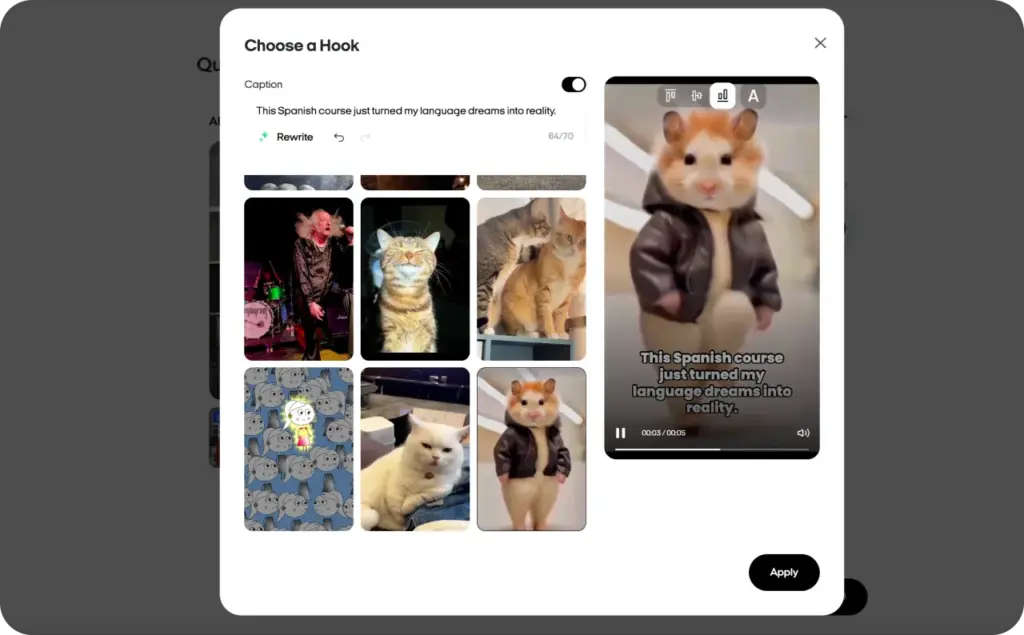
Those are meaningfully different openings. They frame the same offer in different ways. That is a real test. With Zeely AI, you can choose the type of video hook you want, and the AI will generate a strong matching textual hook designed to fit the format, capture attention fast, and improve viewer retention.
When not to start with the hook
There are exceptions.
If the ad is visually confusing, hard to read on mobile, or unclear about the product in the first seconds, visual structure may need to be fixed before you run a clean hook test. Likewise, if the offer itself is weak, no hook will rescue it for long.
But even then, I’d still avoid changing five things at once. Fix the obvious creative failure, then go back to single-variable testing.
How to write a strong creative hypothesis.
A weak test starts with a weak sentence. A strong creative hypothesis connects one change to one expected behavior.
The formula I use for a creative hypothesis
Use this template:
If we change [one creative variable] for [one audience], then we expect [one metric] to improve because [clear behavior reason].
That last part matters. The “because” is where the thinking lives.
Here’s a weak version:
- We think UGC will perform better
Here’s a better one:
- If we open with a customer selfie video instead of a polished brand intro for cold traffic, then click-through rate should improve because the ad will feel more native in-feed and less like an ad.
That is testable. It also tells your team what you think is happening.
Build the hypothesis around one job
Every video ad is trying to do one main job first:
- stop the scroll
- earn the click
- qualify the viewer
- reduce doubt
- convert intent
Pick one.
If you try to make one test answer all five jobs, the read gets muddy. A hook test should mostly answer an attention question. An offer test should answer a value question. A proof test should answer a trust question.
Three examples you can actually use
Example 1: Hook test
If we replace a broad lifestyle opening with a problem-first opening for cold traffic, then hold rate and CTR should improve because the ad will tell viewers faster why this matters to them.
Example 2: Offer test
If we change “20% off your first order” to “Buy one, get one free” for first-time buyers, then the purchase rate should improve because the value will feel more concrete and easier to understand.
Example 3: Proof test
If we move customer results into the first half of the ad, then landing page views and purchases should improve because viewers will trust the claim earlier.
That’s the level you want. Clear, small, and measurable.
Testing hooks without changing everything in your A/B test video ads
This is where most teams break the test.
They say they want to A/B test video ads, but then Version B has a new opening, new product shot, new body copy, shorter runtime, different CTA, and a different thumbnail. At that point, even a winner teaches you very little.
When you test hooks, hold these steady:
- audience
- budget split
- offer
- landing page
And I’d usually keep these steady too:
- CTA
- body script
- format
- duration range
You want the opening to carry the experiment.
Meta’s A/B testing setup is designed to compare versions while keeping exposure separated, and TikTok’s split testing guidance says each group should see only one ad group while other variables stay the same. That’s exactly why native testing tools are usually better than informal side-by-side launches.
Four hook formats worth testing first
I like to start with one of these clusters:
1. Problem-first hook
Name the frustration fast.
Example: “Your ad isn’t bad. It’s just saying the wrong thing first.”
2. Outcome-first hook
Lead with the result.
Example: “This video format cut our cost per lead in half.”
3. Proof-first hook
Open with evidence.
Example: “Here’s the exact ad that got 127 booked calls.”
4. Curiosity-first hook
Open a loop.
Example: “Most video ads fail before the product even appears.”
These are different enough to surface a real audience preference. With Zeely AI, you can easily test different hooks on the same AI UGC video, helping you compare angles, messaging, and attention-grabbing openings without recreating the entire ad.
A simple hook testing matrix
Run two to three variants, not seven.
Try this:
- Hook A: pain-first
- Hook B: outcome-first
- Hook C: proof-first
Keep the rest of the ad nearly identical. Then review:
- early attention signal
- click signal
- downstream conversion signal
If Hook B wins on click but Hook C wins on purchases, don’t panic. That’s not confusion. That’s information. It tells you one opening attracts more curiosity, while another pre-qualifies better.
That’s why ad creative performance testing should never stop at CTR alone. If you are creating video ad for Facebook you may also like to read how to improve Facebook ad CTR.
Testing offers, proof, and CTAs for video ads
Once you have a decent hook, move deeper into the ad.
This is where you stop asking, “Can I get attention?” and start asking, “Why should they believe and act?”
Test offers when video ad attention is decent but sales lag
If people watch and click, but conversion is weak, the offer often needs work.
Offer tests can include:
- percentage discount vs dollar discount
- discount vs bundle
- free trial vs free consultation
- urgency vs evergreen value
- product-first vs outcome-first framing
Example:
- Version A: “Get 25% off today”
- Version B: “Get your first month for $1”
- Version C: “Start today and cancel anytime”
That is a better offer test than changing the whole ad story.
Test proof when video ad clicks are fine but trust is low
If viewers click but don’t buy, they may not believe you yet.
Proof variables worth testing:
- customer testimonial
- before-and-after frame
- product demo
- review count
- expert endorsement
- founder credibility
- guarantee or policy reassurance
I like to move proof earlier before I add more polish. A plain video with strong proof often beats a beautiful video with soft claims.
Test CTAs last more often than you think
Teams love CTA tests because they’re easy to write.
But CTA changes rarely fix a weak hook or muddy offer.
Still, once the ad is healthy, CTA tests can lift performance:
- Shop now vs Get yours now
- Book now vs Check availability
- Learn more vs See how it works
- Try it free vs Start free today
Keep CTA tests small and specific. Don’t expect them to save a broken ad.
Use native ad creative testing platforms when possible
If you want cleaner reads, use the platform’s built-in experiment tools to create native ads instead of tossing variants into one campaign and hoping the auction behaves.
A few practical options:
- Meta Experiments for A/B tests across versions. Meta says A/B testing can compare versions with different images, text, audiences, placements, and other settings, and its Experiments tools include A/B testing options
- Google Ads video experiments if you’re testing video ads on YouTube. Google says you can test different video ads with the same audience
- TikTok Split Testing if you want two clean groups with one main variable. TikTok also lists creative as one of the variables you can test
You do not need every tool at once. You just need one test environment that keeps the comparison honest. Watch the best native ads examples.
How many creative ad variants to launch at once without wasting spend
This answer is less exciting than people want.
Usually, two.
Two variants force focus. They also protect your budget from getting chopped into tiny slices that never produce a readable result. When you launch too many versions at once, you create three problems:
- each version gets less delivery
- results take longer to separate
- your team starts cherry-picking tiny differences
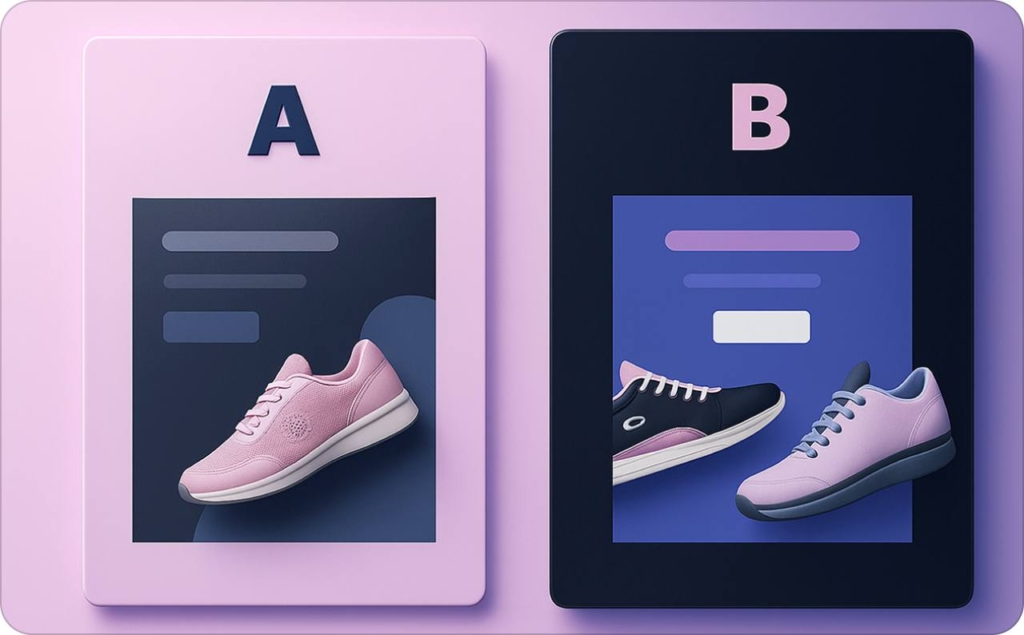
A clean A vs B test gives you a sharper lesson.
That’s especially true when you’re still learning message-market fit or when the account doesn’t have deep daily spend.
Go beyond two only when all of this is true:
- you already have one stable control
- your spend can support more traffic split
- the variants differ in one obvious way
- you already know what you’re trying to learn
Google’s video experiments support 2 to 4 experiment arms, and Google’s experiments overview says video experiments let you compare groups with a chosen success metric. Meta’s Experiments documentation says A/B testing can compare up to five versions. Those ranges are useful, but platform capability is not the same as what’s smart for your budget.
Just because a platform lets you test more versions doesn’t mean you should.
My rule of thumb for launch volume
Here’s the simple version:
- New account or low spend: 2 variants
- Stable account with clear control: 2 to 3 variants
- High-volume account with disciplined structure: up to 4 variants, usually in staged waves
If you’re testing hoohttps://zeely.ai/blog/boost-meta-ads-hook-rate/ks, I’d rather see two strong openings this week and two more next week than six weak versions launched together.
That sequencing gives you better learning and cleaner iteration.
How to read test results without guessing or storytelling
This is where a lot of good testing gets ruined.
The team sees a favorite metric go green and declares a winner. Or they pick the ad they personally like best. Or they switch the goal mid-test because one version “feels stronger.”
Don’t do that.
Read the result based on the job of the test.
Match the read to the variable you changed
If you changed the hook, start with attention and click signals.
If you changed the offer, care more about qualified traffic and conversion.
If you changed proof, watch what happens after the click.
A simple reading order looks like this:
- Hook test: watch signal, click signal, then cost efficiency
- Offer test: CTR, landing page behavior, then conversion rate
- Proof test: click quality, purchase rate, lead quality
- CTA test: click lift, qualified action lift, sales lift
That order keeps you from overreacting to one noisy number.
If multiple ads point to the same page, use URL tagging so you can tell variants apart outside the ad platform.
Google Analytics says you can use UTM parameters to collect campaign data, and it specifically notes that utm_content can differentiate ads or links that point to the same URL. That is one of the easiest ways to keep your ad testing plan readable across analytics.
A basic structure can look like this:
- utm_source=meta
- utm_medium=paid-social
- utm_campaign=spring-hook-test
- utm_content=hook-proof-first
You can build those with Google’s URL builder for custom campaign tracking.
A simple experiment plan you can repeat every month
Here’s the version I’d actually hand to a team.
Week 1: Hook round
- Launch 2 hook variants against 1 control body
- Hold audience, offer, CTA, and landing page steady
- Pick one winner based on the agreed hook metrics
Week 2: Offer round
- Keep the winning hook
- Test 2 offer frames
- Read for qualified clicks and conversion behavior
Week 3: Proof round
- Keep winning hook and offer
- Test one stronger proof element against the current control
- Read for downstream trust and conversion lift
Week 4: CTA or polish round
- Test CTA language, edit pace, captions, or visual packaging
- Only do this after the bigger message variables are working
That is a real ad testing plan. It is simple enough to run and disciplined enough to teach you something.
What to do after the test ends
There are only three smart next moves:
- keep the winner as the new control
- iterate on the winning idea with one new variable
- kill the losing angle and document why
Documentation matters more than people think.
A short note like this is enough:
- Hypothesis
- Variable tested
- Winning version
- Metric that mattered
- What we think the audience responded to
- What we’ll test next
That’s how creative testing turns into a repeatable system instead of a string of random uploads.
Final take
Good ad creative testing is not about making more versions. It’s about making fewer, cleaner decisions.
Start with the hook because that’s where attention lives. Write the creative hypothesis before you touch the edit. Test one variable at a time. Use native ad creative testing platforms when possible. Then read the result based on the job the ad was supposed to do.
That’s how you stop guessing.
And that’s how content optimization starts compounding instead of resetting every week.
Emma blends product marketing and content to turn complex tools into simple, sales-driven playbooks for AI ad creatives and Facebook/Instagram campaigns. You’ll get checklists, bite-size guides, and real results, pulled from thousands of Zeely entrepreneurs, so you can run AI-powered ads confidently, even as a beginner.
Written by: Emma, AI Growth Adviser, Zeely
Reviewed on: May 12 2026