Learn about Zeely AI

Zeely app download guide 2026: Among best AI-powered marketing solutions for e-commerce

If you’re looking for a safe, simple way to download the Zeely app and choose the right AI-powered marketing tools for your online store, you’re in the right place. In this guide, I share what I’ve learned from thousands of AI-assisted campaigns so you can use tools that actually help your store grow.

4 Feb 2026 | 15 min read

The Zeely app is my go-to AI ad creative automation and campaign tool for online sellers who want sales. When you’re ready to start, open the App Store or Google Play, install “Zeely: AI Sales Growth App,” create your account, and connect your store and ad accounts. Once you’re in, Zeely helps you make AI ads and launch simple campaigns. 

You get an AI ad engine plus a clear path to connect your store, publish assets, and see what performs. I want your Zeely app download and first setup to stay under ten minutes, then show you how to place Zeely inside a broader AI system that supports your whole funnel.

Here’s what I cover in this guide:

  • How to download the Zeely app on iOS and Android
  • How to sign up and get started
  • What Zeely actually does for e-commerce in 2026
  • Where Zeely fits among the best AI-powered marketing tools for online sellers
3D icons of the Apple App Store and Google Play Store on a blue background, representing platforms where users can download the Zeely App.

What the Zeely app is in 2026

If you want the real answer to what the Zeely app is in 2026, it’s this: a way for you to turn attention into sales without juggling five tools. I like to think of it as a small creative team and a campaign setup assistant that live in your phone. It stays focused on the work that brings revenue, not on features that slow you down.

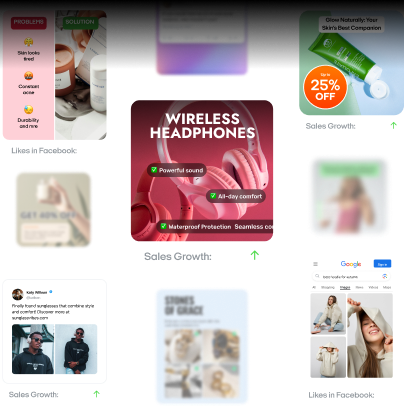
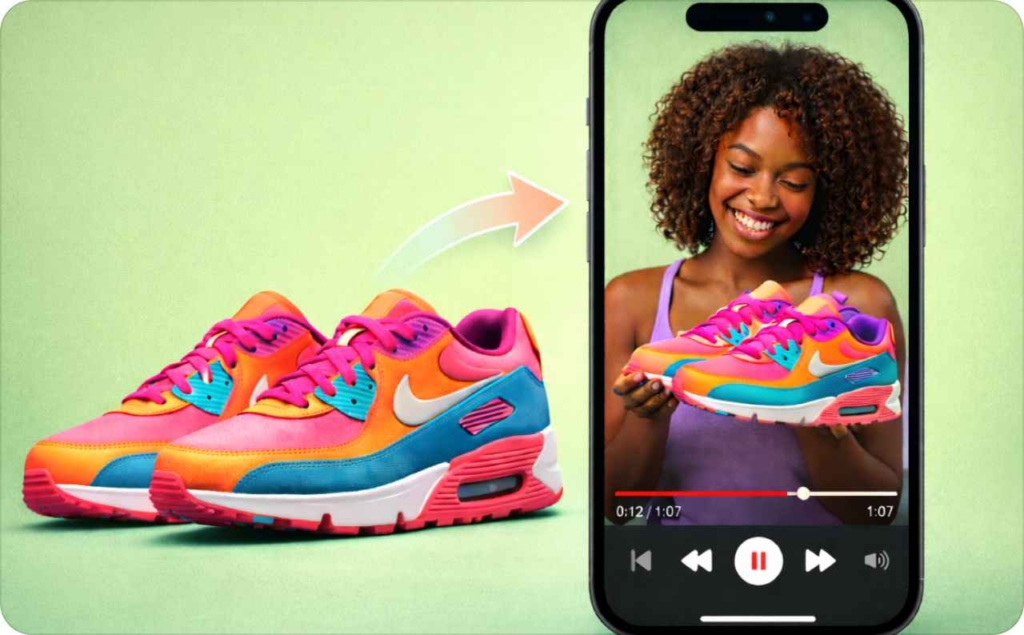
Inside the app, your creative process gets faster. You can make static ads and UGC-style video ads with AI photoshoots, templates, and avatars. You write a short line about your product and Zeely turns it into scripts, visuals, and hooks that feel made for e-commerce. It cuts out the blank page and keeps you producing consistently.

Here’s what that looks like day to day:

  • You create ads from your phone in a few minutes
  • You get AI-generated scripts and visuals that match your product
  • You keep your ad library fresh without hiring a designer
  • You export everything for Meta, TikTok, YouTube, and more
  • You launch campaigns in Instagram and Facebook

If you don’t have a website yet, Zeely creates a simple AI-powered sales page for your product. It gives your ads a clean destination. It stays lightweight on purpose so you can start selling today.

When you’re ready to launch, Zeely connects to Meta Ads. You set your goal, add your budget, and publish ads to Facebook and Instagram without leaving the app. It feels like taking the heavy edge off media buying, which is usually the part that blocks new sellers.

How to download the Zeely app on iOS & Android

If you want to run real ads in 2026, your tools matter. E-commerce sales are expected to reach about $6.42 trillion this year, according to Capital One, and most of that growth comes from stores that use AI well. Getting your Zeely app download right sounds small, but it keeps you safe from copycat apps and saves you from messy data later.

Zeely App Download on iOS 

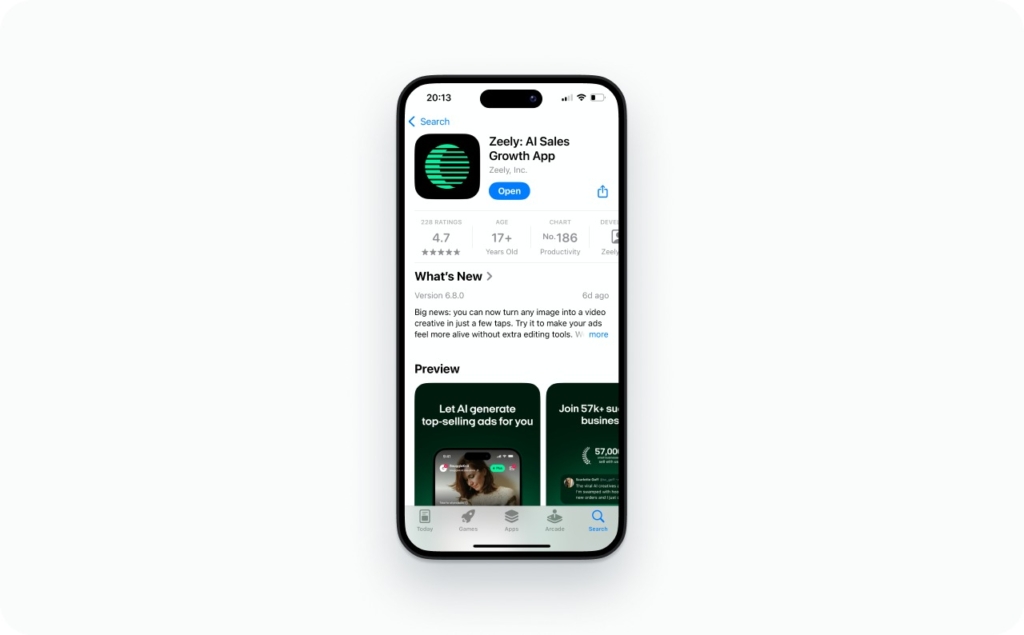
On iPhone, open the App Store and tap the search icon. Type Zeely: AI Sales Growth App. The correct result will show the Zeely logo and the full name.

Before you download, check two things:

  • Developer name: Zeely, Inc.
  • Screenshots that show AI creatives and campaign tools

Some regions may show small wording differences, but the developer name and icon stay the same. Tap Get, confirm with Face ID or your password, and wait for the install. When it finishes, tap Open.

A quick note here. Only install Zeely from the official App Store. It keeps your data and your ad accounts safe.

Zeely App Download from Apple Store screenshot

Zeely app download on Android

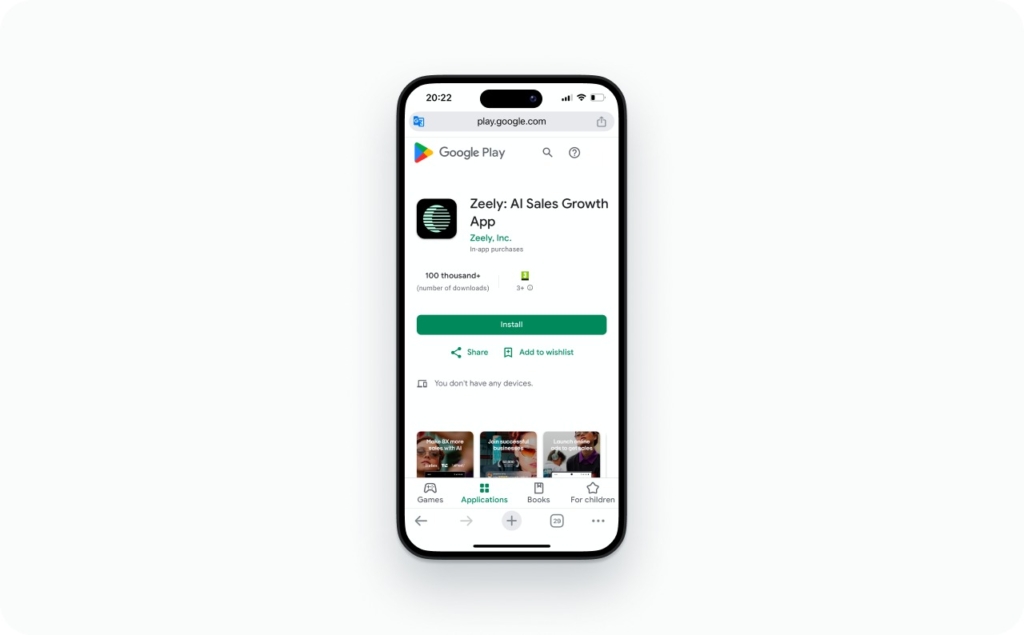
On Android, open Google Play and search for Zeely: AI Sales Growth App. Look for the familiar Zeely icon and a description about AI creatives and sales growth tools.

Check the same markers:

  • Developer: Zeely, Inc.
  • Reviews and install counts that look real

Tap Install and then Open when the download completes. Google Play may ask for permissions. Zeely may request camera and microphone access when you create UGC-style videos, and notification access so you don’t miss campaign alerts. You can change these in settings at any time.

As with iOS, only use the official Google Play listing. It keeps your install clean.

Zeely App Download from Google Play screenshot

First-time setup: From login to your first campaign skeleton

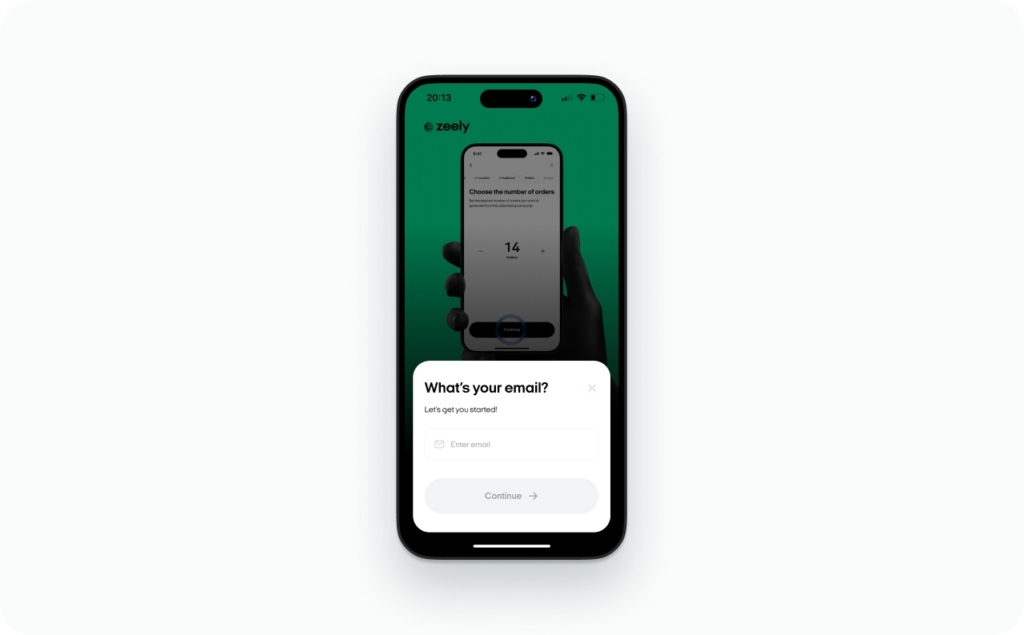
This is the moment the app turns into a working sales engine for your store. Tap Sign up and add your email, your name, and a password you haven’t used elsewhere. Zeely then asks a short set of questions about your business. These questions shape your AI ad suggestions, so your first creatives fit your niche.

The onboarding usually covers:

  • What you sell
  • What you want (traffic, leads, direct sales)
  • Which platforms you already use

Add your first product or website link or a few details about what you sell. Choose a paid plan when prompted. For full pricing, I always point people to the “How much does Zeely cost?” guide so you see all limits and tiers clearly.

This is the moment most founders tell me, “I didn’t think it could be this fast.”

Zeely AI signing up from mobile screenshot

What makes an AI-powered marketing solution “best” for e-commerce in 2026?

When I look at what makes an AI-powered marketing tool “best” for e-commerce in 2026, I start with one simple question: does it help your store grow, or does it just save a few minutes? E-commerce is expected to pass six trillion dollars in global sales, and more of those purchases keep shifting online. If a tool cannot show its link to revenue, it will not earn a place in your stack.

The companies performing best right now use AI to create new value. They test offers faster, refresh creatives more often, and reach customers they could not reach before. McKinsey’s 2025 State of AI research points to the same pattern: leaders use AI for innovation and growth, while everyone else uses it for tiny efficiency gains.

Core evaluation criteria for AI e-commerce tools

When I choose AI tools for an online store, I keep the criteria simple. Fancy frameworks usually hide the point. What you want is a quick way to see if a tool will help you make money or only add noise. These are the buckets I use with founders because you can run through them in an afternoon.

Data and integrations

Your tool has to talk to your store. If it guesses, you pay for the guess. If it does not support your main channels, you spend hours exporting and importing instead of running campaigns.

Control and transparency

Decide how much steering you want. Fully automated agents can be strong, but you should see every change they make. Clear logs and readable suggestions let you stay in control. Black boxes drain budgets quietly.

Ease of use for non-technical founders

You should be able to move from “set up my first project” to “launch campaign” without a course. A good tool handles defaults, guardrails, and setup in a way that keeps momentum instead of slowing you down.

Support and reliability

AI tools shift fast. You want a Support team that keeps documentation up to date, answers questions, and rolls out fixes often. When support is thin, you feel it during campaigns.

Pricing and scaling

Good tools do not lock you into enterprise plans early. You want clear tiers, predictable fees, and a path to scale. If the pricing page feels like a puzzle, it usually means trouble later.

This is the same lens I use when I talk about Zeely. It was built around these buckets from the start. Zeely connects to Meta Ads so it can pull performance data directly into your dashboards. That means you can see which creatives and campaigns are working without spreadsheets.

On the control side, Zeely keeps you in the loop. You set goals, budgets, and audiences with AI guidance, but you always see every setting before you launch. When the app recommends changes, you can accept or adjust with a few taps.

Creative work is where Zeely saves the most time. The AI generator produces static ads, UGC-style videos, AI video avatars, and scripts written for e-commerce. You can test variations quickly through structured A/B options without recording everything yourself.

You can launch Facebook and Instagram campaigns inside Zeely and export assets for TikTok and YouTube. The whole flow stays mobile first, which matters when you’re running a store from your phone. And the pricing is designed for growing businesses, not big agencies. The full breakdown lives in the separate pricing guide if you want the details.

Categories of AI-powered marketing tools for e-commerce

Instead of a random list of tools, I like to group them by funnel stage and channel so you know why each one earns a place in your stack.

AI ad & creative tools

AspectDetails
What this category doesAI ad creative tools handle ideas, scripts, visuals, and hooks for your paid campaigns. They produce static images, video ads, headlines, primary text, and thumbnails tuned for platforms like Meta, TikTok, and YouTube. When you see phrases like ai ad generator for ecommerce, ai video ads tools, or ugc video ads ai, they point to this category.
Problems they solveThey unblock creative fatigue, speed up testing, and align creatives with your store data. Instead of briefing a designer for every ad, you can spin up dozens of variations in a day and let performance decide winners. This matters when CPMs rise and you need more creative testing to keep CPA stable.
Examples (alongside Zeely)Zeely focuses on mobile first AI ad creation for ecommerce founders, with AI UGC video and sales pages that connect directly to campaigns. Alongside Zeely, merchants sometimes test desktop first AI ad studios or video generators, but those often lack the commerce focus and Meta campaign flows.
How it fits your stackThis is your acquisition engine. You pair Zeely or similar tools with your ad platforms, then connect downstream email, CRO, and analytics tools. If an AI ad creative platform cannot speak ecommerce language or forces you to do heavy editing, it probably does not belong in your 2026 stack.

AI email & lifecycle marketing tools

AspectDetails
What this category doesAI email marketing tools and AI lifecycle marketing platforms help you send the right message to the right shopper at the right time. They handle flows like abandoned cart emails, post purchase sequences, winback campaigns, and product recommendation emails.
Problems they solveThey automate follow up so every visit, add to cart, and purchase has an appropriate response. Many now use predictive send time (when an email is most likely to be opened) and AI driven copy that adjusts to segments. This keeps retention strong while your ad tools focus on bringing new visitors in.
ExamplesPopular tools in this cluster include email platforms that added AI features for subject lines, body copy, and segmentation, such as Klaviyo AI capabilities, plus more general email suites that added ecommerce templates. The key is support for core flows like AI for abandoned cart flows and personalized product follow ups.
How it fits your stackYou plug these tools into your store platform and sometimes into your support system. They work best when your ad tools, including Zeely, send clean UTM parameters and campaign names so email reports line up with acquisition. Think of this category as your retention and LTV engine.

AI onsite personalization & CRO

AspectDetails
What this category doesAI product recommendations, AI onsite personalization, and AI CRO tools focus on what happens after a visitor lands on your store or landing page. They adjust product blocks, banners, popups, and offers based on behavior and attributes. CRO, or conversion rate optimization, is the practice of lifting the percent of visitors who convert.
Problems they solveThey raise average order value and conversion rates. AI popups ecommerce tools can show targeted discounts or lead magnets, while AI product recommendation engines learn from browsing and purchase behavior to show the most relevant items. Some tools test headlines, layouts, and CTAs automatically.
ExamplesThis category includes tools like Wisepops for onsite engagement, plus recommendation engines that plug into Shopify and other platforms to show “frequently bought together” or “you might also like” blocks powered by AI. Many of these tools now position themselves as full AI CRO suites for mid sized stores.
How it fits your stackYou layer onsite tools beneath your ad and email stack. Zeely can bring qualified visitors and align landing pages, while onsite AI tools refine the experience deeper in the funnel. For most stores, one simple recommendation engine plus a smart popup tool is plenty to start.

AI analytics & attribution

AspectDetails
What this category doesAI marketing analytics tools, AI attribution tools, and AI LTV prediction ecommerce platforms help you understand where revenue truly comes from. They use models like MMM (marketing mix modeling, a statistical way to connect channels and revenue) and multi touch attribution to estimate channel value even when tracking is noisy.
Problems they solveThey close the loop between creative, spend, and profit. When you use AI ad creative tools like Zeely, you generate many variants and campaigns. AI ROI tracking platforms help you see which mixes of creative, audience, and channel actually grow profits instead of just sessions.
ExamplesYou will find tools that specialize in ad measurement, subscription analytics, or cohort analysis, many with AI to detect patterns and flag issues. Some plug into Meta, Google, and your store and then offer budget reallocation suggestions based on predicted LTV and payback periods.
How it fits your stackThis layer sits over everything else. For smaller stores, native analytics plus Zeely’s reporting can be enough. As you scale, you may add AI analytics tools to validate decisions and forecast growth. Without this layer your AI stack becomes guesswork.

Zeely app download checklist & next steps

Let us bring this back to something very practical. You want a simple Zeely app download checklist and a clear set of next steps so your AI stack starts working, not just existing on your phone.

Zeely app download checklist

Step 1: Confirm category

  • Make sure you understand Zeely as an AI ad and campaign tool, not a general store builder. It specializes in creative automation and paid campaigns for e-commerce founders

Step 2: Download Zeely from official stores

  • On iOS, search the App Store for “Zeely: AI Sales Growth App,” choose the listing from Zeely, Inc., and tap Get
  • On Android, search Google Play for the same name, verify Zeely, Inc. as the publisher, then tap Install

Step 3: Sign up and complete onboarding

  • Open the app and create an account with a secure password
  • Complete the short quiz about your products and goals so Zeely can tailor AI ad suggestions

Step 4: Activate a plan

  • Choose one of the Zeely paid plans that fits your current monthly ad budget and store size
  • For full details on plan levels, limits, and refunds, check the dedicated page instead of guessing from this article
Zeely AI pricing page screenshot

Step 5: Add products and generate first creatives

  • Add one or two priority products or paste URLs from your existing store
  • Use Zeely to generate your first AI video ad or static ad so you can see the creative range

Step 6: Connect Meta Ads and launch a starter campaign

  • Zeely runs your ads through our managed Meta Ads account, so you don’t need to connect your own.
  • Start with a small daily budget to validate creative and audience performance, collect real results, then scale what works.

Why these steps matter for conversions

As DesignRush claims, AI driven product recommendations and personalized experiences can lift conversions by around 20% and increase repeat purchases as well. That is the kind of uplift you aim for when you pair Zeely with good email, onsite, and analytics tools. The goal is not just to have AI; the goal is to see higher CTR, stable or lower CPA, and better ROAS over the next 30 to 90 days.

Zeely brings creative automation, campaign setup, and simple analytics into one app used by hundreds of thousands of sellers worldwide. You then layer in email, onsite personalization, and analytics tools that match your size. For legitimacy, deeper features, company details, payment methods, and value analysis, I recommend reading the separate cluster articles such as “Is Zeely legit?”, “Zeely AI features,” and “Is Zeely worth it?”.

To wrap this up, here is how I would frame your next moves.

Do this now

  • Complete your Zeely app download on iOS or Android and finish onboarding
  • Add two priority products and generate at least five AI creatives per product
  • Launch one low budget Meta campaign through Zeely for each product

Check this

  • CTR on your Zeely campaigns after a few days
  • CPA relative to your previous campaigns without Zeely
  • ROAS at the campaign and product level inside your reports

Expected result

  • Higher CTR from fresher creatives
  • Equal or lower CPA once Zeely’s suggestions and your testing stabilize
  • Clearer ROAS data tied to each AI creative set, so you know what to scale and what to cut

That is how you turn a simple Zeely app download into a real AI-powered marketing partner for your e-commerce store in 2026.

Photo of Emma, AI growth Adviser from Zeely

Emma blends product marketing and content to turn complex tools into simple, sales-driven playbooks for AI ad creatives and Facebook/Instagram campaigns. You’ll get checklists, bite-size guides, and real results, pulled from thousands of Zeely entrepreneurs, so you can run AI-powered ads confidently, even as a beginner.

Written by: Emma, AI Growth Adviser, Zeely

Reviewed on: February 4, 2026

High-converting UGC video made easy
Photo collage of Zeely AI customers
Trusted by 650,000+ customers
Get started
Explore the library
of winning
AI-generated ads
Get started Floating templates of Zeely AI static ads examples
Keep up with
the latest from Zeely