How AI can help small businesses: 7 ways that actually move the needle
How can a three-person team compete with companies that have entire marketing departments? I'll walk you through seven ways AI helps small businesses save hours, cut costs, and grow. Real tools, honest trade-offs, no hype.
Key takeaways
- $0 to $50 a month gets you into most AI tools. The hard part is not the price
- One tool, one problem, 30 days. That is the only adoption plan that sticks. I have seen too many small businesses grab five subscriptions and use none of them
- In 2023, only 23% of small businesses touched generative AI. By 2025 that number hit 58%. The speed caught most people off guard
- I wrote this guide around seven use cases where I keep seeing real, measurable payoff: automation, customer service, hiring, analytics, marketing, cost reduction, and content
AI is not a big-company luxury anymore. Not even close. Tools that used to need an engineering team now run on a monthly subscription cheaper than your phone bill.
The numbers tell the story. U.S. Chamber of Commerce research tracked generative AI use among small businesses: 23% in 2023, 40% in 2024, 58% in 2025. The SBA Office of Advocacy noticed something else in their data: the gap between small and large firm adoption, which sat at 1.8x, collapsed to 1.2x in twelve months. Nobody expected that to happen so fast.
The math is simple. Small teams carry the same workload as large ones. Customers, orders, ads, invoices. All of it, with a fraction of the people. AI takes the repetitive parts off the list.

What AI actually means for a small business
“AI” has become one of those terms people slap onto everything. Your email spam filter? AI. A self-driving car? Also AI. When you are a small business owner trying to choose a $30/month tool, none of that helps. What you need to know comes down to three categories.
Machine learning is the one running quietly in the background. It watches your sales data, your customer behavior, your seasonal demand patterns. Over time it learns what is normal and starts making forecasts. You never have to build a formula. The tool just tells you “hey, you’re about to run out of this product” or “this ad audience is burning money.” That is ML.
Natural language processing is harder to explain but easy to see in action. You type a badly spelled question into a chatbot at 2 a.m., and somehow it still knows what you mean. That is NLP. Siri runs on the same idea. So do the tools that write personalized email subject lines based on what a customer clicked last week.
Generative AI is probably the one you have already tried, even if you did not call it that. You opened ChatGPT, typed “write me a product description for this candle,” and got a paragraph back. That is generative AI. Jasper, Claude, Shopify Magic, they all do the same thing in slightly different ways. Text, images, video, code.
| Problem | AI category | Example tools |
| Customer questions at 2 a.m. | NLP / chatbots | Intercom, ManyChat, Tidio |
| Categorizing receipts and invoices | ML / automation | QuickBooks, FreshBooks, Xero |
| Writing product descriptions | Generative AI | ChatGPT, Claude, Jasper |
| Forecasting next month’s demand | ML / predictive | Google Analytics 4, Looker, Power BI |
| Creating ad visuals and video | Generative AI | Zeely, Canva, Predis.ai |
| Screening 200 résumés | ML / automation | Breezy HR, Workable |
| Scheduling meetings | Automation | Calendly, Appointlet |
1. Automate the tasks that eat your day
Every week, small business owners bleed hours to scheduling, invoicing, data entry, and follow-up emails. These tasks feel productive. They are not. They are maintenance disguised as work.
Take scheduling. I have watched business owners spend half a morning going back and forth on meeting times. Calendly or Appointlet wipe that out. They sync with Google Calendar, Outlook, Slack. Reminders go out on their own, double-bookings stop happening, and that “Does Tuesday work?” email chain dies forever. Two or three hours back per week, just from that.
Bookkeeping is the other big one. QuickBooks and FreshBooks both run machine learning under the hood, but you would never know it. You just see expenses getting sorted into the right categories, invoices going out, and everything staying synced with Stripe or PayPal. The real win shows up at month-end. The software flags a misclassified charge before you even open the file.
Zapier AI goes wider. An order arrives on Shopify. The customer gets a confirmation. The sale logs in your spreadsheet. Fulfillment gets a Slack ping. No manual step in between.
The U.S. Chamber Foundation’s Main Street AI Monitor, a nationally representative survey from June 2026, found that half of all small business workers already use AI at work. The vast majority are using it to boost productivity, not to replace jobs. My advice? Pick the chore that drains you most and automate that one first. Scheduling, bookkeeping, email follow-ups. Whichever makes you groan on Monday morning.
2. Help your customers faster
Customers expect quick answers at any hour. They do not care that your team clocks out at six.
Here is what AI customer support looks like in practice:
- A visitor asks a question. Order status, refund, sizing
- The chatbot replies instantly, pulling real-time data from your store if needed
- If it is too complex, the system hands the conversation to a live person with full context
Two names come up constantly when I talk to store owners: Intercom and ManyChat. They run on Shopify, WooCommerce, Wix, Squarespace. You can shape the voice until it sounds like someone on your team wrote every answer. That level of control surprised me.
Klaviyo handles a different piece: automated email follow-ups. Someone buys a product, they get a tip email a few days later. A week after that, a review prompt. Someone abandons a cart, they get a reminder. All triggered by what the customer actually did, not by a calendar.
Faster response times, fewer missed inquiries overnight, more repeat buyers. For most small stores, those three wins alone make the setup worth it.
3. Make hiring less painful
Hiring when you are a team of four or five is a grind. You put a job posting out, 200 résumés come back, and you spend your evening reading applications from people who clearly never looked at the description. AI is useful here.
Breezy HR or Workable scan résumés, score candidates against your criteria, and push the best matches to the top. If the algorithm misses someone good, adjust the filters and rerun. No delay, no do-over.
Then comes the part nobody enjoys. Emailing shortlisted applicants, scheduling interviews, sending status updates. The ATS handles all of that, and pricing starts free. Paid tiers run $4 to $15 per employee per month, so you are only paying more when you are actually growing.
After someone accepts the offer, BambooHR or Gusto take over onboarding: payroll sync, document management, compliance records.
I would not call any of this “set it and forget it.” The better tools now flag biased language in job posts and let you preview every automated email before it fires.
Start with résumé parsing if the application volume overwhelms you. When the team grows, add retention analytics. The kind that spots turnover risk before someone hands in a resignation letter you did not see coming.
4. Turn raw data into decisions you can defend
You collect sales numbers, email opens, ad clicks, site traffic. The problem is never the data itself. It is doing something useful with it before the quarter ends.
Looker, GA4, Power BI. These are the ones I see small businesses using most. They pull in your CRM, checkout, email, and ad data, clean up the mess, and give you a dashboard where you can actually see what is working. I have helped people set these up and it usually takes 45 minutes to an hour.
But here is where it gets useful: prediction. The tool does not just show you what happened last month. It tells you what is coming. A product is trending and you need to restock. A slow period is approaching and your ad budget should shift. A customer segment is quietly leaving. That kind of heads-up used to require an analyst. Now a $50/month tool does it.
The Goldman Sachs 10,000 Small Businesses survey, conducted in early 2026, found that 93% of small business owners using AI report positive business impact, with 84% citing productivity and efficiency gains. Much of that comes from automated reporting and dashboards replacing hours of manual work.
I would rather make a decision I can explain with a chart than one I defend with “it felt right.”
5. Sharpen your marketing without an agency
Broad campaigns aimed at everyone tend to hit nobody. AI marketing tools learn from your actual customer data and adjust targeting in real time, which changes the equation for small teams without a media buyer.
Performance Max, Meta Advantage+, Klaviyo, Jasper. They all connect to Shopify, Mailchimp, and Google Ads. Setup is minutes, not days. Once connected, the tool watches clicks, carts, and purchases, then builds micro-audiences and tailors offers around what is actually working. Your list can be tiny. That is fine.
After a few days of collecting data, the system starts doing things on its own. Pushing more budget toward people who are close to buying. Pulling spend from ads that are not converting. Rewriting email subject lines that got ignored. You stay in control. Every recommendation shows up in the dashboard for you to approve or reject.
None of this will rescue a weak offer or replace actually understanding your customer. AI makes good marketing faster. That is the whole pitch.
For small businesses that need help with ad creative specifically, AI ad generators built for small business cover the tool comparison by format, price, and workflow. And if you are not sure how much to spend on ads, that guide breaks down budget ranges by business size.
6. Cut costs without cutting corners
AI does not just save time. It quietly reduces operating costs in areas you might not be watching closely enough.
- Inventory management. Katana and Relex watch live sales data, learn seasonal patterns, and flag reorder points before you run out. Fewer stockouts, fewer overbuys, less capital sitting in boxes nobody ordered
- Document processing. Intelligent workflow automation has been shown to cut document classification costs by up to 70% in documented deployments, reducing tasks that took 48 hours to under a second
- Staff scheduling. AI scheduling tools look at your sales patterns by day and hour, then tell you when you are overstaffed and when you are short. That slow Tuesday afternoon where you are paying someone to stand around? Gone. That Saturday morning scramble? Also gone
The question I would ask about any cost-cutting tool: how many dollars of waste does it actually eliminate? A pretty dashboard is not the point.
7. Create content without a content team
This one took off in 2024 and has not slowed down. ChatGPT, Claude, Jasper, Shopify Magic. Hand any of them a product brief and a description of your audience. What comes back is a workable draft: blog post, product description, social caption, email sequence, ad copy. Seconds, not hours.
Is it publish-ready? Almost never. You still need to add your own voice, verify the facts, and make sure it does not sound like every other AI-written post on the internet. But as a starting point, it is legitimately good.
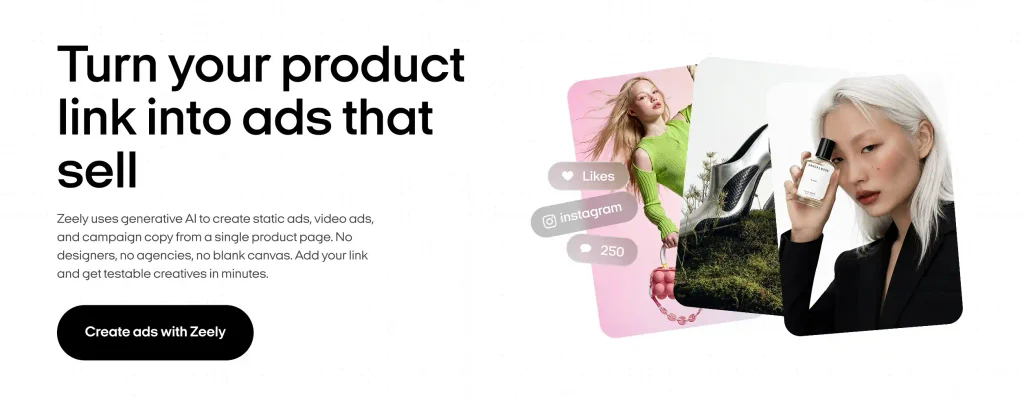
Text is only half the content problem. Most small businesses also need ad images, short-form video, and social content, and that is where visual AI tools come in. Zeely AI handles this side: you paste a product link, and the platform generates image ads, video ads with AI avatars, scripts, hooks, and captions from your product data. Over 2 million businesses use it to produce ad creative that would otherwise require a designer, a videographer, and a copywriter. Static ads generate in seconds, video in under seven minutes.
| Content type | Without AI | With AI | Why the gap matters |
| 50 product descriptions | A full week | An afternoon | Launch faster |
| Welcome email sequence | Days of drafting | One focused session | Revenue starts sooner |
| Week of social captions | Hours staring at a blank doc | 30 minutes of editing | Consistency without burnout |
| 5 ad copy variations | Writing each from scratch | Generate and pick the best | More testing, less unpaid work |
Constant Contact’s Q2 2026 report puts numbers on this: AI adoption in U.S. small business marketing surged from 26% in 2023 to 87% by April 2026. Among users, 42% use AI tools to compose content and 38% to analyze data. The adoption is high because the time savings hit you on day one.
How to get started without overcomplicating it
I see small businesses make the same mistake with AI: they sign up for five tools in the same week, get overwhelmed by the setup, and quietly abandon all of them by the end of the month.
Here is what actually works.
- Pick one bottleneck. Not five. Not “everything that could be better.” Literally one task that eats your time or bleeds your money. Maybe it is answering the same customer question forty times a week. Maybe it is building invoices by hand
- Give one tool 30 days. Before you start, write down your targets. Something concrete. Three to five hours saved per week. Error rates cut in half. A specific cost line trimmed by at least 10%. Without that benchmark, you are just hoping
- Measure it and be honest about what you see. Hit your targets? Great, keep going. Miss them? Do not throw more money at it. Check the logs, adjust, or try a different tool. A $29 subscription collecting dust is not an investment. It is a leak
- Only then add a second tool. And make sure it solves a different problem. Overlap is waste
A Goldman Sachs survey from the same period puts an interesting number on this. 76% of small businesses say they use AI. But when you look closer, only 14% have it actually woven into how they run day to day. Everybody else is testing, trying, figuring it out. That is the right approach.
Risks worth knowing before you spend
I am not going to pretend this is all upside.
- Data security is the one I watch closest. Whenever a tool touches customer data, I want to see SOC 2 or ISO 27001 on their security page. Multi-factor authentication should be on from day one. And here is one people skip: read the privacy policy. I have found vendors that quietly feed your business data into their model training. Not great
- Accuracy is a problem people underestimate. AI will state something completely false with total confidence. The industry has a word for it: hallucination. I once watched a tool generate a statistic, attribute it to a Harvard study, and the study did not exist. Check everything before you publish it or act on it
- Over-automation is what happens when you trust the system too much. One business I worked with launched an automated ad campaign on a Friday, did not check it for three weeks, and came back to find $800 spent on an audience that bought nothing. Same thing happens with email. Let the AI send customer messages without reviewing them and eventually something off-brand goes out
- Intellectual property does not have clear rules yet. AI builds content by drawing on material from all over the web. You might get output that is too close to someone else’s copy or accidentally uses a trademarked phrase. Review before you publish
- Customer trust is the one most businesses overlook. The 2026 Bentley-Gallup Business in Society survey found that 79% of American adults do not trust businesses to use AI responsibly, up from 77% the year before. When AI talks to your customers through chatbots, email, or product recommendations, tell them. Be upfront. And always make it easy to reach a real human
How AI can help your ad creative and campaigns
If paid social is part of your growth plan, AI can take over much of the creative and campaign work that small businesses usually outsource or skip.
Zeely generates image ads, UGC-style video, and copy from a product link, then walks you through launching campaigns on Meta, TikTok, and other channels. If you spend $500 or more per month on ads and want faster creative testing, Zeely AI is worth exploring.
FAQ
Not really. Starter plans sit in the $0 to $50 per month range, and most let you try before you pay. In my experience, the automation savings cover the subscription within a month or two.
Depends entirely on what is slowing you down. If it is scheduling, try Calendly. Bookkeeping, QuickBooks. Customer questions, Intercom. Ad creative, Zeely or Jasper. Writing, ChatGPT or Claude. Reporting, Google Analytics 4.
No. If you can navigate a spreadsheet, you will be fine. The tools I mention in this guide all work with Shopify, Google Workspace, Slack, Mailchimp. Setup is usually 10 to 15 minutes.
No, and I think that framing misses what is actually happening. AI picks up the tasks nobody wants to do: data entry, report building, scheduling, first-draft writing. Your team gets those hours back for strategy and creative work. When Goldman Sachs asked small business owners about this in 2026, 81% said AI added to their team’s output. Nobody was getting replaced.
Before you start, write down your baselines. Hours spent on a task, error rates, costs. Then after 30 and 60 days, compare. The three things worth tracking: time saved each week, money saved in specific areas, and any lift in conversions you can trace back to the tool.
That is the first question I would ask any vendor. Look for SOC 2 or ISO 27001 certifications. Read their data handling policy, especially the parts about whether they train on your inputs. Some do. Turn on every security setting they offer. If something feels vague in their policy, that is your answer.
Depends on the use case. Automation tools and content generators save you time in the first week. The difference is immediate. Marketing optimization and analytics need longer. Those tools require 30 to 60 days of data before they become useful. Give them that runway.

Emma blends product marketing and content to turn complex tools into simple, sales-driven playbooks for AI ad creatives and Facebook/Instagram campaigns. You’ll get checklists, bite-size guides, and real results, pulled from thousands of Zeely entrepreneurs, so you can run AI-powered ads confidently, even as a beginner.
Written by: Emma, AI Growth Adviser, Zeely
Reviewed on: September 25, 2026