Best beauty ads: 15 iconic campaigns and what makes them work
Which beauty ad campaigns are actually worth studying, and what can a smaller brand take from them? I break down 15 examples from Vaseline to K18, explain why each one worked, and pull out the specific move you can steal without matching the budget.
Key takeaways
- Every campaign on this list won by doing one thing clearly, not six things vaguely. The ad had a point, the proof was real, and the format matched the platform
- Half of these brands spent less on production than you might guess. UGC, transparent pricing, and one smart product idea showed up more often than big media buys
- Pay attention to what each brand actually changed. Was it the hook? The proof? The channel? That matters more than knowing the brand name

A model, a tagline, and a magazine page used to be the whole playbook. You still see that formula, but it has not decided a winner in years.
Statista projects the global beauty and personal care market at roughly $698 billion in 2026. Skincare accounts for over 40% of that on its own. The money keeps growing, the ad slots keep filling, and the scroll keeps getting faster. So the creative has to do more work per second than it used to.
I went looking for campaigns worth learning from and ended up with 15. Some are heritage brands that have been running ads since before Instagram existed. Some launched in the last three years with barely a marketing team. What they share is specificity. Each one did a single thing well enough that a smaller business can steal the approach.
15 beauty ad campaigns worth studying
A viral post is a moment. A campaign is a system. I picked these 15 because each one changed something I could name. Sometimes it was the hook. Sometimes the proof format. Sometimes the whole distribution model. But there was always one clear move that made the difference.
1. Vaseline: Scientists testing TikTok hacks in a lab
Over 3.5 million social media posts shared Vaseline hacks, from preventing hair dye stains to creating a soft focus camera lens. Most brands would have ignored it or sent a cease and desist. Vaseline sent scientists.
- What they did. Working with Ogilvy Singapore, Vaseline Verified invited Unilever lab scientists to test hundreds of viral petroleum jelly hacks. Tips that passed got a #VaselineVerified seal and a custom trophy. Unsafe or misleading hacks were called out on out of home ads. The campaign turned a potential brand risk (unsanctioned product uses going viral) into the campaign itself
- Why it worked. Within three months, the campaign had passed 136 million social views. The advertising industry noticed too: Ad Age named it Social Campaign of the Year in 2026, and it collected 20 Cannes Lions (a Titanium and two Grand Prix among them). Unilever said the brand hit double digit growth. Then Vaseline kept going. The team turned verified hacks into actual product launches and partnered with the 2026 London Marathon as the “Official Nipple Protector” for 50,000 runners. That last detail alone earned another wave of press
- What I would take from it. Vaseline did not invent a campaign idea. It found millions of people already experimenting with its product and said, “Let us test that for you.” A small brand can do something similar by filming its own version: pick the five weirdest customer hacks, try them on camera, and post the results. The content writes itself because the behavior already exists
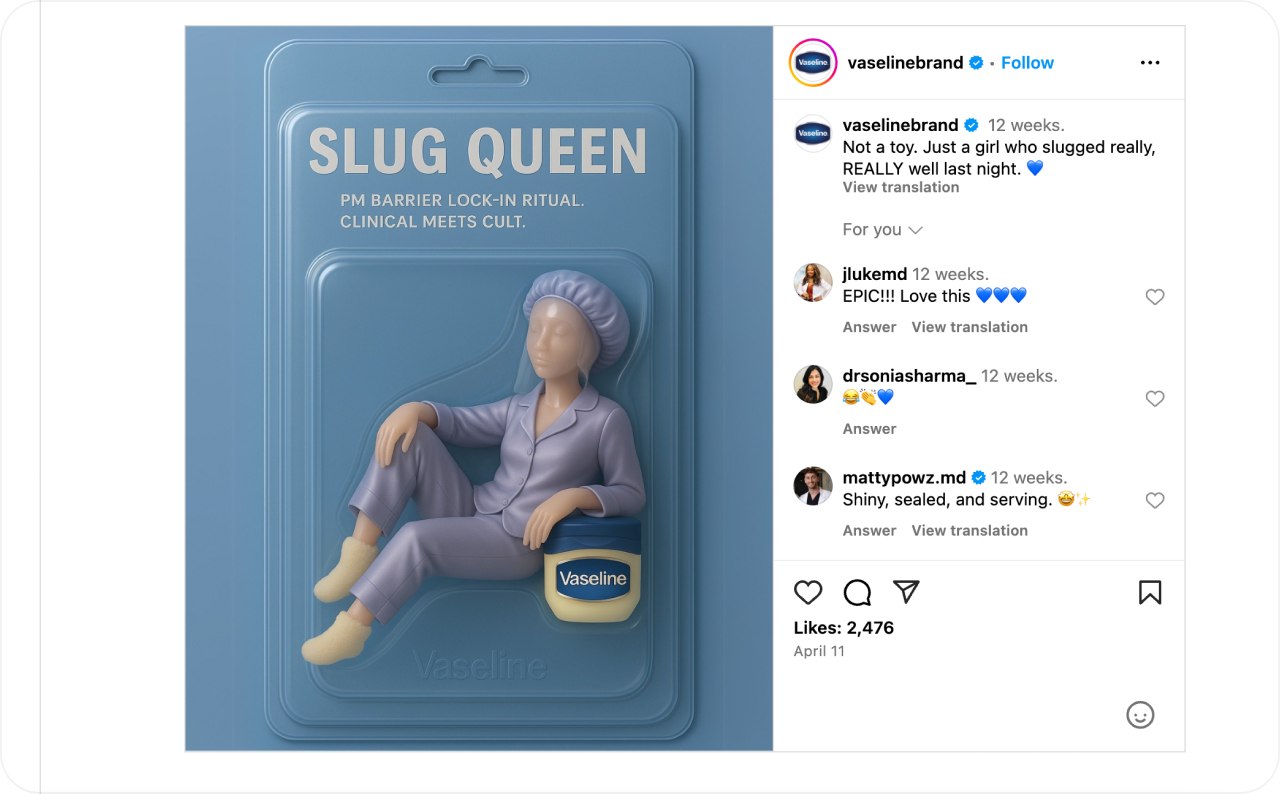
Photo source: @vaselinebrand on Instagram
2. CeraVe: The conspiracy theory that won the Super Bowl
Did Michael Cera secretly develop CeraVe? That was the question bouncing around TikTok and Instagram in late January 2024. Somebody photographed him signing CeraVe bottles at a pharmacy. Influencers weighed in. Old Reddit threads resurfaced. The whole thing looked organic. It was not.
- What they did. Working with Ogilvy, CeraVe recruited over 450 influencers to fuel the conspiracy before the game. The Super Bowl spot revealed the punchline: Cera pitches his “Michael CeraVe” idea to a boardroom of unimpressed dermatologists. The tagline landed the real message: “CeraVe is developed with dermatologists. Not Michael Cera.” It won the Super Clio, a Cannes Grand Prix in Social and Influencer, and reportedly lifted sales by 25%
- Why it worked. By the time the actual commercial aired during the game, millions of people were already invested in finding out the answer. The internet had done the distribution work for free. Three weeks of organic debate made the 30 second spot feel like a punchline everyone had been waiting for, not an interruption nobody asked for
- What I would take from it. The budget was large, but the principle works at any scale. Seed a question, let people debate it, then answer it with your product. A small brand could run a similar arc across two weeks of social posts. The key ingredient was not money. It was patience and a good punchline
3. Fenty Beauty: 40 shades that reset the industry
Fenty Beauty launched with a 40 shade foundation line. Overnight, every other brand’s range looked incomplete.
- What they did. Rihanna handed the campaign to everyday consumers, many of them micro influencers. “Fenty Faces” filled Instagram with real people testing real shades. That user content pulled more engagement than the paid celebrity posts
- Why it worked. The launch generated massive YouTube viewership in its first month and reportedly drove around $100 million in early sales. Competitors rushed to widen their own shade ranges, which said more about the strategy than any metric could
- What I would take from it. Inclusivity is a product decision, not a marketing angle. If your product genuinely serves a group the industry ignores, hand them the camera. They will sell it better than your agency
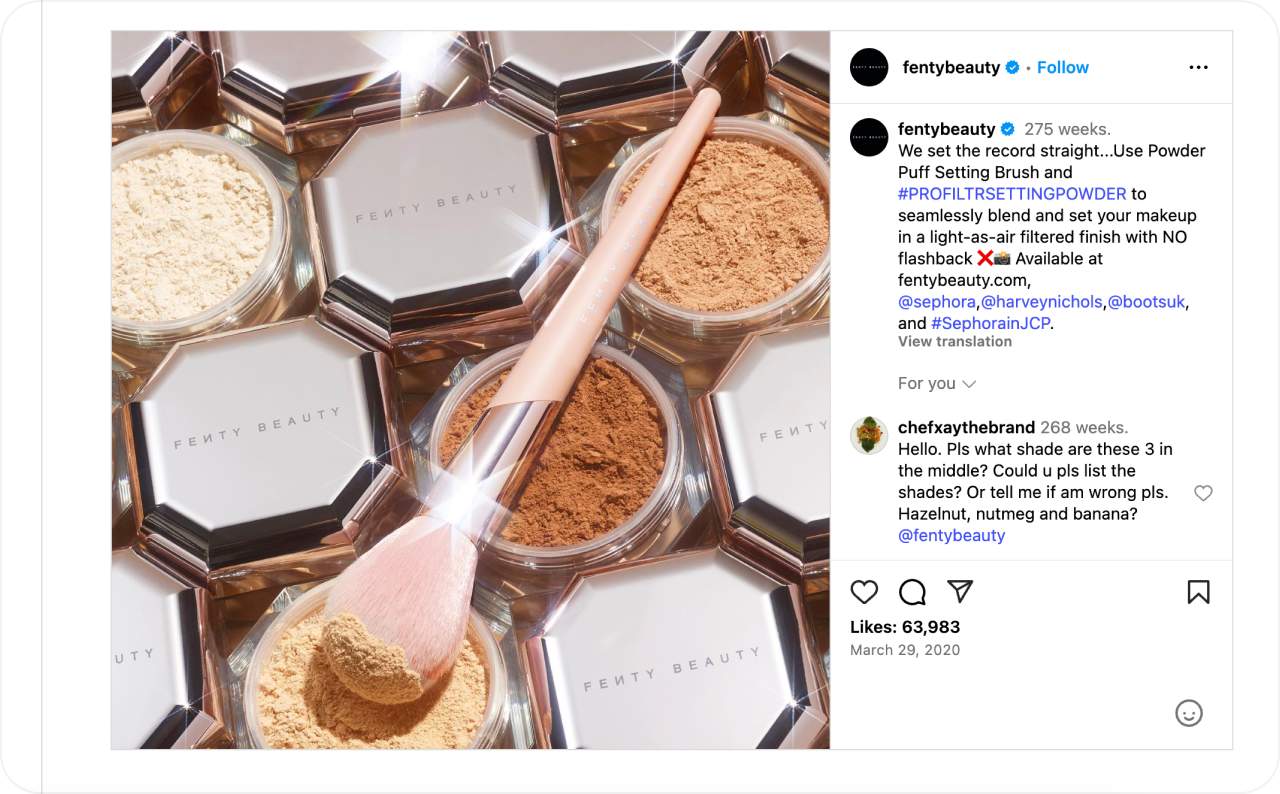
Photo source: @fentybeauty on Instagram
4. Clinique: Picking athletes over beauty influencers
Your mother probably had Clinique on her bathroom shelf. That was the brand’s positioning problem in a nutshell. In March 2026, Clinique launched “Unstoppable Together,” its first creator led campaign. The talent: Olympic long jumper Tara Davis Woodhall and Paralympic sprinter Hunter Woodhall, her husband. Not a single beauty influencer in sight.
- What they did. The campaign paired two Moisture Surge products with the couple’s story of partnership and performance, running across Hulu, Disney+, Netflix, TikTok, YouTube, and Meta. At a dinner in New York, Clinique invited other creators to bring a plus one, matching the “duo” theme. Between them, the Woodhalls carry 7.7 million social followers. Clinique’s own accounts have fewer
- Why it worked. Instead of competing for beauty influencer attention (a market flooded with brand deals), Clinique stepped into a different cultural lane: sport and wellness. Gen Z and millennials together account for 49% of Clinique’s audience, and athletes have become the new figures that demographic looks up to. The campaign repositioned a legacy brand without abandoning its heritage
- What I would take from it. The beauty influencer market is so saturated that standing out in it costs more every quarter. Clinique sidestepped the whole contest. They picked athletes, a category where brand deals are still fresh enough to feel real. A smaller brand could do the same with a local trainer, a chef, a nurse. The point is to go where your audience’s trust already lives, not where every other skincare brand is fighting for attention
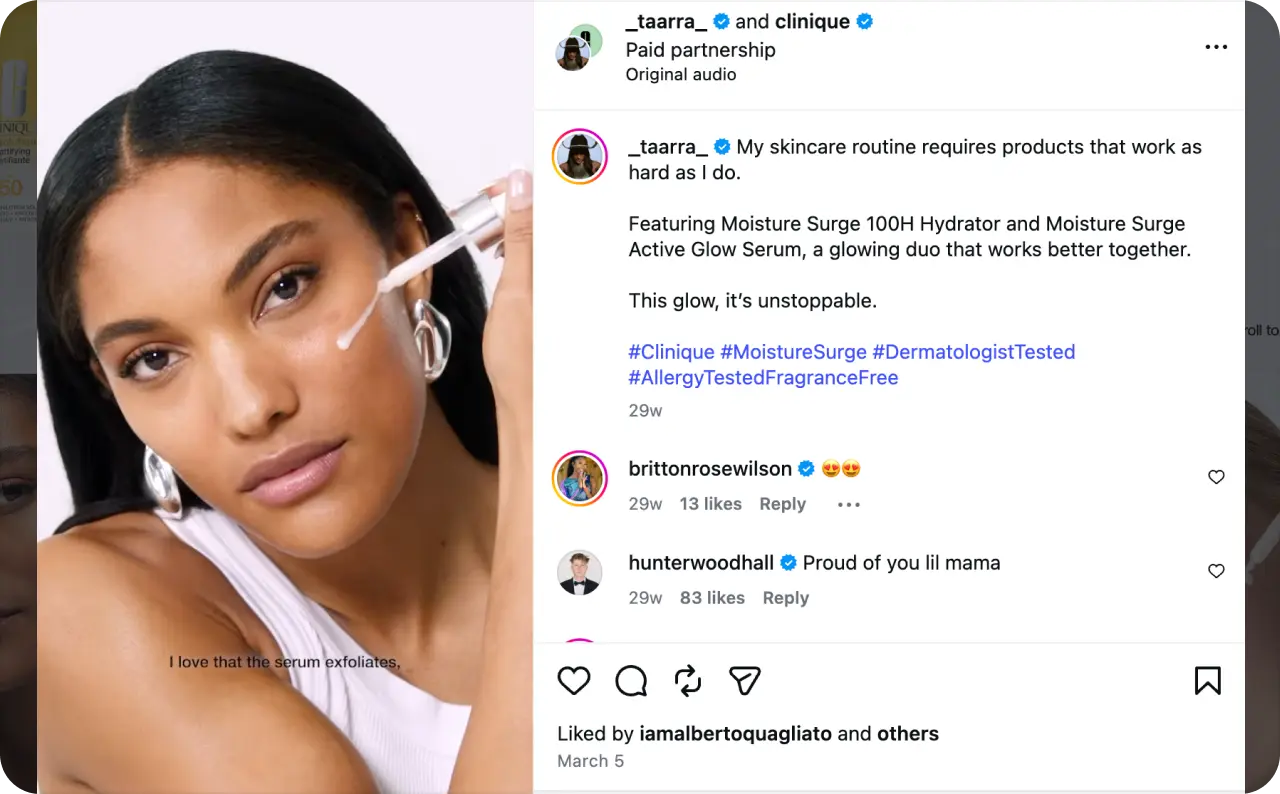
Photo source: @clinique on Instagram
5. Dove: Real Beauty, two decades and counting
Real Beauty has been running since 2004, which is almost unheard of for a single campaign idea. It keeps changing shape. The 2026 version was a vending machine that dispensed identical plastic faces. The point: algorithms have flattened beauty into one look, and Dove wanted people to notice.
- What they did. Started with unretouched photography and social experiments. Then added long form video, community testimonials, hashtag campaigns, and user generated stories over the years. The core message never changed. Only the format around it did
- Why it worked. Revenue grew from $2.5 billion to over $4 billion under Unilever. Favorability lifts have been documented across multiple independent studies
- What I would take from it. Dove found one emotional truth (real beauty lives in real bodies) and spent twenty years finding new ways to say it. That kind of patience is rare. It is also the reason the campaign still works while most competitors’ 2004 ads are forgotten

Photo source: Dove “Real Beauty” campaign
6. Topicals: The influencer trip that did not look like an influencer trip
Most beauty brand trips invite the same handful of macro influencers to the same five star resort. Topicals, a skincare brand focused on chronic skin conditions, did it differently. For its third birthday in 2023, it took 16 creators to Bermuda. Nearly all of them were BIPOC. Several had never been invited on a brand trip before.
- What they did. The Bermuda trip was the first fully BIPOC sponsored beauty brand trip. Topicals followed it with a trip to Accra, Ghana during Detty December, taking 12 creators who live with the skin conditions the products treat. Casting was built around representation, not follower count. Creators were encouraged to film authentically rather than follow a shot list
- Why it worked. Bermuda alone pulled 3 million impressions and added 5,000 followers to TikTok and Instagram. Ghana did even better: 5.6 million TikTok views from just 12 creators. But the numbers only tell part of it. Business of Fashion, BeautyMatter, and Beauty Independent all covered the trips because they challenged a format that had gone stale and exclusionary. Topicals got earned media from the press coverage on top of the influencer content
- What I would take from it. You do not need a five star resort. You need guests who actually represent your customer and a setting that gives them something real to share. Topicals proved that the people you invite matter more than the destination. If your brand serves a specific community, make that community the campaign
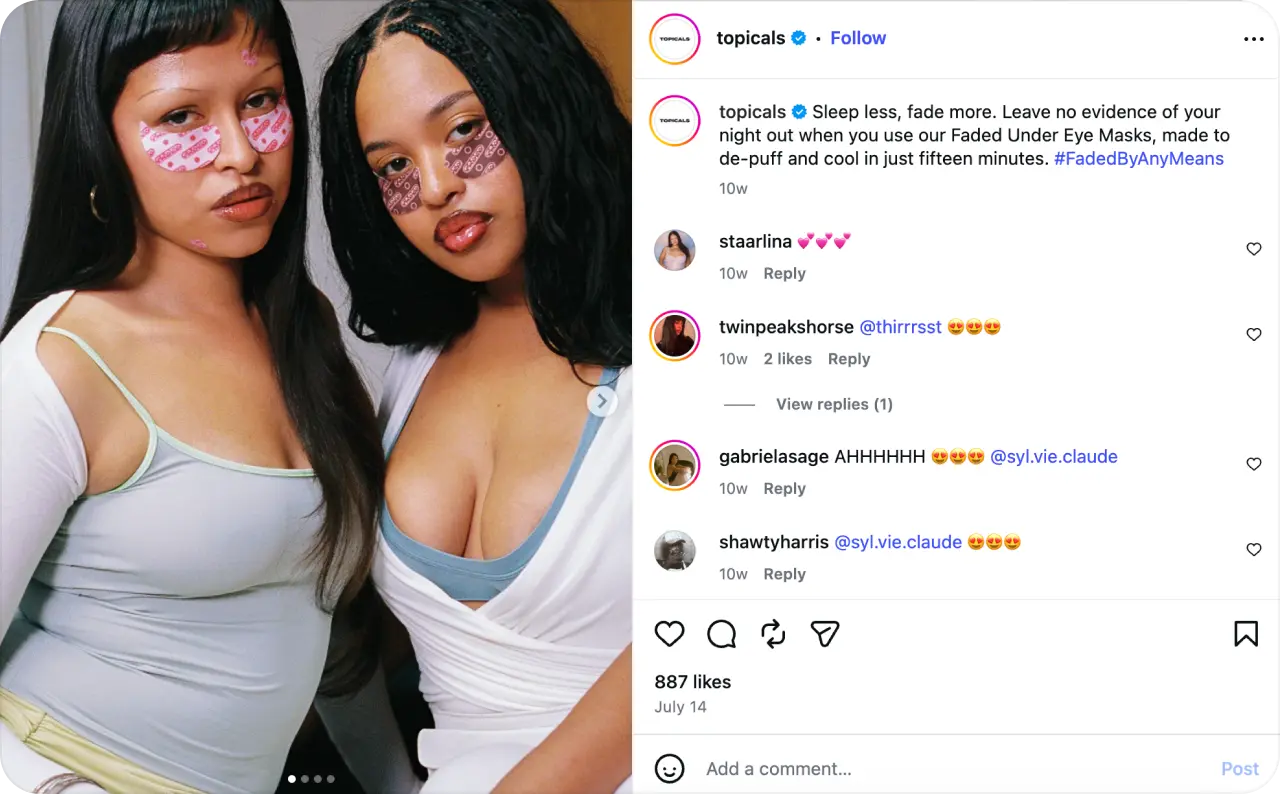
Photo source: @topicals on Instagram
7. SKIMS: UGC first on TikTok
SKIMS treated TikTok as a creative engine, not a media buy. The brand boosted real customers and mid tier influencers filming haul videos and try ons. None of it polished, all of it built for the algorithm.
- Why it worked. TikTok mentions surged within 60 days. Community led videos outperformed the brand’s own paid ads in organic reach. Quarter over quarter sales grew by double digits
- What I would take from it. On short form feeds, a genuine try on shot on an iPhone often beats a studio shoot. It looks like something a friend posted. That is the whole advantage
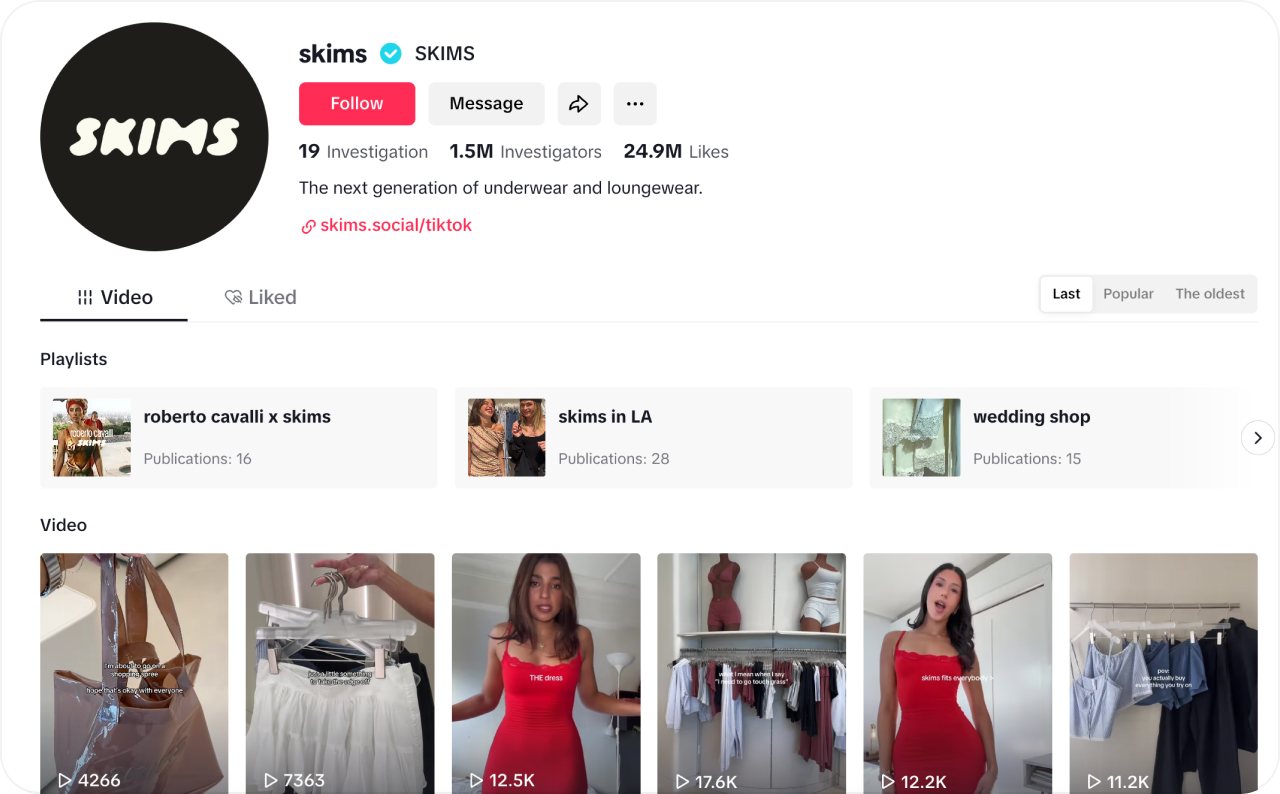
Photo source: @skims on TikTok
8. Garnier: AR filters that turned browsing into buying
Most hair color ads show the after. Garnier let people see the during, on their own face.
- What they did. AR filters on Instagram and Snapchat let users preview shades live. Influencers walked through the feature in tutorials, making it feel both fun and practical
- Why it worked. Swipe up rates on filter campaigns ran far above standard ads. Online hair color sales climbed. Gen Z brand interest jumped
- What I would take from it. If the product creates a visible change, let the customer try it before they pay. Virtual try on tools like Spark AR have become cheap enough for smaller brands to experiment with

Photo source: Garnier virtual Try On campaign
9. Glossier: Customers as the marketing department
Glossier went from beauty blog to $1.2 billion valuation without running traditional ads. The product was the marketing. The customers were the media.
- What they did. #GlossierIRL and #ITGTopShelfie asked buyers to photograph their own routines and post them. That was the campaign. No studio, no script. Glossier shipped free product to regular fans, skipped the celebrity tier entirely, and let whatever those fans filmed become the brand’s feed. The math backed it up: peer referrals drove the vast majority of online sales, and most new customers said they first heard about Glossier from a friend
- Why it worked. When the content is made by real buyers, it reads as real. Glossier’s Instagram outperformed competitors who were spending multiples on production, because authenticity is not something you can buy. You can only get out of its way
- What I would take from it. A branded hashtag, a referral program, and a habit of reposting customer content. That is Glossier’s engine, and it works at any scale. I have watched small skincare brands pull it off with a few hundred followers. For more on this format, see our guide to real UGC video ad examples
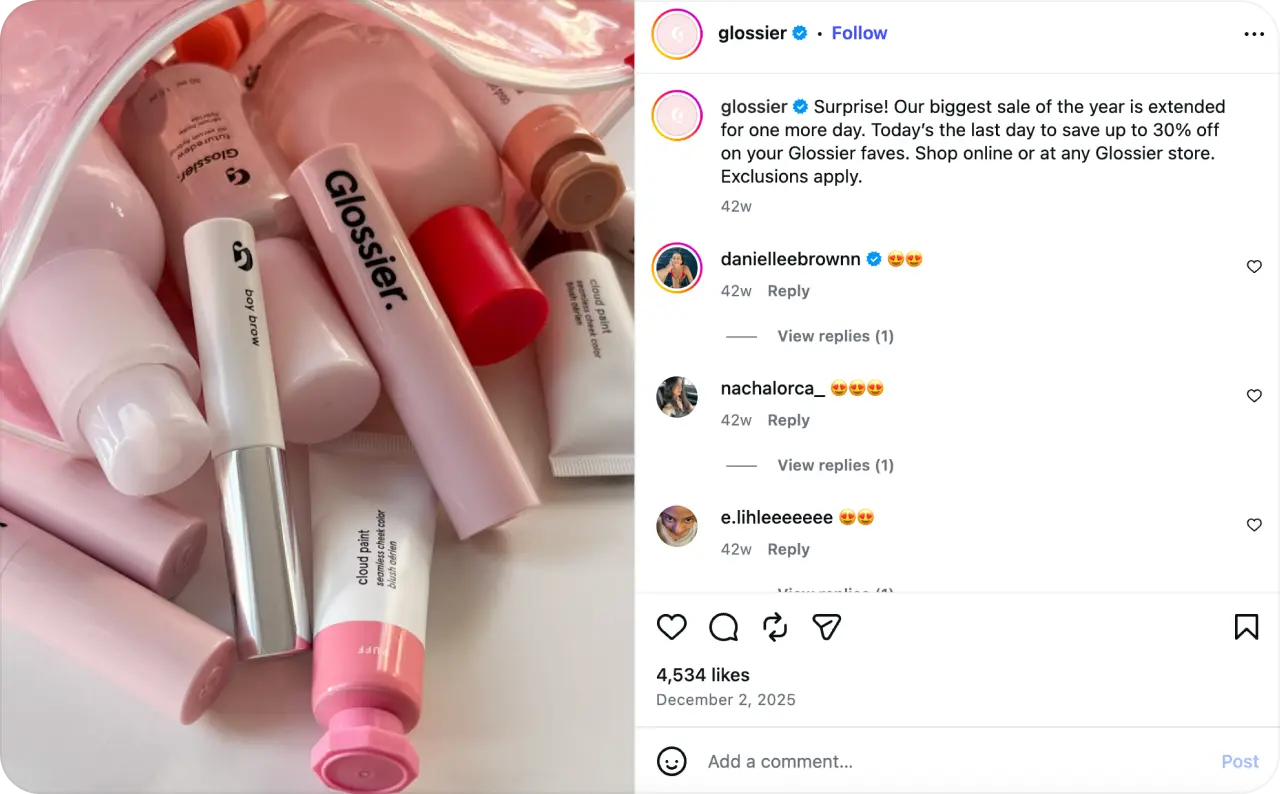
Photo source: @glossier on Instagram
10. Rare Beauty: Mental health as a brand pillar
Most celebrity beauty brands launch with a splashy campaign and a famous face. Rare Beauty launched in 2020 with a philanthropy arm. Selena Gomez attached the Rare Impact Fund from the start: 1% of every sale goes to youth mental health services. The target is $100 million. As of mid 2026, the fund has passed $30 million and supports 30 nonprofit partners on five continents, reaching 3.5 million young people a year.
- What they did. There is very little glamour in the traditional sense. The marketing leads with self acceptance and vulnerability. Once a year, the “Make a Rare Impact” campaign with Sephora gives 100% of Rare Beauty sales on World Mental Health Day to the fund. Gomez herself talks publicly about living with anxiety and bipolar disorder. She does not read from a script about it. You can tell
- Why it worked. The Sephora partnership reached over two million people in 2024. Most celebrity beauty brands compete on shade range or packaging. Rare Beauty gave people a reason to care about the company itself. In a crowded category, that is a real edge
- What I would take from it. If you tie your brand to a cause, show receipts. Rare Beauty publishes how much money goes where. A vague “we care about wellness” line without dollars behind it produces nothing
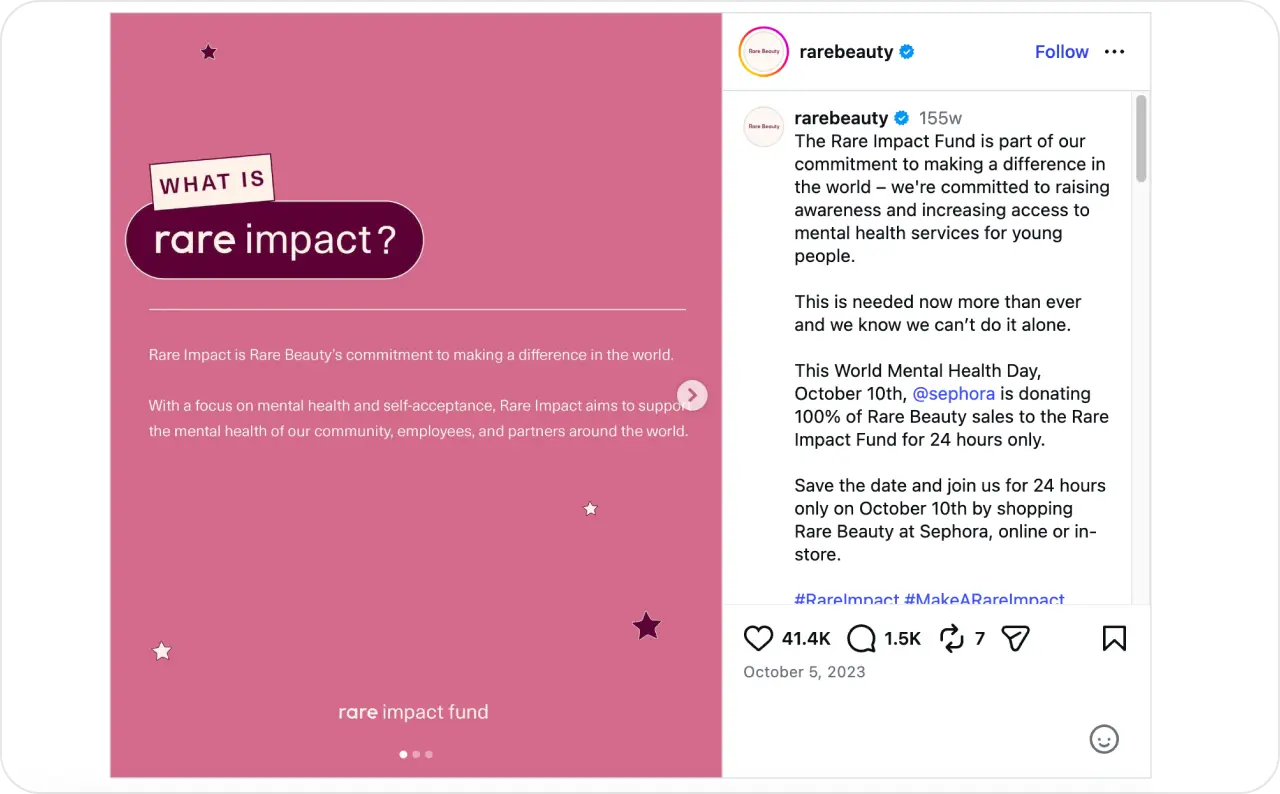
Photo source: @rarebeauty on Instagram
11. MAC Viva Glam: Cause marketing before anyone called it that
The year is 1994. The HIV/AIDS epidemic is killing people across the fashion and beauty industries. Most companies stay quiet. MAC puts RuPaul on a billboard and starts donating every cent from its Viva Glam lipstick to HIV/AIDS programs.
- What they did. A different cultural ambassador every year. k.d. lang, Lady Gaga, Ariana Grande, Winnie Harlow. Each one pulling in a different audience. The 100% donation model turned every purchase into participation
- Why it worked. According to MAC’s 2025 Impact Report, Viva Glam has raised over $540 million since 1994, reaching more than 60 million lives across 92 countries and supporting more than 2,000 NGOs. Viva Glam is not a campaign anymore. It is an institution
- What I would take from it. One off charity promotions disappear in a week. MAC’s version works because the donation is embedded in the product, not stapled to a quarterly calendar. Small brands can start with a fixed percentage per order to one specific organization. Keep it small, keep it permanent, keep it visible
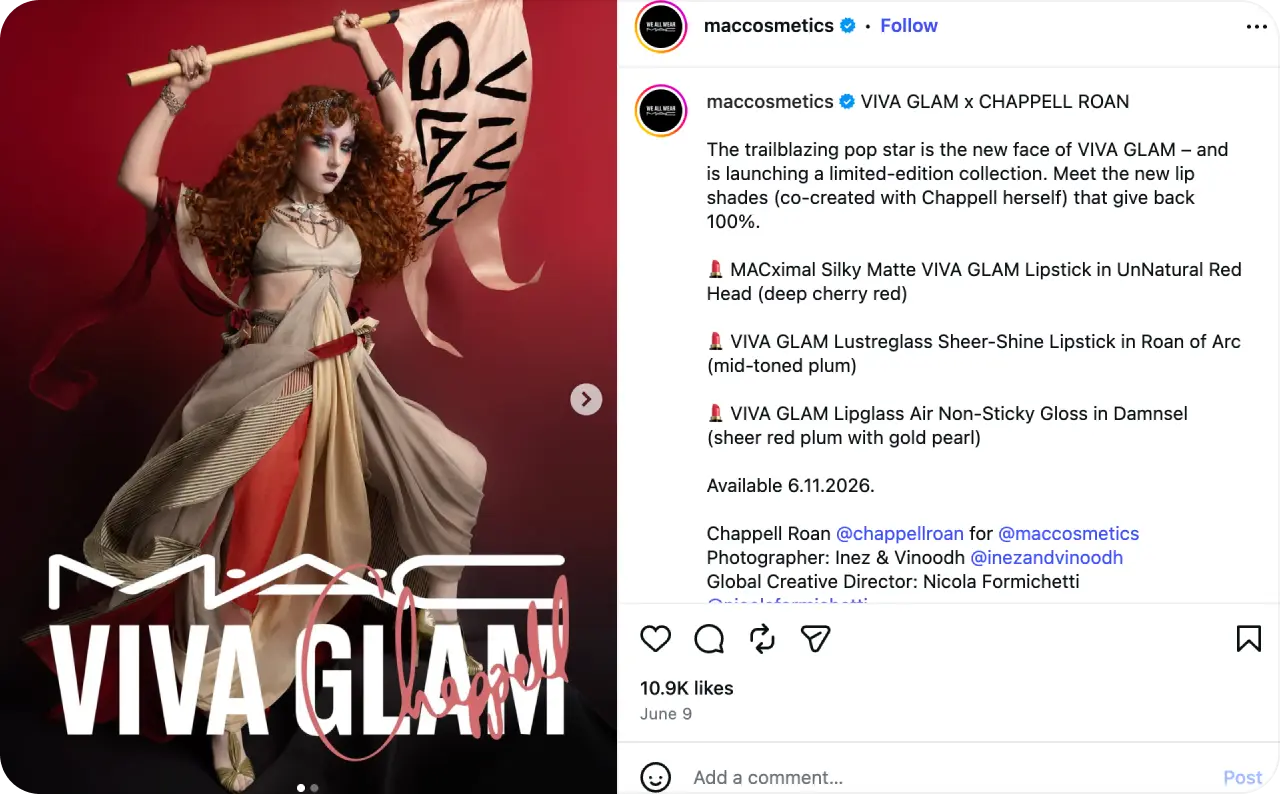
Photo source: @maccosmetics on Instagram
12. Rhode: A phone case that outperformed paid ads
Hailey Bieber’s Rhode did eight figures in its first 11 days. But the marketing moment everyone remembers is not a product. It is an accessory.
- What they did. Early 2024: Rhode released the Lip Phone Case, a slim case with a slot for the brand’s Peptide Lip Treatment. The case solved a real problem: nobody can ever find their lip balm. And every person using one became a walking Rhode ad, which is the kind of marketing you cannot buy at any CPM. Bieber teased the launch to over 50 million Instagram followers and the waitlist hit 440,000. Micro influencers and fans posted organic UGC across TikTok and Instagram. No media buy required
- Why it worked. Rhode became the number one skincare brand in earned media value in 2024. When e.l.f. Beauty acquired Rhode for $1 billion in 2025, the filing disclosed $212 million in net sales for the twelve months ending March 31, 2025. That is from a lineup that started with barely a dozen SKUs
- What I would take from it. The phone case was not really a product. It was a distribution strategy disguised as an accessory. If you can make something functional that people carry around with your brand on it (a sample kit, a tote, a reusable container) you get daily impressions without paying for them
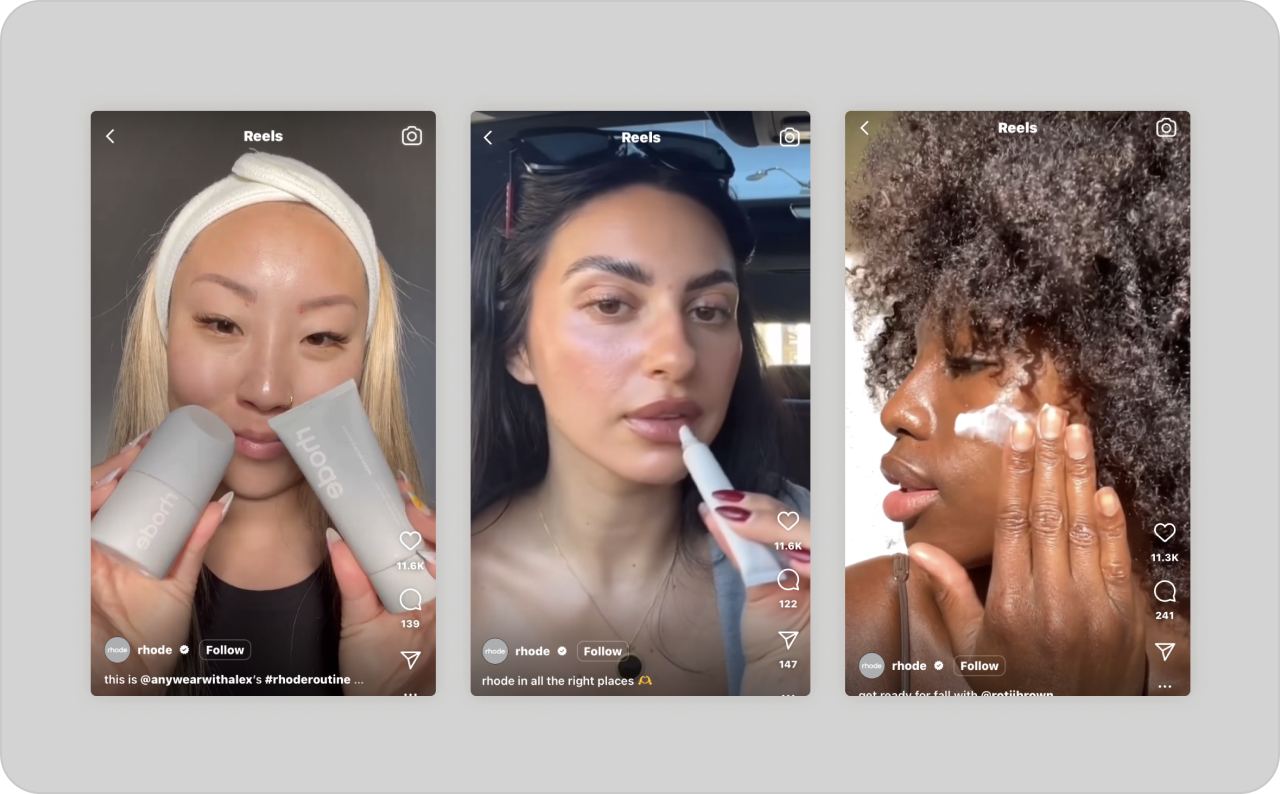
Photo source: Rhode on DTC Patterns
13. The Ordinary: A $175 banana to expose beauty pricing
May 2026. The Ordinary opens fake grocery stores in six cities: Toronto, London, Paris, São Paulo, Mexico City, Melbourne. Inside, everyday food is repackaged with luxury beauty language and absurd prices.
- What they did. Working with Uncommon Creative Studio, “The Markup Marché” sold a banana as an “All Natural Magical Energy Boosting Bar” for $175.90. Toilet paper became a “High Retention Cleansing Cylinder” at $96.20. Coconut: “Exotic Thirst Defying Hydration Vessel,” $195.50. Nobody actually paid those prices. At checkout, visitors walked out with free samples of the brand’s real products, serums under $10
- Why it worked. TikTok walkthrough videos collected millions of views. The Ordinary took consumer skepticism about premium pricing and turned it into physical comedy. The clean beauty segment is growing rapidly, projected to expand from $11.9 billion in 2026 to $35.3 billion by 2033 at a 16.8% CAGR according to Grand View Research. This campaign planted The Ordinary right at the center of that transparency conversation
- What I would take from it. The concept (exposing inflated pricing through humor) could work as an Instagram carousel, a TikTok series, or a short video breaking down your own cost per ingredient. You do not need six popup stores. You need a point and the nerve to make it entertaining
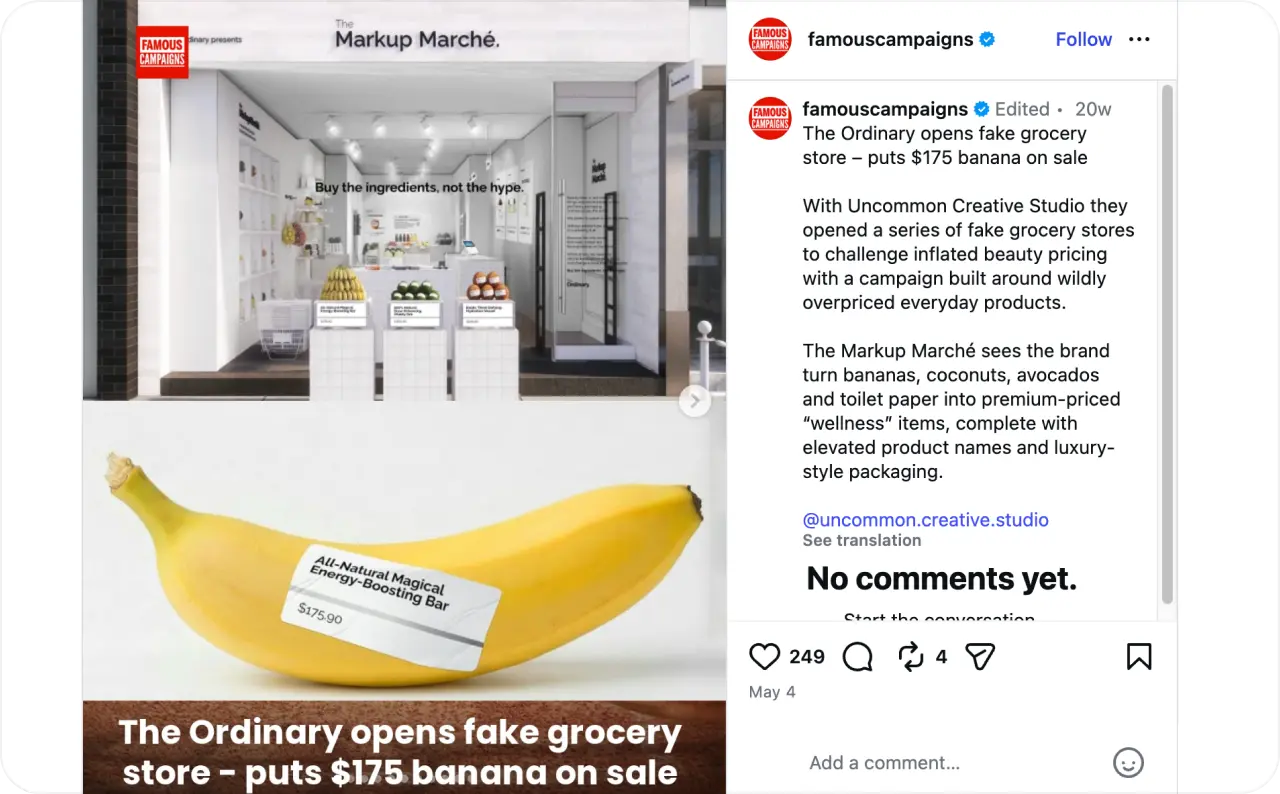
Photo source: @famouscampaigns on Instagram
14. e.l.f. Cosmetics: Beauty at the Super Bowl
e.l.f. was the first indie beauty brand at the Super Bowl, in 2023. They came back in 2024. And 2025. Different creative angle each time.
- What they did. Year one: Jennifer Coolidge in a sticky, playful ad for the viral Power Grip Primer. Year two: “Judge Beauty,” with Judge Judy putting overpriced beauty on trial. Both spots started from a product that was already trending on TikTok and pushed it into mass media
- Why it worked. The national spot in 2024 tripled household impressions. In its fiscal 2026 earnings, e.l.f. reported full year net sales of $1.64 billion and marketing spend of roughly 24% of net sales. The company recently cut the price of its Halo Glow Skin Tint to $14, which produced a 38% sales lift on Amazon and triple digit growth on TikTok Shop
- What I would take from it. Forget the Super Bowl budget. The lesson is smaller: stop making your ads look like beauty ads. Humor and pop culture references grab more attention than one more polished product demo. e.l.f. did not manufacture the TikTok buzz. They just bought it a bigger megaphone
15. K18: The hair flip challenge
One gesture. One product. Millions of views. K18 asked TikTok users to flip their hair after using the brand’s leave in molecular repair mask and let the results speak.
- What they did. K18 partnered with hairstylists and niche beauty creators who had genuine followings, not just large ones. The challenge worked because the proof was visual and effortless to film
- Why it worked. No scripts. No storylines. Just healthy hair on camera. The challenge kept K18 among the most talked about professional haircare brands on social media through early 2026
- What I would take from it. If your product creates a visible result, design a challenge around that one moment. Seed it with creators who actually use it. Forced virality rarely lands. Natural demonstration does
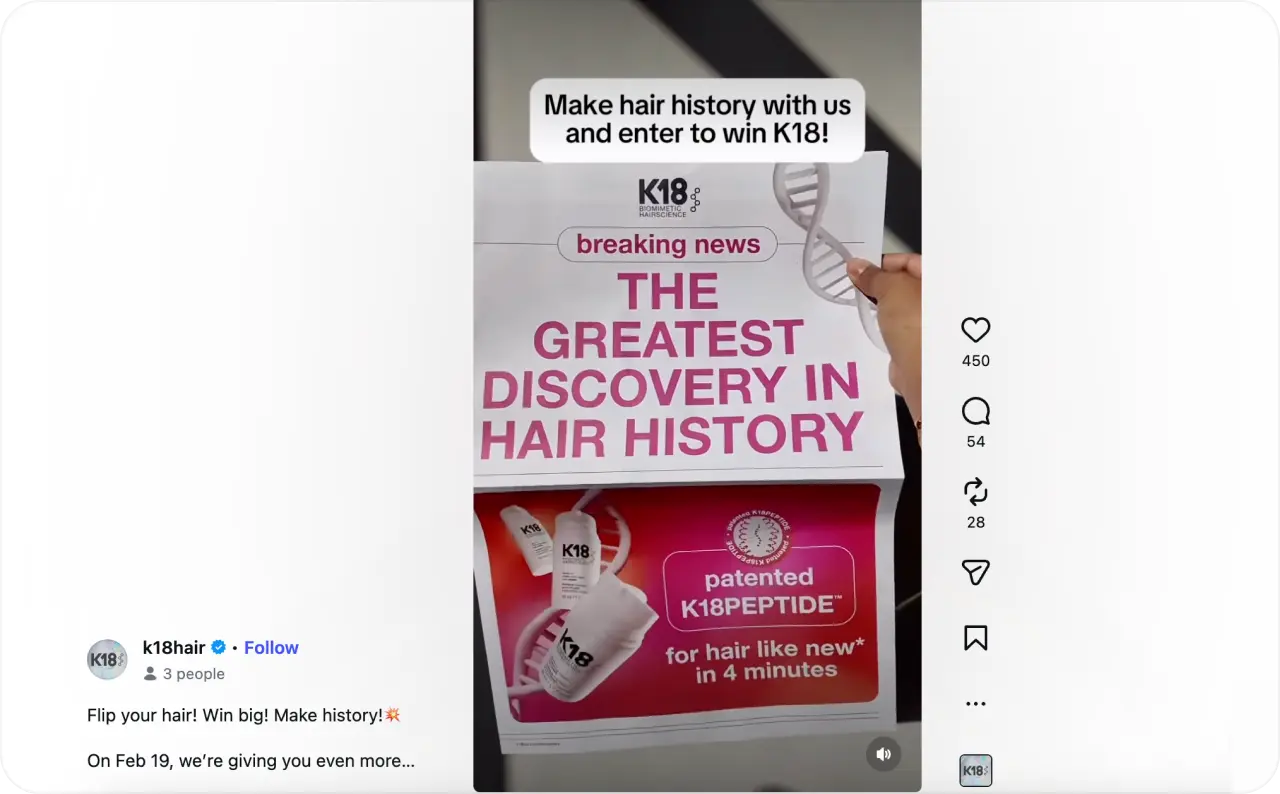
Photo source: @k18hair on Instagram
How to create your own beauty ads
Glossier, SKIMS, and K18 all made this list without traditional production budgets. The tools have caught up to the ambition.
Zeely handles the part that used to require a creative team: image ads, video ads with AI avatars, hooks, scripts, captions, all generated from your actual product data and ready to test. The workflow runs in three stages (Create, Launch, Scale), so you build creatives, push them into Meta campaigns, and read performance from the same place. There are over 2,000 ad references in the library, and you can spin out multiple variations of one idea for A/B testing. Fashion and beauty is the platform’s biggest customer segment, so the AI has already learned what tends to land in this category.

I would not promise that any tool lowers your CPA. What it does is kill the production bottleneck. Three hooks tested by Thursday instead of one edit delivered in two weeks. Then do what every brand on this list did: keep the winner, swap one variable, test again.
Conclusion
Dove won with vulnerability. Fenty won with inclusion. The Ordinary won with a $175 banana. Rhode won with a phone case. e.l.f. won with Jennifer Coolidge and Judge Judy. K18 won with a hair flip.
Not one of those required the biggest budget in the category. They required the clearest story.
AI tools like Zeely now let solo entrepreneurs and small business owners generate marketing ready creatives, launch Meta campaigns, and read performance without hiring an agency. Find your product truth, test it, and scale whatever earns customers.
FAQ
The right viewer quickly understands the product, the benefit, the proof, and what to do next. A clear message and honest proof carry more weight than production value.
Start with what you can afford to test, not what a case study says. Calculate your break even CPA, fund one focused campaign, and read the numbers before you scale.
No. Glossier, The Ordinary, and K18 built strong campaigns without traditional celebrity deals. Micro influencers and real customers often pull higher engagement because the content reads as genuine. If you hire creators, pick ones who actually use the product.
Zeely generates image ads, video ads with AI avatars, and multiple creative variations from your product data. You go from a product link to a testable ad in minutes.
Cramming six benefits into one ad. Every strong campaign on this list carried a single idea. One benefit. One audience. One proof point. One CTA. Your viewer has one thumb and a lunch break.
Emma blends product marketing and content to turn complex tools into simple, sales-driven playbooks for AI ad creatives and Facebook/Instagram campaigns. You’ll get checklists, bite-size guides, and real results, pulled from thousands of Zeely entrepreneurs, so you can run AI-powered ads confidently, even as a beginner.
Written by: Emma, AI Growth Adviser, Zeely
Reviewed on: September 25, 2026