Best Runway alternatives for marketers and short-form video ads
Is Runway too cinematic when your small business needs short-form ads it can launch, test, and improve this week? I’m Emma from Zeely, and I built this guide for small-business concerns about trust, cost, captions, and creative fatigue.
The best Runway alternative for marketers is Zeely if you need product-to-ad workflows, UGC-style scripts, captions, platform-ready exports, and faster creative testing. Pika is better for VFX hooks, Haiper for quick prompt and image-to-video tests, Kaiber for music-led videos, Leonardo Motion for brand visuals, and Moonvalley for controlled cinematic scenes. Runway still wins for deep generative control; switch when you need ads you can launch and test.
Runway is powerful, but not every small business needs a cinematic AI studio. Sometimes you need five product ads, three hooks, captions, a clear CTA, and exports that are ready for TikTok, Reels, Shorts, or Meta campaigns. That is why this guide focuses on Runway alternatives for marketers, not a generic list of every AI video tool online.
Why marketers look for Runway alternatives
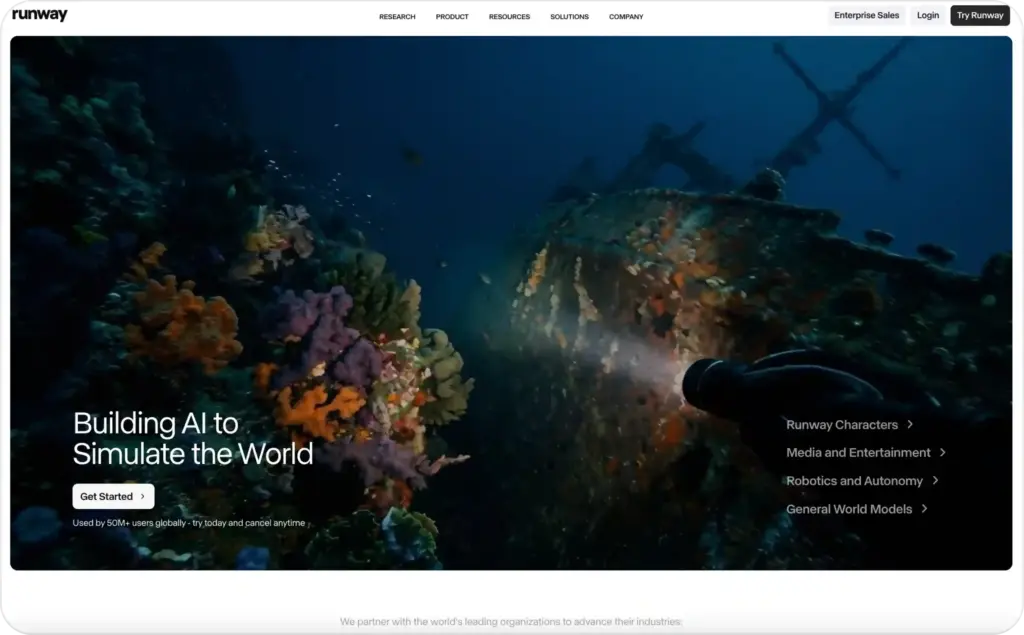
I like Runway for what it is: a serious AI video platform with strong generative models, editor projects, credit-based plans, 4K upscaling, no-watermark paid exports, and access to tools such as Gen-4.5, Gen-4 Turbo, Aleph, Veo, and more. Its Standard plan starts at $15 monthly or $12/month when billed yearly, with 625 monthly credits; Pro and Max add much larger credit pools for heavier production.
But most small business owners are not asking, “Can I generate a beautiful shot?” They are asking, “Can I make a good ad before tonight?” That changes the comparison.
For short-form ads, the job is not only video generation. You need a hook, product proof, captions, a script, a voice or avatar, product visuals, a CTA, platform-ready formats, and enough variations to test before the first idea gets tired. That is where many AI video generators like Runway feel exciting in a demo but incomplete in an actual ad workflow.
There is also a trust problem. In Reddit discussions about AI UGC, marketers worry that AI creator-style ads can damage credibility when they look like fake customers instead of clear brand-made content. It means the best Runway competitors for marketers should help you make ads faster without pretending that fake proof is real proof.
How I compared Runway alternatives for short-form ads
For this page, I am using a marketer’s filter. I am not ranking tools by who can make the prettiest fantasy scene. I am ranking them by whether they help a business owner create, edit, export, and test short-form ads.
The six criteria are simple:
| Criteria | What I checked |
| VFX | Can it create strong visual moments, motion, effects, or AI-generated scenes? |
| Ad templates | Does it help structure ads, or does the user start from a blank prompt? |
| Captions/scripts | Does it help with hooks, captions, scripts, CTAs, avatars, or voice? |
| Export | Can the output move easily into social ads, Reels, Shorts, TikTok, or Meta? |
| Control | Can marketers adjust the message, format, motion, avatar, product, or scene? |
| Price | Is pricing clear enough for repeat testing? |
That last point matters more than most roundups admit. If a tool gives you one beautiful clip but makes it expensive or confusing to test ten new angles, it may not be the best fit for a small business.
Runway alternatives capability matrix
| Tool | VFX | Ad templates | Captions/scripts | Export | Control | Price | Best fit |
| Runway benchmark | Strong AI video generation, Gen-4.5/Gen-4 Turbo, 4K upscaling | Not mainly an ad-template workflow | Creator/editor-oriented, not ad-copy-first | Paid plans remove watermarks and support higher-end outputs | High generative control | Free; Standard from $15/mo or $12/mo yearly; Pro $35/mo or $28/mo yearly; Max $95/mo or $76/mo yearly | Cinematic AI video and advanced generative control |
| Zeely | Ad-focused video creation rather than deep cinematic VFX | Strong product-to-ad and UGC-style workflows | AI scripts, avatars, hooks, music, edits, captions | Built for TikTok, Reels, Shorts, YouTube, Meta-style ad use | Guided control for product, template, avatar, script, and launch | Paid trial/subscription model; current site shows discounted trial plans and $79.95/mo renewal | Product ads, UGC-style ads, and small-business creative testing |
| Pika | Strong VFX hooks, Pika 2.5, Pikaffects, Pikaframes, Pikaformance | Limited ad-template workflow | Good for performance/lip-sync style clips, not full ad strategy | No-watermark downloads and commercial use on listed plans | Strong effect-level control | Free; Standard $8/mo yearly; Pro $28/mo yearly; Fancy $76/mo yearly | Visual hooks, surreal product moments, TikTok/Reels openers |
| Haiper | Text-to-video and image-to-video through Haiper 2.x | No obvious native ad-template layer | No clear built-in ad-script workflow | Better as a generation source than a full ad launcher | Prompt and API-level control | API lists video at $0.05/sec for 720p and $0.033/sec for 540p | Quick visual drafts, B-roll, concept tests |
| Kaiber | Canvas, Editor, Beat Sync, music-led visual workflows | Not built mainly for performance ad templates | Beat Sync/Editor help with creator-style structure, not ad copy | Useful for music and social visual assets | Strong creative workflow control | Starter $10/mo; Creator $29/mo; Pro $99/mo; Visionary custom | Music-led social videos and creator campaigns |
| Leonardo Motion | Image, video, design, and motion creation | No clear native ad-template workflow | No clear built-in ad scripting/caption workflow | Good for brand visuals and motion assets | Strong visual asset control | Free; Essential $12/mo; Premium $30/mo; Ultimate $60/mo | Product visuals, image-to-motion assets, campaign concepts |
| Moonvalley | High-control cinematic generation with Marey | Not an ad-template workflow | No clear ad-script or caption workflow | Built for production-grade cinematic output | Strong camera, motion, and directorial control | Public reporting lists credit tiers of $14.99, $34.99, and $149.99 | Agencies or brands needing controlled cinematic scenes |
1. Zeely — best for product-to-ad workflows
Zeely is the best Runway alternative if your real job is not “make an AI film,” but “make ads for this product.” That is a different workflow.
With Zeely, you can start from a product link, product details, or creative direction. From there, the workflow moves into templates, AI avatars, scripts, music, edits, and finished video ads. The homepage positions Zeely around making video ads in minutes, letting AI handle scripts, avatars, music, and edits, and helping businesses create sales-focused assets without design skills.
This is why I would place Zeely first for small businesses, ecommerce sellers, local services, solo founders, and lean teams. Runway gives you powerful generation. Zeely gives you a guided ad path.
A practical workflow could look like this: paste your product page into Zeely’s AI video ad generator, create a UGC-style concept with the AI UGC video ad, then use an AI ad script to test different hooks and CTAs. When the product page is your starting point, the URL to video ad maker is especially useful because you do not have to rebuild the product story from scratch.
The biggest advantage is speed with structure. A small business owner does not need endless controls if those controls slow them down. They need enough control to fix the message, choose the format, make the product clear, and ship more than one version.
Choose Zeely when you want short-form ads that are ready to test, not a cinematic clip that still needs a strategist, editor, copywriter, and media buyer before it can sell.

2. Pika — best for VFX hooks and social experiments
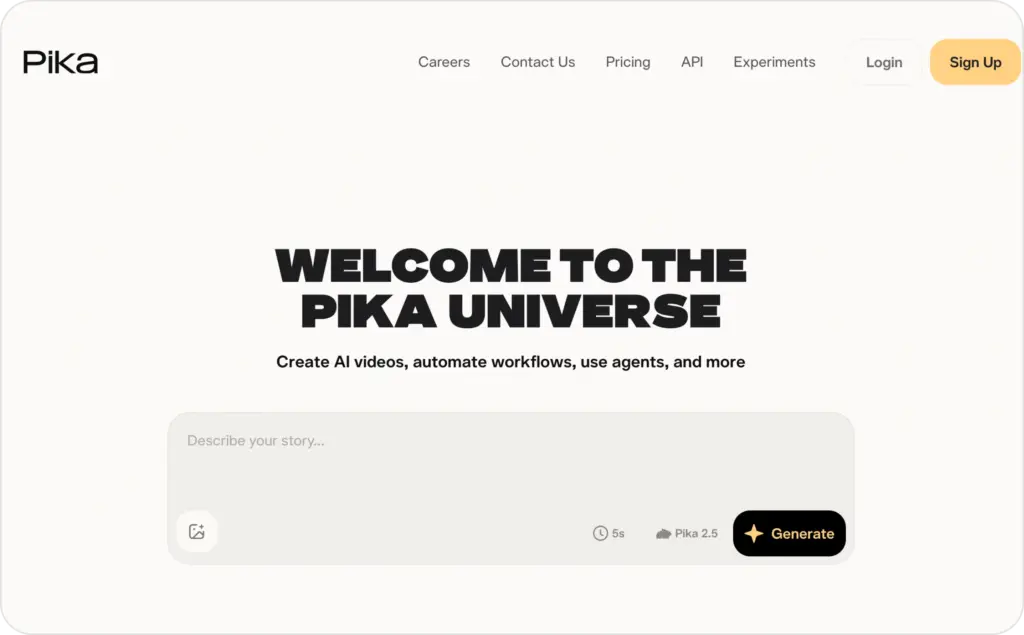
Pika is the tool I would test when the opening moment matters most. Its official pricing page lists access to Pika 2.5, Pikascenes, Pikadditions, Pikaswaps, Pikatwists, Pikaffects, Pikaframes, and Pikaformance across different plans and credit levels.
For marketers, Pika’s best use case is not the whole ad. It is the thumb-stopping moment: a product transformation, a surreal before/after, a fast visual joke, a surprising movement, or a hook that makes someone pause.
That is useful because short-form ads often win or lose in the first few seconds. But Pika is not the same as a full ad workflow. You may still need to write the offer, add proof, structure the CTA, create captions, and assemble the final ad somewhere else.
Choose Pika when you already know your product angle and want a stronger visual opener. Do not choose it as your only marketing system unless your team is comfortable building the rest of the ad workflow manually.
3. Haiper — best for quick prompt and image-to-video tests
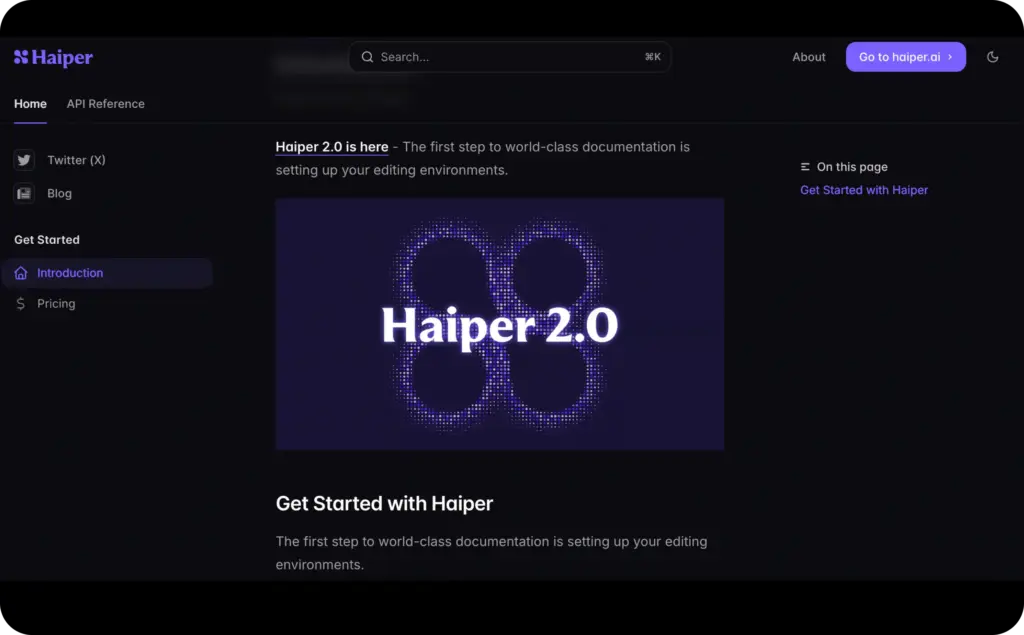
Haiper is a good fit for marketers who want fast visual drafts from prompts or images. Its API documentation lists Haiper Video 2.x for text-to-video and image-to-video, with 720p generation priced at $0.05 per second and 540p at $0.033 per second.
That makes Haiper interesting when you want to experiment with motion ideas, test background visuals, animate product-adjacent concepts, or create early B-roll before polishing the final ad.
The limitation is that Haiper is not clearly positioned as a complete ad builder. I would not expect it to write your hooks, build a CTA, format an ad funnel, or manage product-specific creative testing for you.
Choose Haiper when you need quick visuals. Pair it with a stronger ad workflow when the goal is paid social performance.
4. Kaiber — best for music-led social videos
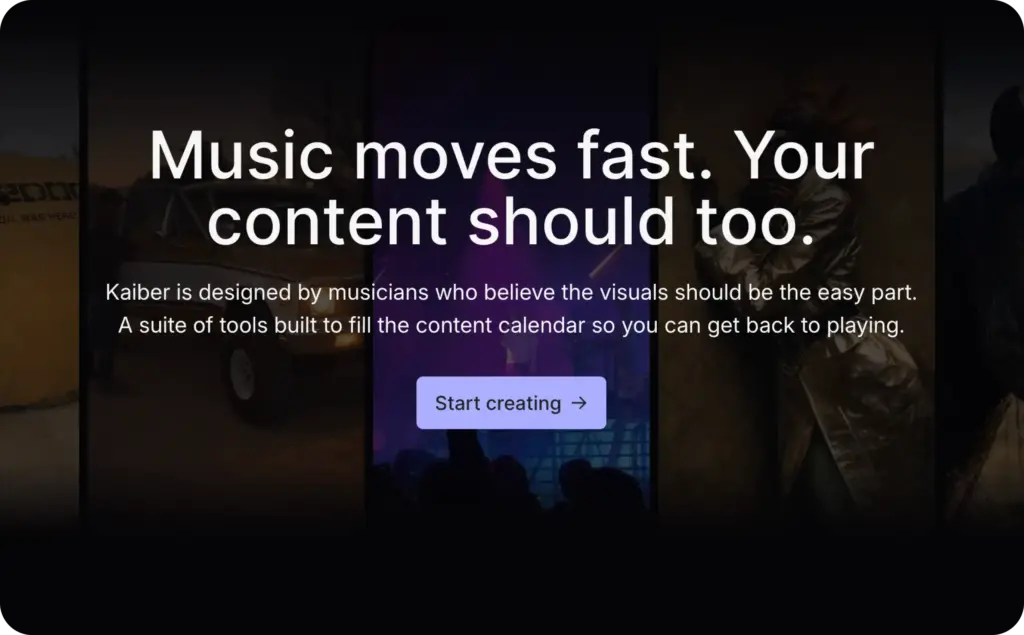
Kaiber is the most interesting option here for music-led content, creator drops, artist campaigns, and rhythm-based videos. Its plans include access to Canvas, Editor, and Beat Sync, and the help center breaks out Starter, Creator, Pro, and Visionary options with credits used across images, videos, and audio.
For a small business, Kaiber makes the most sense when sound is part of the concept. Think a fashion drop with a strong audio identity, a creator campaign, a launch teaser, a visualizer, or a social post where movement and timing matter more than a detailed product explanation.
Kaiber is less ideal when your main need is a simple conversion ad. It can help you create memorable visual assets, but it is not the first tool I would choose for product-page-to-ad automation, offer testing, or UGC-style sales scripts.
Choose Kaiber when music and motion are central to the creative idea. Choose Zeely when the ad needs to sell a specific product quickly.
5. Leonardo Motion — best for brand visuals and image-to-motion assets
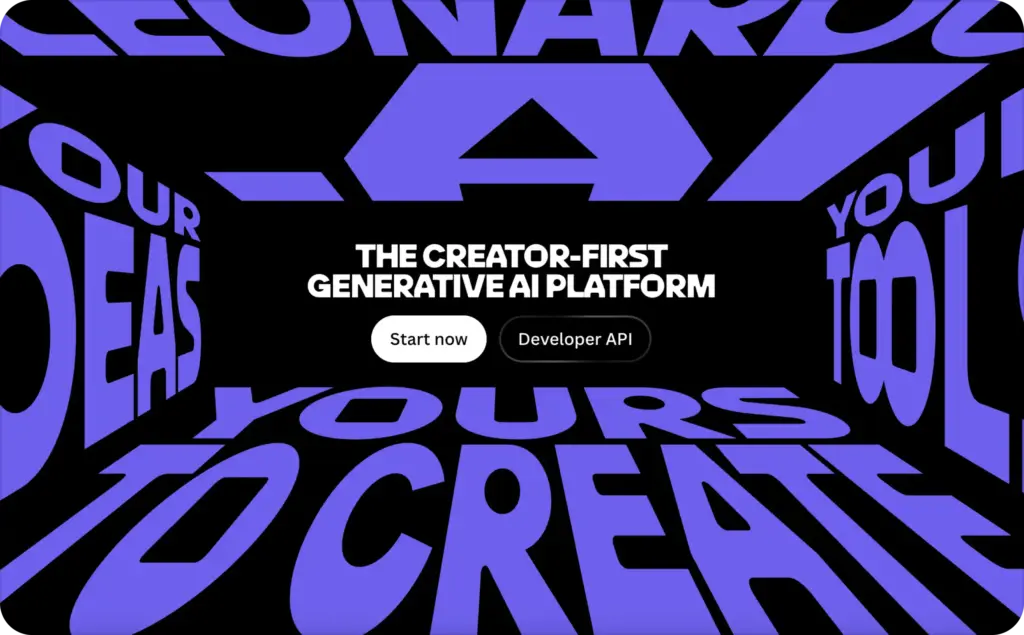
Leonardo Motion fits a different part of the marketing workflow. Leonardo’s pricing page positions the platform across image, video, design, and motion, with Free, Essential, Premium, and Ultimate plans. Its supported models include Motion 1.0, Motion 2.0, and Motion 2.0 Fast.
For marketers, the value is visual development. You can use Leonardo to create product scenes, campaign moods, visual references, animated assets, or branded images that later become part of ads.
That is useful when your product photography is weak or your brand needs more visual variety. But again, this is not the same as a full ad workflow. Leonardo can help you create assets; you still need to turn those assets into a message that sells.
Choose Leonardo Motion when your bottleneck is visual style. Choose an ad-first tool when your bottleneck is launching and testing creatives.
6. Moonvalley — best for controlled cinematic ad scenes
Moonvalley is closest to the filmmaker side of the market, but it is still relevant for some marketers. Its Marey page says the model is built for world-class cinematography, commercial safety, licensed training data, production-grade output, and directorial control.
That makes Moonvalley interesting for agencies, studios, premium brands, or teams that want cinematic control without stepping into unclear IP territory. It is not the simplest answer for a small ecommerce owner trying to make ten product ads by Friday.
The price also needs careful checking before publication. TechCrunch reported Moonvalley’s public Marey release with monthly credit tiers of $14.99 for 100 credits, $34.99 for 250 credits, and $149.99 for 1,000 credits, but I would still verify live pricing in-app before hard-coding it into a buying decision.
Choose Moonvalley when cinematic control and commercial safety matter more than speed. Choose Zeely when your goal is short-form ad output, not film-grade scene direction.

The small-business secret sauce: test proof, not polish
Small businesses do not lose because their AI videos are not cinematic enough. They lose because the ad does not answer the buyer’s real question fast enough.
That question might be:
“Will this fit me?”
“Does it work on my problem?”
“Can I trust this brand?”
“Why should I buy now?”
“What makes this better than the cheaper option?”
A cinematic AI scene can look impressive and still fail every one of those questions.
Reddit discussions around AI UGC show the same concern from a different angle: people are not simply rejecting AI; they are rejecting ads that feel fake, lazy, or dishonest. The Guardian has also reported growing concern around AI-generated influencers used in promotional content without clear disclosure, especially when the content appears to show genuine customer experiences.
So the secret sauce is not “make AI look human.” It is “make the product truth easier to see.”
Here is the workflow I would use:
Start with one product. Write three hooks: problem hook, result hook, and objection hook. Add two proof types: product demo and customer-style explanation. Then create two CTA endings: direct offer and soft discovery. That gives you 12 useful ad variants before you ever worry about fancy VFX.
This is where Zeely’s AI ad generator for static, video, and UGC ads fits naturally. You are not trying to make one perfect video. You are trying to create enough structured variations to learn what buyers respond to.
And please review every AI output before publishing. The REI bike example is a good reminder that AI ad tools can introduce product inaccuracies, and those errors become the advertiser’s problem once the ad goes live.
There is a legal trust layer too. In the U.S., the FTC’s final rule bans fake reviews and testimonials and is designed to deter AI-generated fake reviews. In the EU, AI Act transparency obligations around AI-generated content and deepfakes apply from August 2, 2026.
The safer rule for small businesses is simple: use AI avatars as presenters, not fake customers. Use real reviews only when they are real. Use real product footage when product accuracy matters. Let AI speed up the work, but keep the proof honest.
That is also why the viral tamale shop example is useful. The ad worked because it had a human idea, a timely meme, and a brand-specific twist. AI helped move faster, but the creativity came from knowing the business and the audience.
Which Runway alternative should marketers choose?
Choose Zeely if you need short-form ads for products, services, ecommerce, UGC-style campaigns, or paid social testing. It is the most ad-first option in this comparison.
Choose Pika if your ad needs a visual effect, surprising transformation, or scroll-stopping opening shot.
Choose Haiper if you need fast text-to-video or image-to-video drafts and you are comfortable assembling the final ad elsewhere.
Choose Kaiber if music, rhythm, creator visuals, or launch teasers are central to your content.
Choose Leonardo Motion if you need branded visuals, product scenes, or image-to-motion assets before building the final ad.
Choose Moonvalley if you are an agency, studio, or brand team that needs cinematic control and a stronger commercial-safety position.
For most small business owners, I would start with the ad workflow, not the model demo. The best tool is the one that helps you publish more honest, testable creatives with less production drag.
For a deeper Zeely workflow, read how to create AI video ads with Zeely. For broader production guardrails, use Zeely’s AI video best practices after this page, not before it.
FAQs
Zeely is the best Runway alternative for marketers who need product ads, UGC-style videos, scripts, captions, avatars, and platform-ready creative. Runway is stronger for cinematic AI generation, but Zeely is more practical when the goal is to create short-form ads quickly and test multiple angles.
Yes. Pika, Haiper, Kaiber, Leonardo Motion, and Moonvalley can all create useful video assets, but they do different jobs. Pika is best for effects, Haiper for quick generation, Kaiber for music-led videos, Leonardo Motion for brand visuals, and Moonvalley for controlled cinematic scenes.
No. Runway can be excellent for marketing visuals, especially when you need cinematic scenes or advanced generative control. The issue is workflow fit. If you need hooks, captions, UGC-style scripts, product templates, and fast creative testing, an ad-first tool may be easier.
Check whether the content is honest, whether any customer-style claim is real, whether the product looks accurate, whether the avatar is presented clearly, and whether the ad follows your market’s disclosure rules. AI can help you move faster, but it should not fake proof.
Pika is strong for visual hooks. Zeely is stronger for full ad hooks because it connects the hook to the product, script, avatar, caption, and CTA.
Use Runway when you need cinematic generation and detailed creative control. Use Zeely when you need a finished ad workflow. Many teams will get the best results by using a cinematic tool for special visuals and an ad-first tool for scripts, captions, variants, and launch-ready creatives.
Emma blends product marketing and content to turn complex tools into simple, sales-driven playbooks for AI ad creatives and Facebook/Instagram campaigns. You’ll get checklists, bite-size guides, and real results, pulled from thousands of Zeely entrepreneurs, so you can run AI-powered ads confidently, even as a beginner.
Written by: Emma, AI Growth Adviser, Zeely
Reviewed on: July 10, 2026