How to create high-converting ads with AI: A practical guide
Most ads fail due to vague briefs, not because the ad tool is bad. My guide includes creating both image and video ads using AI to help you through the process. Test your way to a winning ad on a low budget.
Key takeaways
- The ads that convert share a pattern. They tell the right person: this is your problem, here is the fix, here is why it works, and here is your next move
- AI ad generators shrink production from days to minutes. The brief is still what separates a sale from a scroll
- I recommend starting with one product, one audience, and three hook variations. Test the opener before rebuilding the entire creative
- Track CPA and ROAS, not just clicks. A cheap click that never buys is not cheap
Production value is overrated. People will keep scrolling unless they see their problem reflected on screen. It doesn’t matter if the product is effective if people don’t understand the problem it’s addressing within the first few seconds.
I show how to create a campaign from beginning to end using Zeely AI as an example because it captures and illustrates each step of the process. The quality of production doesn’t impact whether or not people will keep watching.
What makes an ad convert?
IAB’s 2026 digital video report predicts U.S. video ad spending will exceed $80 billion this year. Digital video advertising is expected to surpass 60% of TV and video advertising spending for the first time. Digital advertising is ruthlessly efficient with time and space. With 60% of TV and video ad spending going to digital, that means a ton of money is chasing the same few seconds of viewer attention. Ads should be concise and direct to speak to the viewer’s interests and desires to generate a response.
There are four essential parts to any ad that convert viewers to customers:
- The hook identifies a viewer’s problem or desire to create familiarity
- The body illustrates how the viewer can experience the product to achieve their goal or overcome their obstacle
- Proof: Real world evidence to support the claim
- The ad includes a single, clear CTA
No voiceover will rescue a claim that isn’t believed to be true. It’s not unusual for marketers to spend countless hours crafting an effective hook, only to have consumers skip over the body of the ad. An ad’s body is just as important as the hook and should be crafted with the same creativity and care.
The easiest method to craft a message that targets a particular individual with a specific pain point is to complete the following sentence and keep it on your desk: “This ad will help (person) to understand that (product) can solve their problem of (not having/achieving) (thing), because (reason), and ask them to (do something).”
Discard anything extraneous to this message.

How to create high-converting ads with Zeely AI: step by step
AI ad generators can create templates, copy, images and format for you, as long as you provide a good brief. If you give it a bad brief, it will just create randomly generated sentences. This example demonstrates how to use Zeely.
Step 1: Add your product link
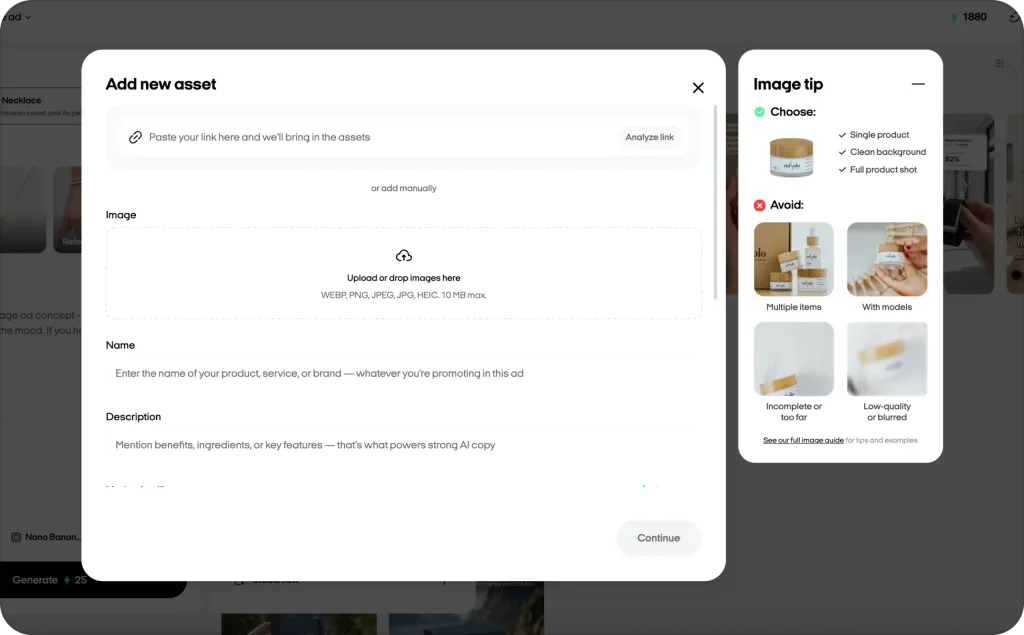
Zeely automatically extracts information about your product including images and descriptions when you enter your product or service URL. If you don’t have a website, add the info manually including name, price, images and a button with a message that encourages users to take the action you want them to take on your site.
Spend a minute checking what info it imported. AI doesn’t create copy from scratch. It just expands on the input data. The more accurate the input data is, the better the output will be.
Step 2: Create a video ad
Add your product details and choose an asset and image. Zeely fills in the product name and description automatically, but you can edit both. Then pick a reference and an AI avatar. The reference controls the scene: pose, outfit, background. You can swap the avatar at any point.
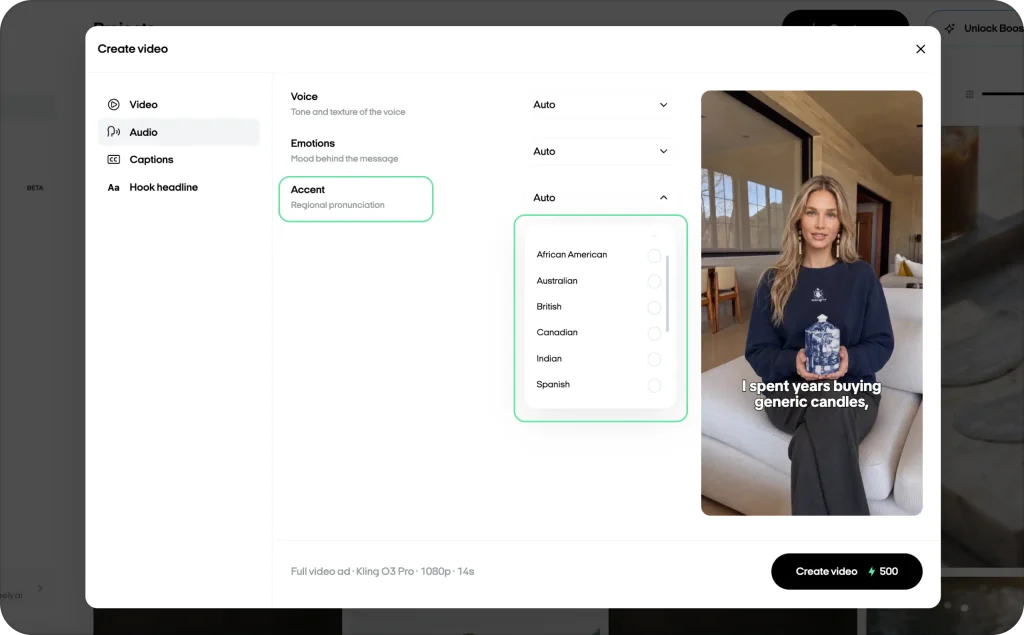
Next, select your video type. With full video ads, you can create a hook and body. You can also create just the hook or body. After that, select your AI model between Kling O3 Pro and Seedance 2.0. With Seedance 2.0, you can adjust the resolution to 720p or 1080p. Alternatively, you can click “Generate script” and have the AI generate a script for you. You can then change either the hook or body script before generating the video, to provide more direction to the AI. You can also use a custom prompt to achieve the same result.
You’re also able to adjust things like tone and emotion, as well as add accents and captions, if you’d like. Set position and highlight color for both captions and the hook headline. Some customization options for the font and its style are also available. Finally, when you’re satisfied with how everything looks, click the button to generate the video and wait while it is rendered.
Step 3: Build an image ad
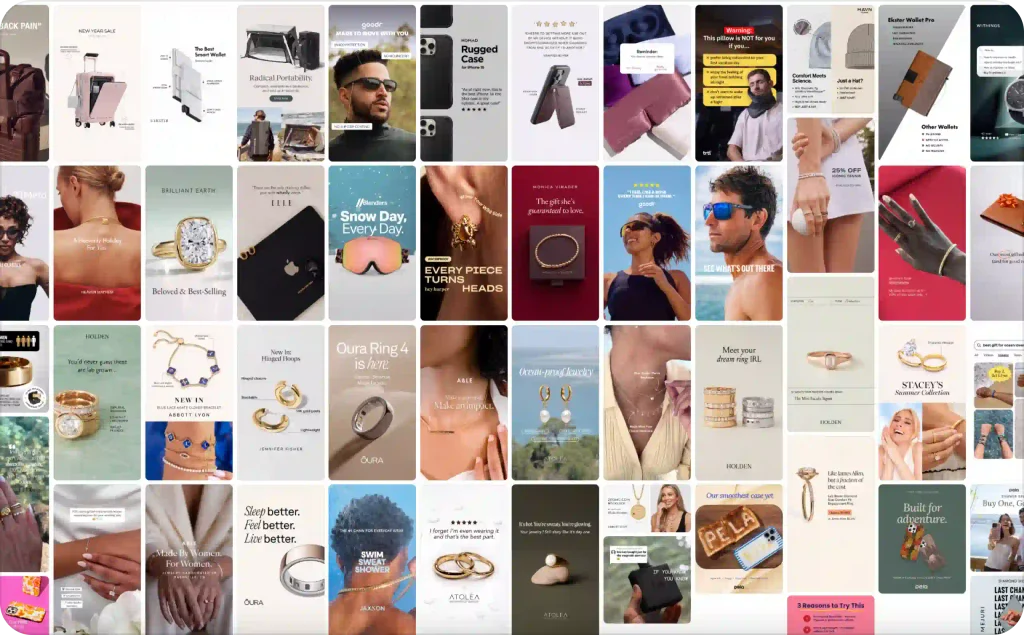
Add a photo or skip it. If you choose to skip, the AI will create the image for you. Next, select a reference from Zeely’s library, or upload your own. Up to ten references can be used to create ten different image ads. If you wish to explain the concept yourself, do so in the prompt. Otherwise, click “Generate Idea” and Zeely will do the explanation for you.
Next, select the AI model you want to use. Options include Nano Banana Pro, Nano Banana 2, and GPT Image 2. Once an idea is generated, you can create up to five variations of that idea with different aspect ratios. Also include your logo if you have Brand DNA set up.
Many people are surprised to learn I run image ads fairly frequently. They’re a great option for retargeting and dollars off offers. Image ads can also be effective in placements where video autoplay is not supported. Check out the ad creation guide for details on image ad dimensions and formatting.
Step 4: Launch your campaign
You have two ways to launch. You can connect your own Meta Ads account, or you can use the Zeely AI Marketplace if you don’t have an account. Marketplace uses one of Zeely’s managed Meta accounts to run the ads for you and so doesn’t require any additional setup.
No matter which option you choose, the next steps are the same. Enter a URL, name the campaign, choose an objective, and upload your creatives. I think using both image and video ads in the same campaign is effective. I’ve found three to five creatives is ideal. Meta needs a sufficient number of creatives to learn and optimize campaign delivery.
Preview each ad to check for anything that might be misleading. Images can always be swapped or removed. Audience size influences ad delivery, and targeting that is too broad or too narrow will adversely affect the result. Zeely gives an estimate of the audience size based on your targeting to help you avoid extremes.
Set your daily budget using the slider and specify the duration of the campaign. Zeely gives an estimate of how many people will see your ad. They also note when your budget is too low and recommend increasing it to ensure Meta can effectively optimize the campaign. Meta approves the campaign to run within 24 hours and charges you at that time.
Step 5: Analyze, learn, repeat
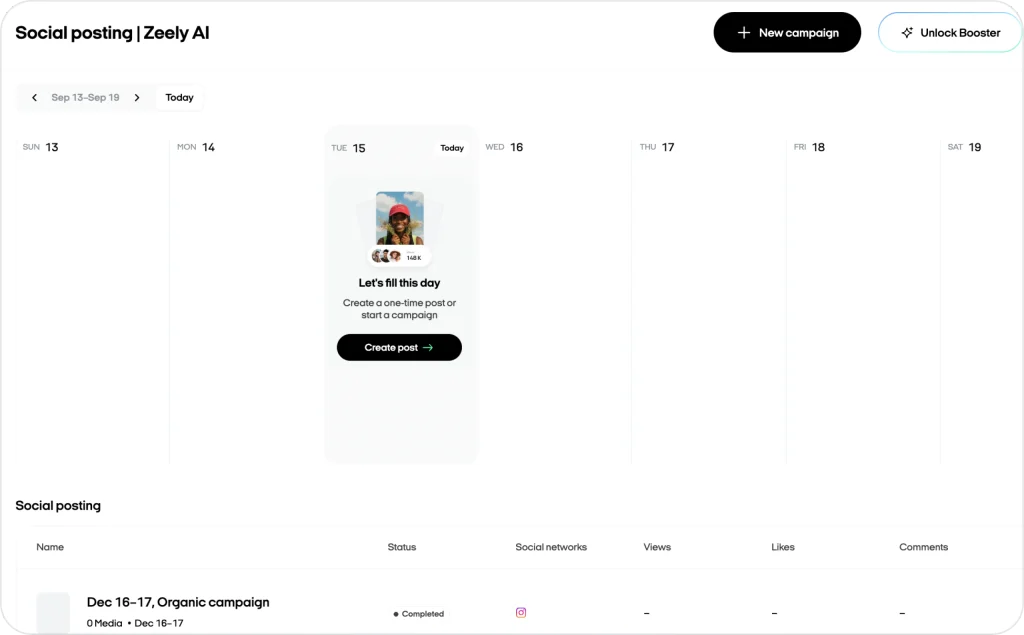
Watch which ads are effective. Take note of which ads receive clicks. At the end of a campaign, reuse the best ads.
The section most guides skip is not to dismantle your best ad. Instead, improve it gradually, as explained in the next section.
Measure and test what matters
Only 20 metrics can be displayed on your dashboard at a time. Most of these don’t impact your profit.
Click-through rates between 3-5% on your search ads usually means your ads are working well. If your click-through rate is lower than this, try improving your ad copy or image. Generally, people are not seeing your ad.
CPC can definitely impact your profit, but it depends on what kind of traffic you’re getting. I’ve seen clicks go through for $0.80 that bounced in less than 3 seconds and clicks for $2.50 that turned into $40 customers. Low CPC does not mean the click is high quality. Benchmarks for CPC and CPM for Facebook and Instagram are included here.
The most important metric for us is break-even CPA. Calculate this before spending any money. Break-even CPA = Average Order Value x Contribution Margin. Using our example of a $60 average order size and 40% margin, $24 would be your break-even CPA. Under this, you’re profiting. Over this, something needs to be fixed on your ad or landing page.
How to test without wasting budget
Motion’s 2026 Creative Benchmarks analyzed 578,750 creatives spending $1.29 billion on Meta. Only 5% qualified as winners. They spent at least ten times the account median. The other 95% were losers. Testing helps find winners.
Begin with the hook. Create three different openings for the same body, proof, offer, and CTA. Choose the better hook and move on to the next variable: proof, offer, and CTA. Be sure to test one variable at a time.
Alternatively, you can keep the strongest hook and change either the CTA, offer, and/or landing page. Again, do not change more than one variable at a time. Although you may see improvements in performance when you test and change all of these together, it will not show which one is most responsible for the change.
| What you see | What the ad likely needs | Next test |
| Weak early viewing | A clearer hook or first frame | Try a sharper opening |
| Good viewing, weak clicks | A more specific benefit or CTA | Rework the promise or action |
| Strong clicks, weak sales | Better message-to-page alignment | Check the offer and landing page |
| A previous winner slows down | Fresh creative energy | Refresh one element |
My approach is to put about 10-20% of my daily budget toward experiments. If something performs better than the baseline, I increase the budget each week by about 10-15%. I never increase the budget by more than 100% in a single day. Doing so previously resulted in my CPC increasing because Meta had to reset its optimizations.
Wait to make a judgment on a variant until it’s been clicked at least 100 times. One slow Tuesday is not a valid judge.
If your CPC is increasing by 30% or more and your conversions are not following suit, make an adjustment. Look for this kind of discrepancy in your data.
Always test different messages, colors and images. Sometimes changing just one of these can improve the ad’s performance. Give your ad a chance to accumulate at least 100 clicks before you reach a judgement on its performance. One slow day is not a valid judgement. If your CTR is less than 1%, your ad is not even capturing your audience’s attention and may need to be modified. If your ad is flat, move your budget to ads which are performing.
I have a guide on creating scroll stopping hooks which includes idea generators. It is broken down by platform and ad type.
When to use AI ads and when to use human creative
Meta’s AI-based ad solutions are certainly proving to be effective. For example, accounts fully utilizing Advantage+ AI features have seen an average increase of 22% in return on ad spend (ROAS). Also, Advantage+ Shopping campaigns have resulted in a 32% reduction in average cost per acquisition (CPA) compared to non-AI-based campaigns. Furthermore, Meta’s AI can create thousands of variations of video ads. AI-based creative solutions give marketers the potential to create hundreds, if not thousands, of variations before a campaign’s creative budget is depleted.
But an AI avatar cannot create user generated content. Reviews, testimonials and before and after shots? Still need a human. With AI created content and AI generated images, which actually shows fewer a significant number of the public still prefers to see human generated content when making a purchase. See AI UGC vs. real UGC for the full comparison. AI generated images don’t think critically and solve problems creatively in the same way as humans.
AI can determine the best ad copy. A human, however, will be better at conveying that message and interpreting it’s meaning to the viewer.
Write better prompts, get better ads with Zeely AI
Given an AI prompt to create an advertisement for you, they’ll probably just create a mediocre ad. On the other hand, if you provide them with a brief that includes an audience, a problem, proof, and a CTA, then you’ll have something more useful to evaluate.
This is the general structure of the prompts I’ve been using to create advertisements using various AI generators:
I need 3 x 15 second video ad scripts for product xyz. Audience is abc. They have the problem def. Focus on ghi. Proof is jkl. Each script should have a different hook. Keep the language informal. Don’t include fake reviews, numbers or guarantees.
About 95% of the weak AI advertisements I have seen are created using a poorly defined brief as input.
Zeely’s AI advertisement generator lets you create an advertisement, including product visuals, within one workflow. Plans and pricing can be found on their website.
FAQ
Sure, they can work. Usually the hook, offer, audience and landing page determine the success of an ad.
Focus on one offer, one product, and one audience at a time. Then use AI to generate three different hooks and test them against each other for at least four days on a single advertising platform. Keep in mind 15 dollars a day will teach you more than 100 dollars a day spent randomly. I’ve seen this play out many times.
AI generated ads are allowed on both platforms. You still must be truthful with your claims and advertising in accordance with the law. The landing page has to be relevant to the claims made in the ad. Advertisers will likely face more regulatory scrutiny surrounding artificial intelligence and synthetic media in 2026 and beyond.
Google search ads typically convert clicks to leads at a rate of 3-5%. On Meta, that conversion rate is more like 1-2%. The math is more important than the rates, though. Having a 1% conversion rate from a source that keeps your CPA below break-even is better than a 5% conversion rate that brings you useless traffic.
Your landing page is likely the issue. The ad promised something that the page didn’t deliver. Be sure the headline on the landing page matches the ad copy. Is there one single action the user can take on the page? Can that action be completed within 30 seconds on a phone? If all of that looks good, check your target audience and your offer.