Etsy ads in 2026: How small sellers can use AI to compete with bigger brands
Are Etsy Ads worth it when you have a small budget and bigger brands can afford more creative, more testing, and more people? I’ll show you how Etsy Ads work in 2026, what they cost, which products deserve your budget, and how I’d use AI to compete without trying to outspend everyone else.
Key takeaways
- Etsy recommends giving an Ads campaign about 30 days to collect meaningful performance data before making major changes.
- Etsy Ads and Offsite Ads are different. Etsy Ads charge per click for promotion inside Etsy, while Offsite Ads promote listings outside Etsy and charge a fee only after an attributed sale.
- Small Etsy sellers can use AI to compete with bigger brands by producing more ad concepts, hooks, static creatives, videos, and UGC-style variations without matching a larger company’s production budget.
- Zeely can use an Etsy product link as the starting point for new static, video, and UGC-style ad creative. It complements Etsy Ads by helping sellers create more ways to market promising products.
Etsy is not a marketplace where more advertising automatically means more sales.
In Q2 2026, Etsy reported approximately 87 million trailing-12-month active buyers and $2.6 billion in Etsy marketplace gross merchandise sales. That is a huge pool of purchase intent, but it also means plenty of sellers are competing for the same moments of attention.
For a small business, I would not try to win that fight by spending like a larger brand.
I would try to learn faster.
That is how I think about Etsy advertising in 2026: use Etsy Ads to reach people who are already searching inside the marketplace, learn which products earn clicks and profitable orders, then use AI to turn those signals into more creative tests without hiring an agency-sized team.
The important part is knowing which tool is solving which problem.
Etsy Ads help with marketplace visibility.
AI helps close the production gap between a one-person shop and a business with designers, editors, creators, and performance marketers.
Let’s separate those jobs properly.

What are Etsy Ads and how do they work in 2026?
Etsy Ads are paid placements for your existing Etsy listings. You choose a daily budget and which listings participate; Etsy decides when and where eligible ads appear and charges you when someone clicks.
If you have searched how does Etsy Ads work, this is the simplest way to picture the current system:
listing → Etsy chooses an eligible placement → shopper sees the ad → shopper clicks → you pay for the click
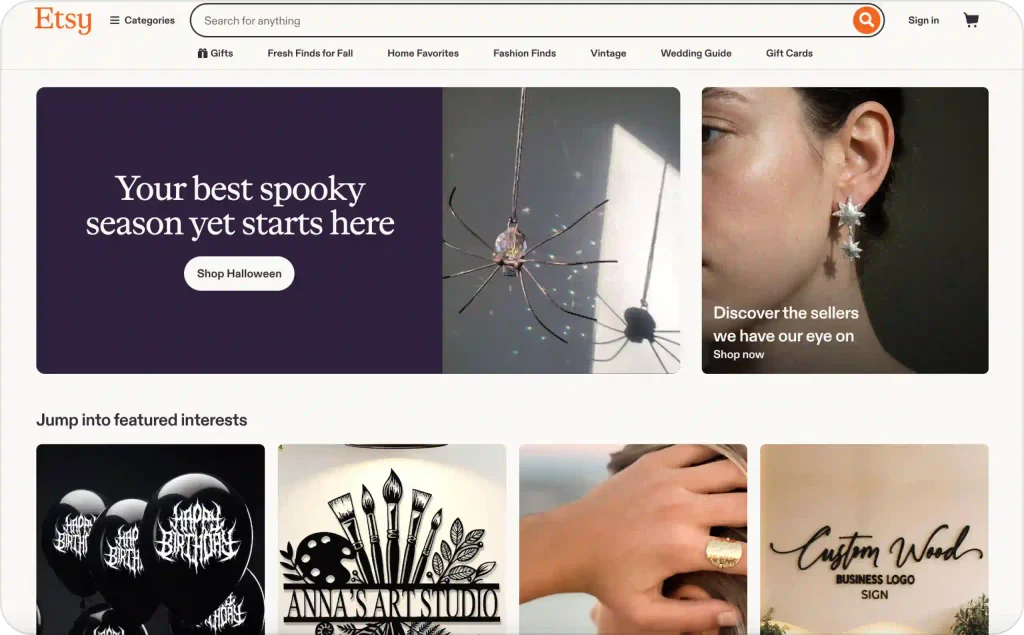
Current placements can include Etsy search, Category pages, and Market Pages on Etsy.com and in the Etsy app. You are not designing a separate onsite ad the way you would build a Meta video campaign. The product listing is the thing being promoted. Some older Etsy Ads guides blur together marketplace advertising and social ad creation. They are different workflows.
Inside Etsy, the seller controls things such as:
- daily budget
- which listings are advertised
- listing strategy when eligible
- which products stay active or get paused
Etsy handles much of the actual delivery and optimization.
There is also a 15-day waiting period after opening a new Etsy shop before you can start Etsy Ads. In its official Etsy Ads campaign setup guide, Etsy says Ads work best when listings are already getting buyer interest and specifically warns that paid exposure is unlikely to turn a low-demand listing into a top seller.
That is one of the most useful sentences in Etsy’s documentation.
Ads multiply visibility.
They do not manufacture product-market fit.
Etsy Ads vs. Etsy Offsite Ads
I would keep these two systems separate in both reporting and decision-making.
| Etsy Ads | Etsy Offsite Ads | |
| Where ads appear | On Etsy | Search engines, social platforms, partner sites, Google Display Network |
| Payment model | Pay per click | Pay a fee when an attributed order occurs |
| Budget control | You set a daily maximum | No seller-set daily budget |
| Listing control | You can choose participating listings | Etsy chooses which listings to advertise |
| Typical role | Capture demand already inside Etsy | Reach shoppers outside Etsy |
| Attribution | Etsy Ads order attribution can occur after the click | Purchase within 30 days of an Offsite Ad click |
For Offsite Ads, shops that have always stayed below $10,000 in Etsy revenue during any consecutive 365-day period currently pay a 15% fee on attributed orders and can opt out. Once a shop reaches $10,000 in sales over a 365-day period, participation becomes mandatory for the lifetime of the shop and the fee drops to 12%; Etsy also caps the Offsite Ads fee at $100 per order.
The distinction matters because “my Etsy ads cost too much” can describe two completely different systems.
Know which one produced the charge before trying to fix it.

How much are Etsy Ads in 2026?
If you are asking how much are Etsy Ads, the technical starting point is simple: Etsy currently allows a minimum daily budget of $1. You are charged when someone clicks an ad, and the cost per click can vary by listing and placement. Etsy also says you will not spend over the daily budget you set.
The daily budget is therefore a maximum, not a promise that Etsy will spend every cent.
Etsy’s June 2026 Seller Handbook recommends setting a minimum daily budget of at least $3–$5 when possible to collect more useful performance data during an initial campaign test. That is a testing recommendation, not a new technical minimum for Etsy Ads.
I would keep those two numbers separate:
- $1/day: platform minimum
- $3–$5/day: Etsy’s recommended starting range for a more informative initial test
- $25/day: threshold that gives eligible campaigns access to additional listing-level strategies
All sellers currently begin with a maximum daily budget of $25. Etsy recalculates that maximum weekly using factors such as recent ad spend, payment status, and payment history, so the maximum can increase over time.
That also means old advice saying Etsy Ads are permanently “capped at $25 per day” is outdated.
What does a $25 Etsy Ads budget unlock?
At $25 or more per day, Etsy currently offers three listing strategies:
| Strategy | What Etsy says it optimizes | When I would consider it |
| Greater visibility | More reach | Strong bestseller, launch, or important seasonal period |
| Efficient spending | Balance between reach and cost | General/default use |
| Lower click cost | Cheaper clicks with less visibility | Lower-margin or inventory-limited product |
Etsy positions Efficient spending as the balanced option: it tries to give you a useful mix of visibility and cost control. Greater visibility pushes harder for reach, while Lower click cost prioritizes cheaper clicks and accepts that your ads may appear less often. Etsy also recommends giving a new strategy around 30 days before deciding whether it works for your shop. You can see the full breakdown in Etsy’s 2026 guide to Ads strategies.
I would not move a $5 daily budget to $25 just because Etsy unlocks another setting.
A feature threshold is not a profitability target.
Seller experiences make that pretty clear too. In a recent Etsy seller discussion about the $25 daily budget, the results were all over the place: some sellers said $25 brought them very little, while others were comfortable with much higher limits and noted that Etsy often spent only part of the budget anyway.
I would treat those stories as context, not benchmarks. The right budget still comes down to your product, demand, margins, CPC, and whether the campaign is actually making money.
Are Etsy Ads worth it?
They can be, but I would answer that with a calculator before I answer it with a feeling.
A campaign is not successful because it generated traffic. It is successful when the business generated enough value from the traffic to justify what it paid.
That sounds obvious until the dashboard shows 300 clicks and five orders and makes “activity” feel like progress.
I care about four numbers:
- CPC: what each click costs
- conversion rate: how many visitors buy
- contribution margin: what remains from the order before advertising
- ROAS: revenue generated for every advertising dollar spent
Calculate your break-even ROAS first
ROAS is:
Revenue attributed to ads ÷ ad spend = ROAS
Spend $100 and generate $400 in attributed revenue:
$400 ÷ $100 = 4.0 ROAS
But a 4.0 ROAS is not automatically profitable.
Imagine you sell a $50 product.
After product costs, packaging, normal marketplace fees, shipping contribution, discounts, and the variable costs you include in your model, you have $20 left before advertising.
Your pre-ad contribution margin is:
$20 ÷ $50 = 40%
Your simplified break-even ROAS is therefore:
1 ÷ 0.40 = 2.5
Below 2.5, advertising consumes more than that available contribution margin.
Above 2.5, you have room.
This is why I would not copy someone else’s “good Etsy Ads ROAS.”
Etsy’s 2026 advertising performance guide mentions ROAS benchmarks in the 2.8–4 range, but I would not treat those numbers as a profitability rule for your shop. The benchmark Etsy references comes from older 2019 Amazon advertising data, not a fresh Etsy-specific study.
I would use it as context, nothing more. Your real target should come from your own margins, costs, and break-even ROAS.
Which Etsy products should I advertise?
I think of Etsy product ads as amplifiers.
Before advertising a listing, I want a reason to believe that more qualified traffic could help.
Good candidates usually have some combination of:
- proven sales or favorites
- clear first images
- strong product-market fit
- enough margin for paid acquisition
- reviews or other trust signals
- accurate titles and product information
- competitive shipping and pricing
- enough inventory or production capacity to handle more orders
But I would not turn “advertise only existing winners” into a hard rule.
Etsy’s own 2026 guidance supports several strategies. A seller may use Ads around bestsellers, a promising category, new inventory, or seasonal priorities depending on the goal and available budget.
The difference is intention:
- If I advertise an unproven product, I know I am paying partly for information.
- If I advertise a proven seller, I am paying to see whether more visibility can scale something that already works. Those are different experiments.
My Etsy Ads strategy for a small budget
My Etsy Ads strategy for a small shop is not “advertise everything forever.”
It is a controlled diagnostic loop.
Step 1: Fix the listing before buying more traffic
I start with what the shopper sees. Can I understand the product from the first image? Is the title clear? Is the price credible for the category? Do shipping, processing time, reviews, dimensions, materials, personalization, and included items answer the obvious buying questions?
If the listing creates doubt, Ads simply pay to bring more people into the doubt.
Step 2: Keep the test small enough to understand
Etsy recommends advertising all active listings when you first have enough budget to let the system gather broad information. It also explicitly points sellers with limited budgets or large inventories toward more selective listing strategies.
For a lean shop, I prefer a test I can interpret. If $5 is split across 80 unrelated listings, I may not learn much. If it is concentrated around a smaller, intentional group, I can see which products actually consume the budget and what happens after the click.
Step 3: Give the campaign enough time
Etsy recommends letting a campaign run for at least 30 days before major adjustments. During that period, Etsy says its system is learning from searches, impressions, clicks, and shopper behavior. A purchase made within 30 days of the original Etsy Ad click can also be attributed back to the campaign.
That is why I would not rewrite the campaign every morning. Constant intervention makes clean comparisons harder.
Step 4: Diagnose the funnel
Here is the table I would use before touching the budget:
| Pattern | What it may mean | What I check first |
| Few impressions | Weak relevance, low search demand, limited eligibility or budget | titles, tags, demand, listing quality |
| Impressions but few clicks | Shoppers see it but are not interested enough | thumbnail, product clarity, title, price |
| Clicks but no sales | The ad did its job; the listing did not close | offer, trust, reviews, shipping, description, price |
| Sales but weak ROAS | Demand exists but economics may be poor | CPC, margin, average order value, fees |
| Profitable ROAS | Product may deserve more exposure | inventory, capacity, next budget test |
Step 5: Move money toward evidence
Once I have meaningful data, I stop treating every listing equally. A listing that earns profitable sales deserves a different decision from one that absorbs clicks and produces nothing.
The question I ask is not “Which product got the most traffic?” It is “Which product earned the right to my next advertising dollar?”
What is a good click rate for Etsy Ads?
A good click rate for Etsy Ads depends on the category, product, price, competition, season, and how well the listing matches what the shopper is looking for.
That is why I would be careful with generic advice like “2% is good” or “3% is ideal.” Those numbers can look reassuring, but they do not tell you whether the traffic is actually valuable.
I would look at CTR in context. Compare a listing with its own past performance and with similar products in the same shop, then check what happens after the click.
A higher CTR is not automatically better if conversion drops. And a more modest CTR can still be perfectly healthy when the listing converts well and delivers a strong ROAS.
The goal is not to make one dashboard metric look prettier. It is to attract the right clicks and turn them into profitable orders.
How small Etsy sellers can use AI to compete with bigger brands
One person running an Etsy shop may be doing product development, customer support, photography, copywriting, fulfillment, accounting, social media, and ads.
A larger brand splits those jobs across a team.
AI can help the small seller compress some of the marketing work.
I would use it to:
- generate multiple hooks from one product
- turn one value proposition into several customer angles
- create static ad variations
- draft video scripts
- build UGC-style concepts
- explore gifting, seasonal, demonstration, comparison, and problem-solution angles
- adapt creative for different social placements
- create several iterations without organizing a fresh shoot every time
- summarize campaign results before deciding what to test next
This fits the wider ecommerce advertising strategy I use: marketplace advertising captures people who are already close to a buying decision, while social advertising can create discovery, reminders, and additional demand.
What AI should not replace
For an Etsy seller, I would keep human control over:
- what the product actually is
- materials
- dimensions
- included items
- pricing
- handmade or production claims
- customer promises
- safety or performance claims
- brand positioning
- final creative approval
If AI produces a beautiful image but changes the product, it has failed.
If a generated ad shows three candles when the customer receives one, changes the stone in a piece of jewelry, makes a bag look twice its real size, or invents a product result you cannot prove, faster production has created a new problem.
That is why I treat AI output as production, not truth.
The product truth still belongs to the seller.
How I’d use Zeely for an Etsy product
For an Etsy seller, I see Zeely as the creative layer around products that already show potential.
If a listing is getting sales, strong engagement, or promising Etsy Ads performance, I can import the product URL into Zeely and use that existing product information to create new static, video, or UGC-style ad variations without rebuilding everything from scratch.
That is useful because the goal is not to produce more ads for the sake of volume. It is to test more angles around a product that already has a reason to win: gifting, seasonality, product benefits, social proof, demonstrations, or different audience hooks.
Zeely can help turn one strong product into several creative directions for channels such as Meta, TikTok, and YouTube, while the seller still checks the product details, claims, visuals, and offer before anything goes live.
For me, that is the practical advantage: Etsy Ads can show which products deserve more attention, and Zeely can help a small seller create more ways to market those products without adding a full creative team.

Mistakes that make Etsy Ads expensive
Most wasted spend comes from pushing traffic before the basics are working.
I would be careful with listings that get clicks but still fail to convert, especially when the budget is already limited. Spreading a few dollars across too many products can make it hard to learn anything useful, and jumping to $25 just because Etsy unlocks more controls is not a strategy on its own.
The same goes for judging performance too early. Etsy recommends giving campaigns around 30 days to collect meaningful data, so I would avoid reacting to every slow day or changing the setup before there is enough evidence.
I also would not optimize around CTR or ROAS in isolation. More clicks are not valuable if they do not lead to profitable orders, and ROAS still needs to be viewed alongside product costs, fees, shipping, and margin.
Finally, I would not copy another seller’s budget or let AI make the product look better than it really is. Both can create the wrong expectations: one about how much you should spend, the other about what the customer will receive.
The better question is always the same: is this spend helping the right listing attract the right buyer at an acceptable cost?
FAQ
The Etsy Ads minimum daily budget is currently $1. Etsy separately recommends roughly $3–$5 per day when possible for an initial campaign test because more budget can generate more useful performance data.
There is no official universal Etsy CTR benchmark that I would use for every shop. Compare similar listings against your own historical performance and connect CTR to conversion rate, CPC, and ROAS. A high click rate with no profitable sales is not a strong result.
They can be, but a new shop currently has to wait 15 days before starting Etsy Ads. I would use that time to improve listings, product images, titles, pricing, shipping information, and trust signals first. Etsy says Ads work best when listings already show buyer interest.
Start with a budget you can afford to run long enough to learn from it. The technical minimum is $1, while Etsy currently recommends about $3–$5 per day for a useful initial test. A $25+ budget unlocks additional listing-level strategy controls but is not a universal recommended starting spend.
Etsy recommends allowing around 30 days before making major performance-driven adjustments. That gives the system time to collect data and also captures purchases that happen after the original ad click.
Yes. Etsy initially enables current listings when a campaign begins, but you can turn individual listings on or off. That lets a small seller focus the budget on a smaller group or even a specific product when appropriate.
No. The daily budget is the maximum Etsy is allowed to spend, not a guaranteed daily charge. Actual spend depends on available ad opportunities and clicks. Etsy stops showing paid placements once the daily maximum has been reached.
Not in the normal seller workflow described in Etsy’s current documentation. You choose the budget, participating listings, and eligible listing strategies; Etsy manages delivery and determines cost per click based on each ad and placement.
Etsy Ads promote listings inside Etsy and charge per click. Offsite Ads promote Etsy listings across external search, social, display, and partner sites, with a fee charged only when an eligible click leads to an attributed purchase.
Yes. AI can help turn product information into hooks, static ads, video concepts, UGC-style creative, copy, and variations for external marketing. The best use is to increase testing capacity while you keep control over product accuracy, claims, positioning, and final approval.
Use AI where larger brands normally use more people and production budget: creative ideation, scripting, variations, video production, repurposing, and testing. The goal is not to match a larger company’s spending. It is to reduce the time and cost required to run more useful experiments.
Yes. Zeely’s current Help Center lists Etsy among supported platforms for product URL imports. Use a direct, public Etsy listing URL without unnecessary tracking or redirect parameters.
Zeely should not be described as a replacement for Etsy’s onsite Ads system. Zeely can help create advertising assets from Etsy product information, while Etsy controls its own onsite ad delivery, placement, and campaign system.

Emma blends product marketing and content to turn complex tools into simple, sales-driven playbooks for AI ad creatives and Facebook/Instagram campaigns. You’ll get checklists, bite-size guides, and real results, pulled from thousands of Zeely entrepreneurs, so you can run AI-powered ads confidently, even as a beginner.
Written by: Emma, AI Growth Adviser, Zeely
Reviewed on: September 23, 2026