Instagram Reels ads in 2026: benchmarks, strategy, and practices that actually work
What do the current numbers actually say about Instagram Reels ads? I'll walk through 2026 benchmarks, real cost data, exact specs, creative practices that hold up, and a step-by-step setup so you can spend on Reels with a plan, not a guess.
Key takeaways
- Reels now eat up 33% of all Instagram ad impressions, nearly double what they had a year ago
- Lower CPM and higher CTR than Feed or Stories, but cheap reach alone won’t save a bad offer
- Reels play sound by default. That single difference changes how you should think about creative
- More than half of Reels viewers aren’t following you, which is why prospecting works so well here
- Keep ads between 15 and 30 seconds, nail the hook in two to three seconds, and match your CTA to where the viewer’s head is at
- Test often. Most Reels campaigns die from creative fatigue, not bad targeting
Reels ads now reach over 726 million users through Meta’s ad network. To put that in context, it’s over half of everyone Instagram can show an ad to.
If you run a small business or sell online, Reels have quietly turned into the best deal on the platform. Cheaper than Feed. Better click rates than Stories. And the ads don’t stick out like ads, which helps more than you’d think.
I’ll cover benchmarks, specs, costs, creative practices, campaign setup, and testing. By the end you should have a spending plan, not just a collection of someone else’s averages.
What are Instagram Reels ads?
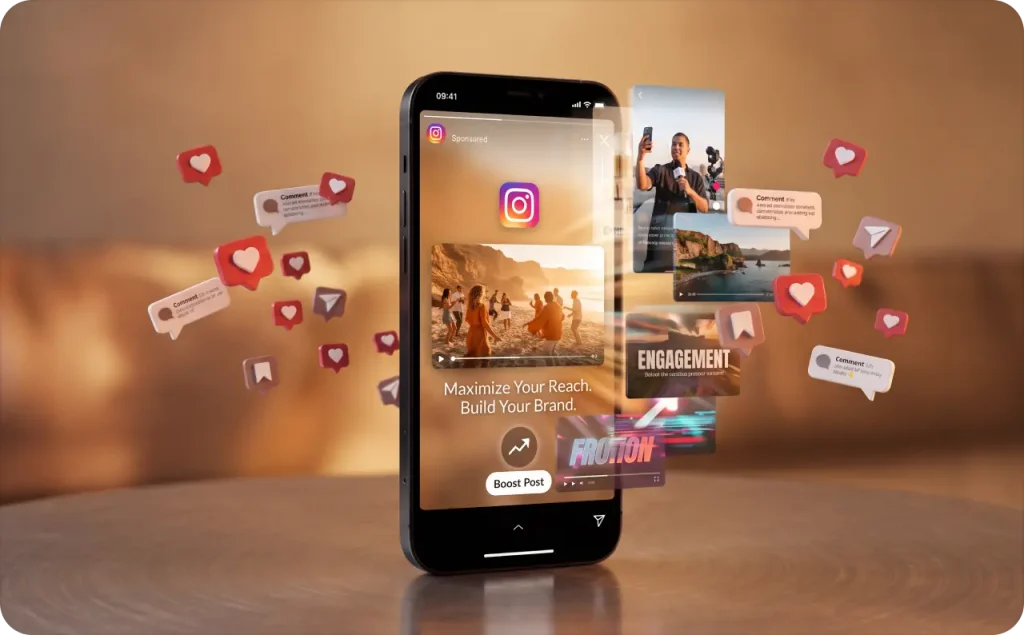
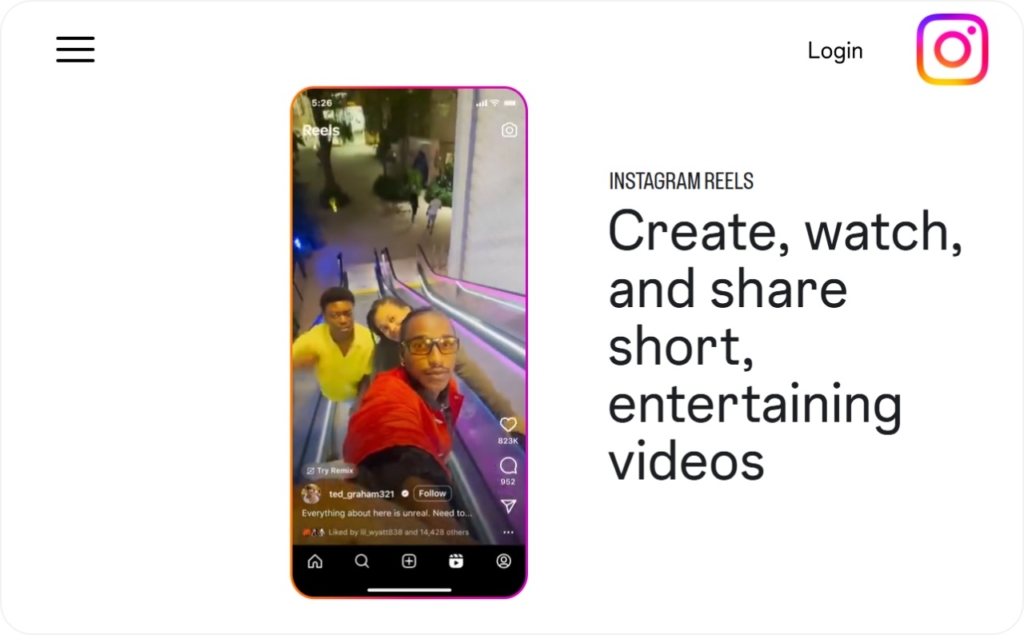
Short version: full-screen vertical video ads that play between organic Reels in the Reels tab, Explore, and main feed. Same Meta auction as Feed and Stories. Different behavior entirely.
Here’s what makes them different:
- Sound is on by default. Feed, Stories, Explore all start muted. Reels don’t. So voiceover, music, and audio branding actually carry weight here instead of being background noise nobody hears
- They loop. Your message gets another shot without costing you anything extra.
- 55% of Reels views come from people who aren’t following the account. That’s a huge discovery advantage
- People engage with Reels ads the same way they engage with regular Reels. Likes, comments, saves, shares. All of that signals back to the algorithm that your ad is worth showing to more people
A “Sponsored” label shows on each ad. The viewer knows it’s paid. Your job is making them not care.
The data on how people actually use Reels is wild. Roughly half of all time spent on Instagram now goes to watching Reels, according to Sprout Social. Text overlays and captions help retention, probably because a lot of people still scroll with their phone on mute even though Reels plays sound. Meta says sound-on Reels ads beat silent ones by 35% on engagement. That’s not a marginal difference. That’s a format advantage worth building your creative around.
You can run Reels as standalone campaigns or alongside Stories, Feed, and Explore. Most experienced advertisers I’ve talked to isolate Reels in a dedicated ad set. Cleaner performance data that way.
How the Reels algorithm ranks ads
Adam Mosseri laid out three ranking signals for Reels back in January 2025. They haven’t changed:
- Watch time: how long people stick around, especially past the 3-second mark
- Likes per reach: not raw likes, but likes relative to how many people saw it
- DM shares: how often someone sends your Reel to a friend
Watch time is the one you can actually influence with your creative. People make the stay-or-swipe decision in about two seconds. Blow the first frame and it doesn’t matter how good the rest of your script is.
There’s also an Originality Score that punishes recycled content. Reposted content, especially TikToks with watermarks still on them, saw steep reach drops. Creators who made original stuff saw increases. Lesson’s pretty clear: make original Reels. Don’t just cross-post and hope nobody notices.
Instagram Reels ad specs and requirements
Wrong specs cause auto-cropping, compression, or outright rejection. Here’s what Meta requires for 2026:
| Specification | Requirement |
| Aspect ratio | 9:16 vertical |
| Resolution | 1080 x 1920 px minimum, 600 x 1067 px floor |
| File format | MP4 or MOV |
| Video codec | H.264 compression, high profile preferred |
| Audio codec | Stereo AAC at 128 kbps or higher |
| Maximum file size | 4 GB |
| Duration | 1 to 90 seconds, 15 to 30 seconds recommended |
| Frame rate | Fixed frame rate, progressive scan |
| Safe zone | Leave roughly 14% top, 35% bottom, 6% each side free of key elements |
Safe zones catch more people than you’d expect. Instagram’s UI overlays cover the edges of every Reel: the profile icon, like and comment buttons, the caption area. Put your headline or CTA outside that zone and it disappears behind interface chrome. For exact measurements and templates, see the Instagram safe zones guide.
- On duration: You get up to 90 seconds for Reels ads. Organic Reels can run 3 minutes. But more time rarely means a better ad. Socialinsider studied 140,000 Reels and found the 30 to 60 second range pulls the highest average reach rate at 5.60%. I keep my direct-response ads between 15 and 30 seconds. That’s enough for a hook, one benefit, proof, and a CTA before anyone gets bored
- On recycled content: That Originality Score I mentioned? It also picks up TikTok watermarks and other signs of repurposed video. Cross-posting without re-editing is a quiet way to tank your delivery. Strip the watermark, re-cut it, and export natively
How much do Instagram Reels ads cost?
Reels deliver the lowest CPM of any Instagram placement. That sounds great until you remember that cheap impressions and cheap customers aren’t the same thing.
Costs across placements, based on aggregated 2026 benchmark data:
| Metric | Reels | Feed | Stories |
| CPM | $4 to $10 | $14 to $22 | $8 to $14 |
| CPC | $0.50 to $1.50 | $2.00 to $3.50 | $1.00 to $2.00 |
| CTR | 1.3% to 2.8% | 0.22% to 0.88% | 0.33% to 0.54% |
Why are Reels so much cheaper? Two reasons. Reels inventory nearly doubled, going from 19% to 33% of Instagram’s total ad impressions between Q1 2025 and Q1 2026. More supply means lower prices. On top of that, the full-screen, sound-on format gets better engagement, and the auction gives cheaper delivery to ads people actually interact with.
Do not confuse low CPM with low CPA though. A $5 CPM that delivers viewers who never buy is more expensive than a $16 Feed CPM that converts at 3%. I use CPM to compare reach efficiency. CPA and ROAS make the actual spending decisions.
Here’s something I wish someone had told me earlier: if two ads in the same ad set target the same audience and one costs way less per impression, that’s not random. Meta is rewarding the one that gets more engagement. CPM differences between siblings with identical targeting are basically a creative quality report card.
The Facebook ads benchmarks for 2026 break down Meta-wide cost data by industry. The Instagram ads cost guide goes deeper on CPC, CPM, break-even math, and daily budget planning.
Reels vs. Stories vs. Feed ads
Each placement does a different job. Choosing by CPM alone is the fastest way to misallocate budget.
| Feature | Reels | Stories | Feed |
| Format | 9:16 vertical video | 9:16 vertical, image or video | 1:1, 4:5, or 16:9 |
| Sound | On by default | Off by default | Off by default |
| Max duration | 90 seconds | 60 seconds | 60 seconds for video |
| Discovery | High, reaches non-followers | Low, mostly followers | Medium |
| CPM | Lowest | Mid-range | Highest |
| CTR | Highest | Low to medium | Low |
| Best for | Prospecting, awareness, discovery | Retargeting, urgency, time-sensitive offers | High-intent conversions, catalog sales |
| User behavior | Lean-back browsing, sound on | Tap-through quickly | Scroll-and-pause |
Reels work best at the top of the funnel. Over half of views come from non-followers, and no other placement puts your ad in front of that many strangers at that price.
I mostly use Stories for retargeting and flash promotions. They feel more intimate, which works when the audience already knows you.
Feed carries the highest purchase intent per impression. Also the highest price tag. It’s where I close, not where I introduce.
Strong campaigns run all three and allocate by funnel stage. But if you’re testing new creative on a limited budget, start with Reels.
Benefits of Instagram Reels ads
Average organic reach rate for Reels is 30.81% of followers, according to Socialinsider. That’s more than double what carousels, image posts, and Stories deliver. Reels also get reshared over 4.5 billion times per day across Instagram and Facebook, according to Meta, which drives compounding organic reach on top of whatever you’re spending on paid.
I don’t love benchmarks on their own, but that reach gap is consistent across multiple studies and large datasets. It holds up.
Non-follower discovery
Feed and Stories ads mostly land in front of people who already know you. Reels are different. They show up in the Reels tab, Explore, and mixed into organic content where people are actively looking for something new. If you’re starting from zero with a tight budget, this is the one placement on Instagram that can actually build an audience for you.
Cheaper testing
Lower CPMs mean more budget for creative variations. Different hooks, scripts, visual styles, CTAs. You can test all of those without draining your account on a single ad. More tests means more data, and more data means you find what works faster. Not glamorous. Works.
A format people actually watch
Well-made Reels ads just look like content. They don’t feel like interruptions, so people watch longer. I’ve seen UGC-style video ads, think product demos, unboxings, quick testimonials, consistently beat polished brand video on Reels. Why? Because that’s what everything else in the feed looks like. People have learned to swipe the second something feels like an ad. So don’t give them one.
For ecommerce specifically, Reels with product tags consistently outperform the same tags placed on Feed posts in click-through, and UGC in shoppable formats converts at higher rates than professional product photography. Both patterns point the same direction: native beats polished.
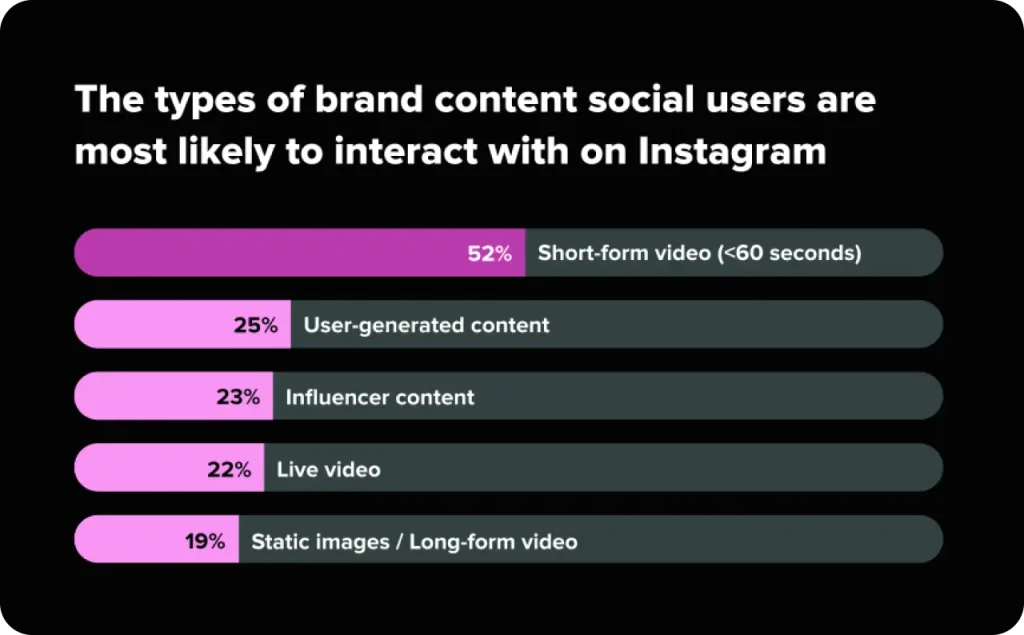
Photo source: Sprout Social
How to create Instagram Reels ads: Step by step
1. Choose your campaign objective
Open Meta Ads Manager. Pick the objective first. Ecommerce? Choose Sales or Catalog Sales. Lead generation or traffic? Choose the corresponding objective.
Skip Reach and Brand Awareness if your actual goal is revenue. Those optimize for impressions, not actions, and Reels’ engagement potential goes to waste on a reach-only campaign.
2. Define your audience
- Broad targeting. Let Meta’s algorithm find the right users. This works well when your creative is strong and you’re prospecting
- Interest-based targeting. Layer in interests, behaviors, and demographics tied to your product
- Lookalike audiences. Upload a customer list and let Meta find similar people
On Reels, broad targeting with strong creative frequently beats narrow interest stacks. Give the algorithm room.
3. Select Reels as your placement
Advantage+ placements let Meta distribute budget across everything automatically. Manual placements let you isolate Reels in its own ad set.
I go manual when I want clean Reels data. Advantage+ when I want maximum reach and trust Meta to allocate.
For ecommerce, a third option is gaining ground: Advantage+ Shopping Campaigns, or ASC. ASC hands audience and placement allocation entirely to Meta’s algorithm. Many experienced advertisers now run Reels inside ASC rather than managing placements themselves. You trade clean reporting for better optimization. ASC blends placements together, so isolating Reels performance requires manual breakdowns in Ads Manager.
4. Create the video ad
Creative quality matters more here than any other setting in your campaign.
- Hook in the first two to three seconds. Lead with movement, a bold line, a question, or a visual surprise. Viewers decide to stay or swipe almost instantly
- Shoot in 9:16 vertical at 1080 x 1920 px minimum
- Keep text and key visuals inside the safe zone
- Add captions. Reels play with sound on, but plenty of viewers still watch silently. Cover both
- End with one CTA matched to where the viewer’s head is at. If your Reel builds curiosity, “Here’s how I fixed my skin in 7 days,” close with “See the full routine.” Not a generic “Shop now.” It should feel like the obvious next step, not a sudden sales pivot
Don’t have a production team? Zeely lets you create video ads and image ads from product information, AI-generated scripts, and creative references, then launch them as Meta campaigns from the same platform. Create, Launch, Scale, without switching tools.
5. Set budget and schedule
A test budget of $20 to $50 per day over 7 days gives Meta enough data to optimize. Check after three to four days. Shift spend toward whichever variant has the lowest cost per result. Pause the rest.
Don’t judge one quiet day. My cash-protection rule: pause after spending two to three break-even CPAs without a single target result.
6. Launch and monitor
Meta review takes up to 24 hours. Once the campaign goes live, check CTR, cost per result, watch time, and engagement rate at least weekly.
Three to five days of delivery data is usually enough to spot a problem or confirm a direction. Do not wait a month.
Creative best practices for Instagram Reels ads
The hook decides everything. Draft three hooks before you touch the body. The opening carries way too much weight to accept your first attempt.
The structure that works consistently:
- Seconds 1 to 3: Hook. Movement, bold text, a provocative question, or something visually unexpected
- Seconds 4 to 10: Problem. Agitate the issue your product solves
- Seconds 11 to 20: Demo or social proof. Show the solution working
- Final 5 to 10 seconds: CTA. Tell the viewer what to do next
Reels with a 3-second hold rate above 60% outperform weak openers by 5 to 10x in total reach. Spend your creative energy on the opening, not the logo animation.
Shoot native, not polished
Brand-heavy, studio-grade video often tanks on Reels. The stuff that works looks like a creator shot it on their phone. Handheld, natural light, talking straight to camera, quick cuts.
UGC-style ads, reviews, unboxings, “day in my life” clips, those get better engagement than anything with a production budget. Can’t film real UGC? AI-generated video with realistic avatars can fill in, at least for testing. I tend to use AI to find which message actually clicks, then bring real creators in once I know what’s working.
Use sound, but caption everything
Reels is a sound-on environment. Voiceover, trending audio, and music all lift engagement. Meta’s data puts the sound-on advantage at 35%.
Still add captions. Around 20% of viewers watch silent, and captions improve comprehension regardless. Both things are true at the same time.
Produce more creative, faster
No single production trick will move your Reels performance as much as sheer creative volume. Instead of perfecting one ad, produce variations and let the numbers choose. Different hooks. Different scripts. Different visual styles.
When you see CPM rising, CTR declining, and frequency increasing all at once, that’s the audience telling you they’ve seen enough. Most advertisers need fresh creative every two to four weeks.
The dynamic creative optimization guide covers systematic testing approaches in more detail.
How to scale Reels ads with AI creative tools
Most small businesses don’t stall on budget. They stall on production. You need fresh video every few weeks, and filming, editing, resizing, re-scripting it all manually eats time you don’t have.
AI tools change that equation entirely. Multiple video ad variations from product photos, scripts, and references, generated in minutes instead of days.
Zeely is an AI Marketing Intelligence Platform built around this: Create, Launch, Scale.
- Create. Generate video ads from your product information, AI avatars, scripts, and creative references. Pick the path that fits: Video ad for avatar-led product showcases, Talking-head video for direct-to-camera content, or Animate an image to turn a product photo into a short clip. Scripts draw from proven marketing frameworks like AIDA, PAS, and Before-After-Bridge
- Launch. Go straight from finished creative to Meta campaign setup without switching platforms. Zeely walks you through destination URL, objective, audience, budget, and creative selection. Any video or image ad you’ve generated in Projects can go into a campaign
- Scale. One dashboard shows you which creatives win. Use those patterns to generate the next round and keep improving
More than 2 million businesses run on Zeely. The platform generates over 35,000 AI ad creatives a day, mostly for ecommerce and service businesses running Meta campaigns. Not agencies. Not enterprise teams.
I can’t promise lower CPC, CPM, or CPA. Zeely saves production time and makes structured testing easier to pull off. When your best-performing ad starts fading and you need a replacement by Friday, that speed matters.
I’ve written full walkthroughs for creating Instagram Reels with AI and making AI video ads with Zeely if you want the step-by-step.
Measuring and optimizing Reels ad performance
Key metrics to track:
- CTR, or click-through rate: Reels benchmarks sit between 1.3% and 2.8%. Consistently below 1.0%? Your hook or CTA needs work
- CPM, cost per 1,000 impressions: $4 to $10 is normal. Consistently above $15 usually means audience overlap, creative fatigue, or targeting that’s too narrow
- Engagement rate combines likes, comments, saves, and shares. High engagement feeds the algorithm and improves delivery. Just make sure you’re tracking it next to conversions, because engagement without revenue is a vanity metric
- Watch time and completion rate are what the algorithm cares about most. If 60% or more of viewers stay past the 3-second mark, the hook is working. A sudden drop-off at a specific timestamp pinpoints exactly where attention breaks
- CPA and ROAS require proper conversion tracking through the Meta Pixel or Conversions API. Without that setup, you’re optimizing for applause
How to optimize
- Check after three to five days. Not a month
- Kill underperformers early. If one variant has significantly worse cost per result after reaching significance, stop it and move the budget
- Rotate creative every two to four weeks. CPM rising while CTR falls at stable frequency? The audience has had enough
- Change one variable per test. Hook, then CTA, then script. Not all three at once. Changing everything produces weak data
- Scale winners slowly. Bump daily budget 20 to 30% every few days. Doubling overnight can wreck delivery
| What you see | Likely cause | Next move |
| Weak early viewing | Unclear hook or first frame | Test a sharper opening |
| Good viewing, few clicks | Vague benefit or weak CTA | Test the promise or action |
| Strong clicks, no sales | Message-to-page disconnect | Fix the offer or landing page |
| A former winner fading | Creative fatigue | Refresh one element |
One test, one question. Slower than guessing for ten minutes. Much faster than guessing for ten weeks.
Track results through Meta Ads Manager or Zeely’s campaign performance dashboard, which shows spend, views, clicks, CTR, CPA, and per-ad performance in one place.
FAQs
15 to 30 seconds for direct response. 30 to 60 seconds for awareness. Socialinsider’s 2026 study of 140,000 Reels found the 30 to 60 second range generates the highest reach rate. Meta allows up to 90 seconds, but most viewers leave well before that.
They’re worth testing when your customers are on Instagram, your margins cover the spend, and you can track the result. Reels give you the cheapest reach and strongest CTR on the platform, plus discovery that puts your ad in front of people who’ve never heard of you. Not a guarantee. A reasonable bet with real upside.
Reels play with sound, show up in the Reels tab and between organic Reels, and reach non-followers through algorithmic discovery. Stories play silent by default, sit between user Stories, and mostly reach people who already follow you. Use Reels to find new customers. Use Stories to retarget warm ones.
CPMs from $4 to $10 versus $14 to $22 for Feed. CPC usually falls between $0.50 and $1.50. Actual costs depend on industry, audience, creative, and season. Q4 pushes everything higher.
Technically, yes. Practically, you probably shouldn’t. Meta’s Originality Score flags recycled content, especially TikToks with visible watermarks. Strip the watermark, re-edit natively, or just generate a separate version for each platform.
An immediate reason to keep watching. A bold claim, a surprising visual, a direct question, movement that stops the thumb. It has to land in the first two to three seconds. Reels with a 3-second hold rate above 60% dramatically outperform weak openers. Write at least three. The first line carries too much responsibility to accept your first draft politely.
Every two to four weeks. Watch for CPM climbing, CTR dropping, and frequency rising all at the same time. When those three converge, rotate in new creative, even if the original was your best performer.
Absolutely. Zeely generates video ads from product photos, AI avatars, and AI-written scripts. You produce variations, test them, and launch Meta campaigns without filming anything yourself.
Emma blends product marketing and content to turn complex tools into simple, sales-driven playbooks for AI ad creatives and Facebook/Instagram campaigns. You’ll get checklists, bite-size guides, and real results, pulled from thousands of Zeely entrepreneurs, so you can run AI-powered ads confidently, even as a beginner.
Written by: Emma, AI Growth Adviser, Zeely
Reviewed on: September 24, 2026