Seedance AI video ads: Why Zeely uses this model
Seedance is one of the AI video models inside Zeely’s creative stack. I explain how the ByteDance model family works, where Seedance 2.0 performs best for ecommerce, how Zeely turns its raw outputs into ad-ready creatives, and when another video model may be a better fit.
Seedance 2.0 is ByteDance’s current flagship video model. It can use text, images, audio, and video as references, then generate short clips with synchronized sound. Zeely uses Seedance as one engine inside a broader AI ad stack, not as the entire product.
Seedance is especially useful when an ecommerce ad needs realistic product motion, controlled camera work, refined lighting, and continuity from reference assets. Zeely adds the workflow around the model: product inputs, ad angles, prompts, model selection, captions, offers, formats, review, and creative variations.
What is Seedance?
Seedance is a family of generative video models developed by ByteDance Seed. The first generation focused on text-to-video and image-to-video creation, smooth motion, cinematic visuals, prompt following, and multi-shot storytelling. The family later added joint audio-video generation and broader reference control.
The current flagship, Seedance 2.0, uses a unified multimodal architecture. In plain English, it can read several kinds of creative input at once. Text can describe the scene. Images can anchor the product or visual style. Video can guide movement or camera behavior. Audio can guide pacing, speech, ambience, or sound design.
That combination is important for ecommerce. It is what makes this ByteDance video model relevant to product-led creative.
A product ad rarely begins with a blank prompt. It begins with a product photo, listing, offer, brand look, target customer, format, and approved claims. A model that can work from references has more useful information than a model asked to invent everything from one sentence.
Seedance is still a model, not a complete advertising product. Our guide to AI models for ad creative generation explains the difference: the model is the engine, while the creative tool handles the business workflow around it.
The Seedance AI model family
ByteDance’s current model catalog lists Seedance 1.0, Seedance 1.5 Pro, and Seedance 2.0. Each release marks a practical change in what the family can contribute to commercial video.
| Model | Main strength | Role in ecommerce creative |
| Seedance 1.0 | Smooth motion, detailed visuals, prompt following, and native multi-shot generation | Useful for polished silent product footage, visual concepts, controlled camera movement, and studio-style scenes |
| Seedance 1.5 Pro | Joint audio-video generation, complex instruction following, lip sync, and film-style camera work | Useful for short ad scenes where voice, sound, and action need to develop together |
| Seedance 2.0 | Text, image, video, and audio references in one generation system | Best fit for reference-guided product motion, native audio, consistent visual direction, and richer ad scenes |
Seedance 1.0 introduced image-to-video and text-to-video generation with detailed visuals, stable motion, prompt adherence, and cohesive multi-shot sequences. Seedance 1.5 Pro moved the family into native audio, multilingual voices, spatial sound effects, lip sync, and more complex camera direction. Seedance 2.0 combines those capabilities with a broader multimodal reference system.
You may also encounter the term Seedance 1.0 Pro. ByteDance’s current official catalog uses Seedance 1.0 and Seedance 1.5 Pro as the model names. The useful distinction is not the extra word. It is the development path.
The earlier generation established studio-grade realism, refined lighting, and stable motion. Seedance 1.5 Pro added native audiovisual storytelling. Seedance 2.0 brings those ideas into a broader multimodal system that can follow several references at once.
That is why Seedance 2.0 leads this guide. The older models help explain where the family came from, but they should not take over a page built around current ecommerce use.
Why Zeely uses seedance in its AI video stack
At Zeely, we do not expect one video model to handle every creative job equally well.
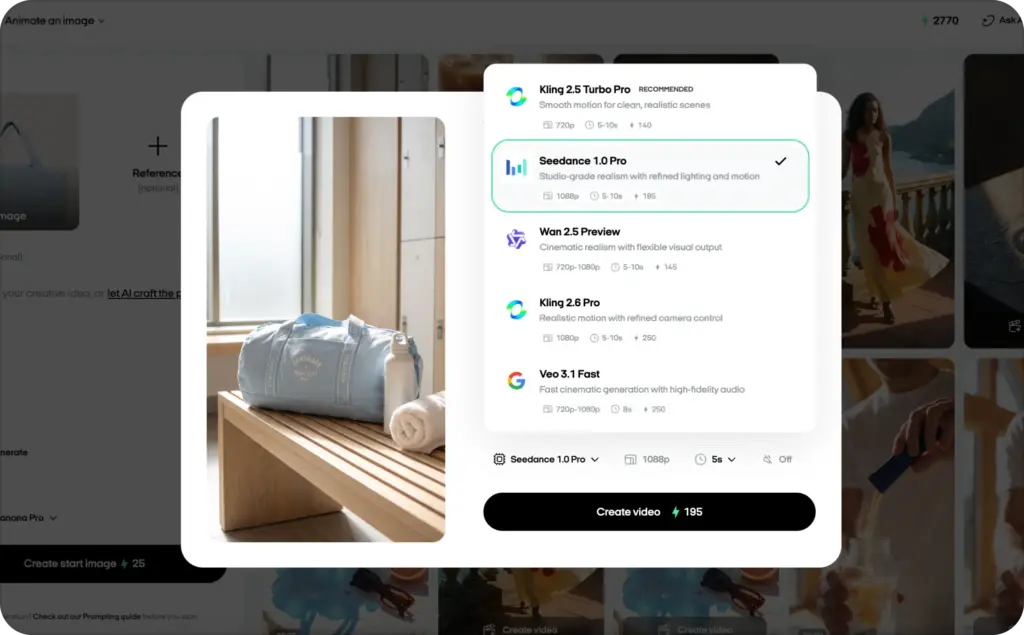
Zeely works as the workflow layer around several models, with Seedance appearing inside its AI video ad generator. The model contributes where its strengths are useful. The rest of the system handles the ad structure.
Seedance 2.0 earns its place for four reasons:
- Reference-guided motion: Product images and other visual references can help anchor the object, setting, style, and movement.
- Native audio: Sound can be generated with the video rather than treated only as a separate layer.
- Camera and lighting control: Seedance is designed to follow direction around performance, camera movement, light, and shadow.
- Multimodal input: Text, images, video, and audio can contribute to the same scene.
This does not mean every Zeely video should use Seedance. It means Seedance is a strong engine when the brief calls for realistic movement, visual polish, or several connected references.
The user should not have to compare model IDs, manage API settings, or rewrite the same prompt twelve times. That is the point of the stack.
Zeely deals with the model layer so the business owner can stay focused on the product and the ad.
How Seedance fits into Zeely’s ecommerce workflow
A Seedance generation sits in the middle of the Zeely workflow.
Zeely first collects product truth from a URL, images, or manually entered details. That source material defines what the ad can accurately show and say. Zeely can use product-page information and imagery as the starting point rather than asking a business owner to build a technical generation prompt from scratch.
Zeely then chooses the selling angle, hook, message, scene sequence, and CTA. Seedance may generate a product shot, lifestyle moment, transition, or audiovisual scene.
Zeely places approved footage inside a larger ad with captions, proof, offer text, brand elements, and platform formatting.
The simplified flow looks like this:
Shopify
For Shopify, Zeely brings product content into the ad-building process.
Seedance can support moving product or lifestyle scenes, while Zeely keeps the copy, price, CTA, and format connected to the store. The merchant works with the product and ad setup, not with Seedance settings.
Amazon
For Amazon, the listing remains the source of truth.
Seedance can supply visual motion, but the finished creative cannot invent a feature, certification, quantity, or result. The raw clip still needs product checks and ad assembly.
This separation matters. A model can generate an attractive scene while quietly changing the bottle size, number of items, cap design, or label. Zeely’s role is to place generated footage inside a controlled creative workflow rather than treating every output as publishable.
TikTok Shop
TikTok Shop ads often need motion early.
Seedance can support a product entering frame, opening, rotating, dispensing, or moving through a lifestyle scene. Zeely adds the hook, captions, offer, pacing, and vertical composition.
The model supplies the shot. Zeely makes that shot behave like an ad.
Social commerce
For Meta, Reels, and other social placements, one approved Seedance scene can support several ad variants.
Zeely can change the opening line, CTA, offer, caption treatment, or sequence without asking the model to rebuild every frame. This is how a stack creates useful volume without creating visual chaos.
It also lets the team preserve an approved product shot while testing different selling messages around it.
How Zeely prompts seedance for product marketing
Production prompting must describe the scene while protecting the product.
A useful prompt contains six parts:
- Output job: Hero shot, lifestyle scene, demonstration, UGC-style moment, or brand film
- Reference priority: Which image, video, or audio asset controls the result
- Single main action: Rotate, open, pour, apply, pick up, reveal, or move
- Camera and light: Framing, lens feel, camera motion, lighting, and background
- Product constraints: Shape, color, label, cap, logo position, quantity, and scale
- Exclusions: Extra products, invented text, altered packaging, or unnecessary actions
This structure reflects Seedance 2.0’s emphasis on reference inputs and control over movement, performance, lighting, shadow, and camera direction.
The logic changes slightly by ad type.
| Ad type | Prompt pattern Zeely can use | Why it helps |
| Product showcase | Exact product reference + one camera move + studio surface + controlled light + preserve packaging | Keeps the scene simple and gives the product most of the visual attention |
| Lifestyle ad | Product reference + believable setting + one human action + natural camera feel + preserve scale | Shows how the product fits into a routine without asking for a full story in one clip |
| UGC-style ad | Product reference + creator behavior + phone-camera framing + natural audio + strict packaging constraints | Adds social familiarity while reducing the risk of random product changes |
| Brand campaign | Several references + defined pacing + camera direction + sound cue + continuity rules | Helps connect visual identity, motion, and audio across a more polished scene |
Zeely’s exact production prompts are part of a larger system, but the principle is simple: give the model one clear visual job.
Overloaded prompts create more places for the product to drift.
Best practices and common pitfalls
Keep the product source clean. Old packaging, conflicting colors, and low-resolution images give the model room to guess.
Ask one scene to do one job. A product cannot rotate, open, pour, transform, and land in a creator’s hand without raising the failure risk.
Treat generated text as temporary. Price, offer, logo lockups, claims, and CTA copy belong in Zeely’s ad assembly layer, where they can remain accurate and editable.
Review product contact points. Hands, lids, straps, liquid, fabric, reflections, and small accessories are common places for visual errors.
Do not force Seedance into every shot. A good model stack uses the best engine for the task. Loyalty is lovely in a dog. It is less useful in production software.
Keep native audio editable. Seedance can generate synchronized audio, but the final ad may still need a different voice, music track, caption timing, volume balance, or platform-safe version.
Check the final frame. A short clip can look accurate until the final second, when the label, lid, fingers, or product proportions suddenly shift.
Judge the finished ad. The clip still needs a hook, selling point, proof, offer, captions, and a clear next step.
The most common mistake is confusing model quality with ad quality.
Model quality asks, “Does this clip look good?”
Ad quality asks, “Does this clip accurately show the product and help communicate why someone should buy it?”
Zeely is built around the second question.
How Zeely turns Seedance output into finished video ads
Seedance gives Zeely another strong way to generate motion. Zeely gives that motion a commercial job.
A business can start in Zeely with a product link, product image, or product details. The platform helps build the message, script, visual sequence, captions, offer, and platform-ready version.
When Seedance is the right engine for a scene, it works inside that process. You do not need to manage the model separately.
This is the practical difference between accessing an AI video model and using an AI ad generator.
One gives you raw footage.
The other helps turn product information and model output into a creative you can review, test, and launch.
FAQ
Seedance is ByteDance Seed’s family of generative video models. It includes Seedance 1.0, Seedance 1.5 Pro, and Seedance 2.0. The current flagship supports text, image, audio, and video references in a unified audio-video generation system.
The phrase usually describes video ad scenes generated with a Seedance model.
In Zeely, Seedance is one engine inside the creative stack. Zeely adds the product inputs, ad concept, copy, captions, offer, formatting, review, and variations around the generated footage.
Yes. Zeely uses Seedance 2.0 inside its multi-model video stack when the model fits the scene.
The user works through Zeely’s ad workflow rather than operating Seedance as a separate production tool. Seedance supplies part of the generation layer, while Zeely handles the business-facing creative process.
Seedance 1.0 Pro is a common search phrase, but it is not the current model name used in ByteDance’s official catalog.
ByteDance lists Seedance 1.0 and Seedance 1.5 Pro. Seedance 1.0 is known for smooth motion, visual quality, prompt following, and multi-shot generation. Seedance 1.5 Pro added joint audio-video capabilities.
Yes. Seedance 2.0 is designed for joint audio-video generation. It can work with audio references and generate sound as part of the clip.
Zeely may still add or adjust music, captions, voice, timing, and other ad elements in the final assembly.
Not for every task.
Seedance 2.0 is a strong fit for multimodal references and controlled short scenes. Kling is especially relevant for character motion. Veo 3.1 is strong for cinematic realism, audio, reference control, and filmmaking tasks.
The useful question is which model best serves the scene inside the finished ad.
Yes. Zeely can start from product photos, product details, or a product URL. It then uses AI models, scripts, templates, captions, and editing controls to build ad-ready variations.
Seedance may generate part of the motion when it matches the creative job.
Emma blends product marketing and content to turn complex tools into simple, sales-driven playbooks for AI ad creatives and Facebook/Instagram campaigns. You’ll get checklists, bite-size guides, and real results, pulled from thousands of Zeely entrepreneurs, so you can run AI-powered ads confidently, even as a beginner.
Written by: Emma, AI Growth Adviser, Zeely
Reviewed on: August 10, 2026