How to get more followers on TikTok in 2026: 14 ways that work
Want to know how to get more followers on TikTok in 2026 without buying fake followers or posting all day? I’m Emma from Zeely, and I’ll show you the practical growth tactics I’d use to turn more TikTok views into relevant followers for a small business.
To get more followers on TikTok in 2026, I’d focus on a clear audience, a strong first three seconds, videos people actually finish, searchable topics, repeatable series, active comments, and a profile worth following. Then I’d track which videos turn views into followers.
Key takeaways
- Get discovered: use clear audience targeting, TikTok SEO, and Creator Search Insights
- Keep attention: hook viewers fast and improve watch time and completion
- Give people a reason to follow: build series, recurring formats, and stronger follow CTAs
- Grow sustainably: post consistently, use comments for new ideas, and avoid buying followers
- Measure what converts: track profile visits and follower growth, not views alone

How to get more followers on TikTok in 2026
Pew Research Center reports that 37% of U.S. adults use TikTok, up from 21% in 2021. Usage reaches 63% among adults under 30. That is a large audience, but not a reason to market to “everyone.”
For small businesses, TikTok now works as an entertainment feed, search engine, and product-discovery layer. That changes what a useful follower is. You need people who can become customers, referral sources, repeat viewers, or advocates.
TikTok says its recommendation systems use three main factor groups: user interactions, content information, and user information. In For You, interactions such as watching, skipping, liking, sharing, and commenting can carry substantial weight. In Search, content information is generally weighted more heavily for most users.
What TikTok does not publish is just as important: there is no official universal “70% completion rate” that guarantees distribution, fixed first-hour threshold, or magic hashtag count. I would not build a business plan on an unconfirmed formula.
And if you search for TikTok subscribers, TikTok’s own term is followers. The meaningful question is whether those followers are becoming a recognizable audience.
Track a simple funnel:
Views → profile visits → new followers → high-intent actions.
Those actions might be website visits, DMs, quote requests, email signups, product views, bookings, store visits, or sales. That is how follower growth becomes a business metric instead of a scoreboard.
My 14 ways of getting followers on TikTok
Adobe’s 2026 survey of more than 800 consumers and 200 small-business owners found that 49% of consumers use TikTok as a search engine. A useful video can keep finding people because it answers a question.
I would not spend the whole week trying to predict trends. I’d build content around what customers already want to know, then make it easy for them to recognize why the account is worth following.
1. Define exactly who you want to follow you
Trying to reach everyone usually makes it harder to give anyone a reason to follow. “People interested in skincare” is too broad to shape useful content, while “people with oily skin who want a simple morning routine” gives you a much clearer direction.
If I were building a small-business account, I’d make sure I could finish one sentence: we help or show this specific audience something they care about, through content we can repeat. A bakery might show what happens before opening, a bookkeeper could answer one money question from first-time founders, and a florist could explain wedding-flower choices at different budgets.
That is the level of specificity I’d aim for. If I only had three hours a week for TikTok, I’d rather become recognizable to one type of customer than vaguely relevant to everyone.
2. Optimize your profile for follower conversion
Once a video gets someone to your profile, the profile has one job: make the follow feel like an obvious next step. A new visitor should quickly understand who the account is for, what the business does, and what they will keep getting if they stay.
I’d use a recognizable profile image, a clear name, a useful bio, and pinned videos that answer the questions a new visitor is most likely to have. One can introduce the business, another can show proof through a result or demonstration, and the third can show the kind of content you post regularly.
Also check that important text and visuals are not covered by TikTok’s interface. Zeely already has a dedicated TikTok safe zones guide, so I’d keep the technical placement details there rather than repeat them here.
3. Hook viewers in the first 3 seconds
If someone swipes before your point lands, the rest of the video never gets a chance to work. TikTok’s own advertising research found that more than 63% of videos in its highest-CTR group communicated the key message or product within the first three seconds. That is ad research, not a guarantee for organic reach, but the principle is still useful: get to the interesting part quickly.
For a small business, that might mean opening with a mistake, a customer question, a surprising result, or a clear contrast. “Here’s why our first batch failed” or “A customer asked why ours costs twice as much” works because the viewer immediately knows there is something to learn.
I would avoid forcing drama just for the sake of a hook. The goal is not to sound louder than everyone else. It is to make the next few seconds feel worth watching. If this is the part you struggle with most, Zeely’s TikTok ad hooks guide has more examples, while this article stays focused on follower growth.
4. Improve watch time and video completion
You will see a 70% completion rate mentioned a lot in TikTok growth advice for 2026, but I would not treat that number as a rule. TikTok confirms that full watches, skips, and watch time can influence recommendations, but it does not publish a universal 70% threshold that every video has to reach.
What matters more is where people lose interest. If viewers leave before the result, move the result earlier. If the first eight seconds are setup, cut the setup. If a 40-second explanation works just as well in 22 seconds, test the shorter version.
That is how I would use retention data: not as a score to obsess over, but as a way to find the part of the video that is slowing people down. The better question is not “Did I hit 70%?” It is “Where did people stop caring, and what can I remove or improve?”
5. Make videos people want to come back for
Getting views and getting followers are not the same thing. A useful standalone video can perform well and still give the viewer no reason to follow the account.
That is why I like recurring formats and simple series. A packaging brand could document “Day 1 of redesigning our boxes.” A seller could share one pricing mistake a day. A product business could test five suppliers over a week. The point is not the format itself, it is that the viewer can see there is something else worth coming back for.
If I were trying to get TikTok followers, I would spend less time ending every video with “follow for more” and more time making the next piece of content feel genuinely useful. People follow when they understand what they are likely to get next.
6. Use TikTok SEO to reach people already searching
TikTok is increasingly used as a search tool, so I would make search-led content a regular part of the calendar rather than relying only on trends.
Start with the language customers already use. A florist might answer “How long do wedding bouquets stay fresh?” A bookkeeper could explain “How much does a bookkeeper cost?” A product brand might answer “Can linen go in a washing machine?” or “Why does handmade soap need to cure?”
TikTok says Search can consider how closely content matches a query, alongside signals such as hashtags and sounds. That means the best place to start is not with keyword stuffing, but with a real question and a useful answer.
I would use the main search phrase naturally in the video, on-screen text, and caption when it helps clarity. If the content genuinely answers what someone is looking for, you are already doing the most important part of TikTok SEO.
7. Find content gaps with Creator Search Insights
Creator Search Insights is one of the 2026 tools I’d actually build into a small-business content workflow because it helps replace guesswork with real search demand. TikTok shows frequently searched topics and includes a Content gap filter for subjects people are looking for but that are not yet covered by many videos.
That gives you a much better starting point than opening TikTok and wondering what to post. If you sell jewelry and notice people searching for ways to stop rings from discoloring, one search can give you several useful videos: a direct answer, a materials comparison, a care demo, a common mistake, or a myth worth correcting.
This is the kind of content system I like for small businesses. Instead of chasing a new idea every day, you take one clear demand signal and build a small cluster around it. It saves time, keeps your content focused, and gives people more reasons to see you as useful enough to follow.
8. Post consistently without becoming a content factory
Posting more often can give you more chances to learn, but it can also give you more mediocre content if you are creating just to fill a schedule. Socialinsider’s 2026 benchmark found that brand posting frequency increased 40%, while accounts with 1K–5K followers moved from an average of 6 posts per month to 8. I would treat that as context, not a quota.
If I were running TikTok with a small team, I would not try to compete by posting three times a day. I’d batch content around work that is already happening: customer questions, product demos, objections, packaging, behind-the-scenes moments, or the decisions you make while running the business.
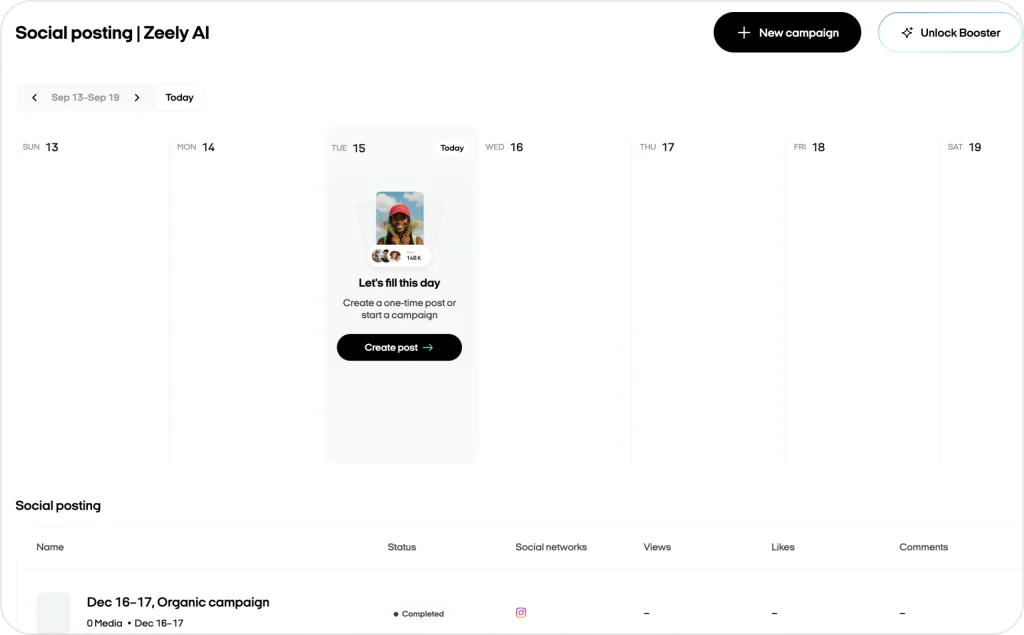
That is also where scheduling can help. Zeely’s current Social posting workflow lets users connect a public TikTok account, choose content, and set the publishing date and time. If remembering to post is the bottleneck rather than coming up with the strategy, you can use Zeely’s TikTok Social posting workflow to keep the schedule moving without turning your day into constant manual publishing.
9. Post when your audience is actually active
I would use universal “best time to post” charts as a starting point, not as a rule. A restaurant audience may behave very differently from an ecommerce audience, and your strongest posting window can change depending on location, age, working hours, and what people come to your account for.
Your own analytics are more useful. Test a few likely time slots over several weeks and look for patterns rather than judging a posting time after one or two videos.
You may also see advice that the first 60 minutes determine whether TikTok expands a video to a wider audience. TikTok confirms that engagement signals matter, but it does not publicly confirm a universal first-hour cutoff. I’d still pay attention to early performance because it tells you how the first viewers react, but I would not treat minute 61 as a deadline. Use early data to learn, not to panic.
10. Turn comments into your next videos
If TikTok is starting to feel like another full-time job, one of the easiest fixes is to stop inventing every content idea yourself. Your comments are already telling you what people want to know.
A question like “Does this work for curly hair?” can become a full video. So can “Why is yours more expensive?”, “Can I use this outside?”, or “What size should I buy?” Those questions are useful because they come from people who are already interested enough to stop and ask.
I like this approach because it creates a natural loop: you publish, listen, answer, and publish again. You are not guessing at the next content brief; your audience is helping you write it. And for a small business, that is much easier to sustain than trying to come up with a completely new idea every morning.
11. Use trends selectively, not automatically
I would not tell a business owner to ignore trends, but I would not build the whole account around them either. A trend is useful only when you can connect it to something your buyer actually cares about.
If a format helps you show a product problem, demonstrate how something works, explain an objection, or reveal a behind-the-scenes part of the business, use it. If you are forcing your product into a trend that has nothing to do with why people follow you, I would skip it.
The trend is only the packaging. Your expertise, product, or point of view still has to be the content.
There is also one practical business detail worth knowing: TikTok requires the content-disclosure setting when you promote your own business, product, or service, and TikTok says using that disclosure does not affect feed distribution. I would rather make sure a business gets that right than spend time chasing another supposed hashtag trick.
12. Collaborate with creators and complementary businesses
When I look at collaborations, I would start with audience overlap, not creator follower count. A smaller creator or neighboring business can be much more useful if the people watching are already close to your target customer.
A florist could work with a wedding photographer. A dog-accessory brand could partner with a groomer. A coffee shop could create something with the bakery next door. A bookkeeper could answer founder questions alongside a small-business lawyer.
Adobe found that 38% of surveyed small-business owners use TikTok influencers for product sales or promotions, but collaboration does not have to mean a formal influencer campaign. A joint demo, Q&A, Duet, Stitch, comparison, or “two experts answer the same question” can be enough to introduce your account to a relevant new audience.
The point is not to borrow someone else’s follower count. It is to borrow relevant attention and trust.
13. Measure the posts that actually create followers
Your most-viewed TikTok is not automatically your best growth post. If the goal is followers, I want to know what happens after the view.
I would track the path from views to retention, profile visits, and follows, then connect that to the business outcome that matters most, whether that is website visits, DMs, leads, bookings, or sales.
Imagine one trend gets 80,000 views and 40 followers, while a tutorial gets 12,000 views and 300 followers. The first post looks more impressive on the surface, but the second one is doing a much better job of turning attention into an audience.
That is also why I would not judge an account only by size. Socialinsider found that 1K–5K accounts had a 4.40% engagement rate by views in its 2025 dataset, higher than the larger follower bands immediately above them. Small does not automatically mean weak. What matters is whether the audience is relevant and whether the content keeps converting.
14. Don’t buy TikTok followers
If you want sustainable TikTok growth, I would skip purchased followers completely. TikTok prohibits services that artificially increase engagement and says fake followers or likes may be removed, but the bigger problem for a business is what fake followers do to your data.
If thousands of accounts in your follower count were never interested in the business, it becomes harder to tell whether weak engagement comes from the content, the audience, or both. You end up with a bigger number and less useful information.
You may also see people search for TikTok subscribers, although TikTok normally calls them followers. Whatever the wording, I would rather have 2,000 real people who chose to see the next post than 20,000 accounts that never cared in the first place.
That is the audience you can actually learn from, sell to, and build around.
How to get followers on TikTok when your views aren’t converting
I would diagnose the funnel before telling you to post more.
| What you see | Likely problem | What I’d test |
| Low views | Discovery or hook | Topic, first frame, search intent |
| Views, weak retention | Delivery | Pacing, length, earlier payoff |
| Good views, few profile visits | Weak curiosity | Series, positioning, CTA |
| Profile visits, few follows | Profile conversion | Bio, pinned posts, clear promise |
| Followers, few customers | Commercial conversion | Offer, landing page, trust |
Small-business discussions show this frustration in the wild. In one 2026 Reddit thread, people questioned whether brands getting decent TikTok views were actually turning that attention into customers.
That is anecdotal evidence, not a TikTok benchmark. But it exposes the right question:
What happens after the view?
Getting attention is only part of the job. If a video performs well, the next challenge is handling what comes after it: more comments, more DMs, more questions, more profile visits, and hopefully more leads or orders. That can become a workload problem very quickly for a small team, especially if every response has to be written from scratch.
This is why I’d build content around the business itself instead of constantly chasing new ideas. Customer questions can become videos, reviews can show you the language people actually use, returns can reveal objections worth addressing, and everyday product or service decisions can turn into useful comparisons or behind-the-scenes content.
It is also much easier to sustain. You are not inventing a new content strategy every morning; you are turning real customer conversations and real business activity into content people already have a reason to care about. If I had to choose between 30 trend ideas and ten questions customers keep asking before they buy, I’d start with the questions every time.
How to gain your first 1,000 followers on TikTok
Your first 1,000 followers are where you figure out what people actually want from your account.
From 0 to 100: test what people respond to
I’d start with three clear content themes and test different angles around them: customer questions, product demos, mistakes, comparisons, behind-the-scenes moments, and searchable how-tos.
The goal is not to go viral. It is to find the first topics that make people stop, visit your profile, and follow.
From 100 to 500: build around what is already working
Once a topic starts bringing followers, I would not immediately move on. I’d expand it.
If a bakery gets traction from explaining why custom cakes cost what they do, the next videos could cover ingredient costs, production time, minimum order value, or what actually changes the final price.
One useful topic can easily become five or six strong videos.
From 500 to 1,000: make the account recognizable
This is where I’d turn the best-performing topics into recurring series, use Creator Search Insights to find related searches, and make the reason to follow more obvious.
If publishing consistently becomes the bottleneck, Zeely can help with the workflow. Its Social posting feature supports scheduling organic TikTok content created inside Zeely, so you can spend less time managing the calendar and more time testing which ideas actually work.
The real win at 1,000 followers is not the number itself. It is knowing why people follow you, which topics make them stay, and what you should create next.
That gives you a much stronger base for the next 1,000.
FAQ
The fastest way to get TikTok followers is to test more intelligently, not post more randomly. Focus on one audience, create several videos around problems they already care about, and repeat the topics that bring profile visits and follows. A viral post can speed things up, but there is no reliable shortcut or posting formula that guarantees fast growth.
To gain your first 1,000 followers, start with a few clear content themes and test different formats around them. Once a topic starts converting viewers into followers, build on it with follow-ups, series, and comment replies. The goal is to learn why people follow your account, so you can repeat what works instead of constantly starting over.
There is no single follower threshold for making money on TikTok. A small business can sell its own products or services with any audience size, while platform programs have separate eligibility rules. TikTok’s Creator Rewards Program currently requires at least 10,000 followers, while some TikTok Shop creator features have lower thresholds. For a deeper breakdown, see Zeely’s social media monetization guide.
There’s no fixed timeline, it depends on posting frequency, niche, and how quickly your content finds the right audience. Some accounts hit 1,000 followers within a few weeks of consistent posting; others take a few months. Rather than watching the follower count alone, track how many of your views turn into profile visits and follows. That conversion rate tells you faster than a calendar whether your content strategy is working.
Yes, potentially. TikTok’s Community Guidelines prohibit trading in services that artificially inflate engagement, and accounts that use them can face content or account restrictions, not just the removal of fake followers. There’s also a trust cost: a follower count that doesn’t match your engagement rate is easy for real customers and potential partners to notice, and it undercuts the credibility you’re trying to build in the first place.

Emma blends product marketing and content to turn complex tools into simple, sales-driven playbooks for AI ad creatives and Facebook/Instagram campaigns. You’ll get checklists, bite-size guides, and real results, pulled from thousands of Zeely entrepreneurs, so you can run AI-powered ads confidently, even as a beginner.
Written by: Emma, AI Growth Adviser, Zeely
Reviewed on: September 14, 2026