How to reduce advertising costs with AI for small businesses
Where can AI cut your advertising bill without costing you customers? I’ll show you which costs to tackle, which tools fit, and how to check the savings.
Key takeaways
- To reduce advertising costs reuse approved assets with AI, then fix spending that fails to produce customers
- Include media, software, revisions, and management in your calculation
- Compare qualified leads, closed sales, and customer value
- Create only enough distinct ideas to evaluate with the spend you have
- Keep the workflow when the complete bill falls and customer results hold
To reduce advertising costs, first separate production bills from campaign spending. Extra versions, revisions, and subscriptions can pile up for small businesses and agencies. I’ll help you find the expensive steps and choose where AI fits. Then I’ll show you how to check the savings against customer results.

Why advertising costs put pressure on small businesses
You can keep the same ad budget and still feel squeezed. One month brings a new offer. The next needs fresh videos, several sizes, and client revisions. The work around the campaign grows even when your media budget stays flat.
The price of reaching people also depends on your industry. WordStream’s 2026 search advertising study examined more than 13,000 Google and Microsoft search campaigns across 23 industries. Its overall Google Ads cost per click was $5.42. Average cost per lead across the study was $66.69.
Here’s the part I would not skip: overall cost per lead fell in 2026 for the first time in five years. Some industries still saw increases. Your own prices may move differently from an overall average.
So I would look at three separate pressures:
- Media: what you pay platforms to show or deliver ads
- Production: photos, video, design, copy, and revisions
- Campaign work: software, setup, management, and checking results
AI can help with tasks in each category. It cannot make an expensive click cheap by generating another picture. First find which cost is growing, then choose the fix. If you are still deciding how much to spend at all, use my small business advertising budget guide for that separate decision.
Find what is driving your advertising costs
Open last month’s invoices and campaign report. Put media, production, software, and management costs on separate lines. Then count the new customers or genuinely qualified leads that came from the work.
This quick check points to a better first move:
| What you notice | Check first | First action |
| New ads cost more to produce | Shoots, edits, revisions, and unused versions | Reuse one approved product asset or concept |
| Clicks rise while sales stay flat | Offer, page, checkout, and tracking | Fix what happens after the click |
| Leads are cheap but rarely buy | Qualification, response time, and close rate | Measure a qualified lead or actual customer |
| Subscriptions keep growing | Overlapping features, seats, and paid retries | Give each paid tool one clear job |
| Agency hours grow without higher fees | Extra versions and approval rounds | Define scope and one final approver |
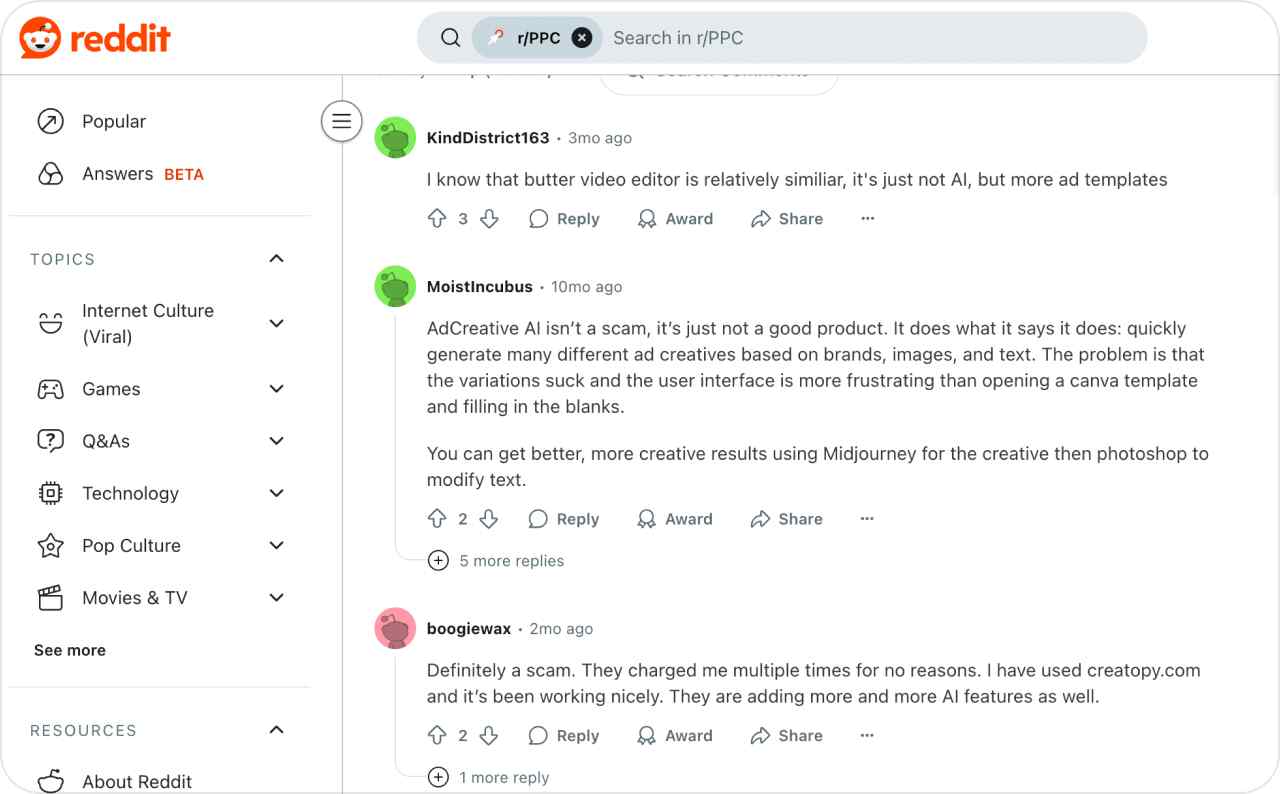
Include your own time, but label it correctly. In a Reddit PPC discussion about AI and extra cleanup, practitioners describe getting faster analysis while spending time verifying AI output.
Imagine reporting once took four hours. AI drafts it in one hour, but checking it takes two more. You saved one hour, not four. If your employee’s salary stays the same, that hour gives the team more capacity. It does not lower your cash bill yet.
I’ll use campaign cost per new customer below: the defined campaign’s media, production, software, and management costs divided by the new customers recorded. That is broader than media cost per purchase. It may still exclude other sales and marketing costs in your full business accounting.
Strategies for reducing advertising costs
I start with the result a campaign buys. A cheaper click helps only when enough of those clicks become valuable customers.
Optimize for customers and qualified leads
Say two campaigns each spend $300:
| Campaign | Leads | Cost per lead | New customers | Media cost per customer |
| A | 30 | $10 | 3 | $100 |
| B | 15 | $20 | 5 | $60 |
These numbers are hypothetical. Campaign B has fewer leads and a higher cost per lead. It brings in more customers for the same media spend.
For services, define what makes a lead useful. Did they live in your service area? Did they answer your follow-up? Did they book and pay?
Start by recording those outcomes, even if you are not ready to change campaign optimization. A form submission and a paying customer should have different jobs in your report.
Test only as many ideas as your budget can support
A local business owner asked PPC practitioners on Reddit whether a modest budget could support advertising at all. There is no magic daily amount that works for every shop.
Use your own past results to frame the test. If you have $300 and your historical media cost per customer is $40, that budget might bring roughly seven or eight customers if performance holds. Spread it across ten new ads, and each idea may receive too little customer data to judge.
I would begin with one clear offer and a few different buyer reasons. For a backpack, you might test capacity against comfort. Changing only the background gives you another file, but little new information about why someone buys.
If you have no reliable past result, set a spending cap you can afford. Track qualified inquiries and sales before adding more concepts. My bulk creative guide covers how to produce those versions once you know what to test.
Fix the page and follow-up before buying more traffic
Look at the page or form your ad sends people to. Does it show the advertised price? Can buyers see delivery details or the service area? Is the next step clear on a phone?
For lead campaigns, choose who responds and how quickly. AI can draft a reply or summarize an inquiry. Someone still needs to answer the customer and record whether the lead was worth buying.
Here is the simple math. At a $2 cost per click and a 2% conversion rate, media cost per conversion is $100. If that same traffic converts at 4%, it is $50. Those are illustrations, and neither improvement is promised.
The relationship is cost per click ÷ conversion rate, using the conversion rate as a decimal. Both numbers must describe the same visitors and the same desired action. Sometimes the cheapest fix sits on the page, not inside the ad.
Use native automation with a clear goal and spending limit
Before paying for another optimization subscription, check what your ad platform already offers. Google Smart Bidding uses auction-time signals to pursue conversion or conversion-value goals. Meta Advantage+ offers automated delivery options for eligible campaigns.
Those systems still need a useful goal, working measurement, and a budget you control. Cheap form fills can look good to a system when the business really needs booked appointments.
Record your current setup. Make a bounded change you approve. Give customer results time to arrive before making another major adjustment. For Meta-specific choices, see my Advantage+ versus manual setup guide.

Ways to reduce costs using generative AI
I would use AI where a good input already exists and the next version has a clear purpose.
Reuse accurate product photos and existing footage
Start with the clearest photo of your real product. Adapt it for a new offer, background, or placement. For video, trim an existing product demonstration into short clips and add readable captions.
You can also ask AI for three openings aimed at different concerns. A backpack ad might address what fits inside, how it feels during a commute, or whether it works as a carry-on. The underlying product facts stay the same.
Review the generated image against the actual item. A new color, missing feature, or invented fit can create complaints after the sale. If a claim needs a fresh demonstration, record the real one. Editing that footage may be cheaper than trying to generate it.
Make useful variations from an approved base
Once an offer and visual are approved, repeated resizing and rewriting become easier to handle. Ask for versions sized for the placements you actually use. Change one buyer reason or call to action at a time.
For a small shop, that could mean one product photo, two distinct messages, and a feed and vertical version of each. It is a manageable set with a job for every ad.
I would keep the original asset and approved wording together. When the price changes, update the correct versions without rebuilding the idea. My automated ad creation guide covers the full production process.
Shorten review loops and cap paid retries
Here is a made-up credits example, not Zeely pricing. If one generation costs 100 credits and only the fifth attempt is usable, that clip consumed 500 credits. Add the time spent reviewing four rejected versions.
Before another full regeneration, check whether you can edit the script, repair recorded audio, or use real footage. Review product appearance, prices, captions, and claims before you publish.
A lower price per generation matters less than your cost per approved asset. I would track both.
Best marketing tools to reduce acquisition costs
The best tool depends on which part of the bill needs work. A design subscription does not manage bidding. A bidding feature does not replace a product photo. I would choose one creative tool for the recurring task, then use the campaign and customer records I already have.
Zeely AI for recurring ad creative and Meta campaigns
I would start with Zeely when image and video production keep delaying the next campaign. Zeely’s current product page shows creative variation tools, Meta campaign workflows, and performance views for ads.
For example, a small retailer could start with one approved bag photo and a clear offer. Zeely can help create image and video directions around capacity, comfort, and everyday use. The owner reviews the real product details, chooses a small set to test, and decides when to launch.
That is where Zeely fits the cost question: less repetitive creative preparation and fewer handoffs between making an ad and preparing a Meta campaign. It does not determine whether your offer converts, and the advertising budget remains a separate cost.
For this decision, start with one product and one repeatable creative task.



Match the remaining tools to the expensive task
| Tool | Task it can help with | What to count before paying |
| Canva | Repeated layouts and branded graphics | Free or paid plan, AI allowance, any add-on, and time spent editing |
| Descript | Trimming, captioning, and reusing footage you already have | Hobbyist shows $24 monthly, or $16 per month with annual billing; check media hours and AI credits |
| Google Smart Bidding | Automated bidding toward measured conversions | Available campaign features and your separate media budget |
| Meta Advantage+ | Automated placement and delivery decisions | Eligible controls, media spend, and the quality of reported results |
| HubSpot CRM and Sales Hub | Recording lead stages and supporting follow-up | Free CRM capabilities versus paid seats, features, and AI usage |
How much can AI actually save your marketing budget?
There is no dependable percentage I can promise your business. The IAB’s 2026 advertising study found that 64% of surveyed advertisers cited cost efficiency as a benefit of AI. That is what advertisers reported valuing. It does not mean their budgets fell by 64%.
Here is the calculation I would use instead.
Calculate cash savings separately from saved time
This example is hypothetical. Assume the same campaign records 60 new customers in both months:
| Monthly campaign cost or result | Before | With AI-assisted production |
| Media spend | $1,500 | $1,500 |
| External creative-production fees | $500 | $250 |
| Software and usage charges | $100 | $150 |
| Campaign-management fees | $300 | $300 |
| Total cash cost | $2,400 | $2,200 |
| New customers recorded | 60 | 60 |
| Campaign cash cost per new customer | $40.00 | $36.67 |
Production fees fell 50%, saving $250. Software cost an extra $50. The net cash saving is $200, or about 8.3% of the original total.
Media still costs $25 per recorded customer: $1,500 divided by 60. The improvement came from production after paying for additional software.
Now count staff time on a separate line. If AI saves three hours and you value that time at $30 an hour, you gained $90 in capacity. Your cash bill changes only if an expense actually falls. Do not count the same avoided contractor fee again as saved employee time.
This is a defined campaign calculation. A business-wide customer acquisition cost may include other sales and marketing expenses.
Keep the savings only if customer results hold
Suppose the new workflow brings 50 new customers instead of 60. The cash bill is still lower, but $2,200 divided by 50 is $44 per customer. You now pay more to win each one.
Check what those customers contribute after product, delivery, payment, and expected return costs. If a first order leaves $35 before acquisition, a $36.67 campaign cost per customer already exceeds it. Repeat purchases may change that picture, but measure them before relying on them.
A Reddit discussion about AI-managed campaigns raises another good question: are reported returns coming from new demand? Compare platform-attributed purchases with your order records. Separate first-time and returning buyers. For search ads, inspect branded and nonbranded results where you can.
Branded ads can still have value. A strong platform ROAS alone does not tell you how many sales the ads added. ROAS is attributed revenue divided by ad spend, not profit.
How agencies can reduce delivery costs with AI
Agency costs include client work after the first draft.
Reduce marketing costs with AI across repeatable client work
I would standardize the brief fields, asset folders, first reporting draft, and final review checklist. That removes repeated setup without turning every client ad into the same message.
If one subscription serves four clients, allocate its actual cost across that work. Do not claim the full subscription as a saving four times. Record creative direction, fact-checking, campaign decisions, and reporting time as real work too.
Clients may ask what they are paying for when AI drafts quickly. For advertising, I would show the decisions, checks, and customer results behind the deliverable.
Agree on scope before faster production becomes extra work
Write down what the client buys. An illustrative package might include two concepts, two formats, two revision rounds, and one person authorized to approve the final offer. Additional requests can become a new scope decision.
Then compare hours per accepted deliverable and the client’s customer outcomes. If payroll stays the same, faster delivery creates capacity. A cash saving appears when a real expense falls or that capacity supports additional paid work.
A 30-day plan to cut costs and protect sales
Choose one expense to address first. Thirty days gives you a practical review rhythm, although a long buying cycle may need more time.
| When | What to do | What to record |
| Days 1–7 | List current media, production, software, and management costs | New customers or qualified leads, team hours, and usual conversion delay |
| Days 8–14 | Pilot one AI-assisted production task | Attempts, credits or fees, approved assets, and review time |
| Days 15–21 | Run a limited test with an approved ad or campaign change | Spending cap, hypothesis, person who approved it, and date |
| Days 22–30 | Compare the complete bill with customer outcomes | Cash change, time saved, lead quality, and the next decision |
Keep the workflow when the complete bill falls and customer quality holds. If it only creates more drafts and more checking, change the task you gave AI.
FAQ
Use AI for repeatable work: adapting approved photos, drafting ad versions, editing footage, or organizing campaign analysis. Compare the time and invoices it removes with subscriptions, paid usage, retries, and review. Savings depend on the whole task, not the price of one generated image.
Generative AI can help produce copy, images, and videos. Ad-platform AI can adjust eligible bids or delivery toward the goal you set. Other tools can organize results or support lead follow-up. Give each tool one job and check its output against real customer outcomes.
There is no standard percentage. In the hypothetical example above, a 50% cut in production fees saves $200 after added software charges. That is 8.3% of the original total campaign bill, assuming the same number of customers. Your costs and results will differ.
It can reduce production work even when media spending is limited. A small media budget also limits how many ad ideas you can judge from sales data. Start with one offer, a few distinct messages, and a spending cap you can manage. Expand after you see qualified customer results.
Choose the tool for your recurring expense. Zeely fits repeated image and video ad work plus Meta campaign preparation. An editor fits footage you already have. Native ad-platform features handle some delivery tasks. Keep your existing CRM if it already tracks leads well.
AI may let you bring specific repeatable tasks in-house. You still need accurate product material, a sound offer, creative judgment, review, and someone to manage campaign decisions. Compare the full cost and quality of both workflows, including your own time.
Choose one expense from your last campaign. Give AI a clear task, review what it produces, and compare the complete bill with new customers. If creative production takes too much time, start with one product in Zeely and build a small set of ads you can afford to test.

Emma blends product marketing and content to turn complex tools into simple, sales-driven playbooks for AI ad creatives and Facebook/Instagram campaigns. You’ll get checklists, bite-size guides, and real results, pulled from thousands of Zeely entrepreneurs, so you can run AI-powered ads confidently, even as a beginner.
Written by: Emma, AI Growth Adviser, Zeely
Reviewed on: October 1, 2026